By Zhanna Avagyan
Armenia has made significant progress rebuilding its armed forces since the 2020 Nagorno-Karabakh war, but the country remains in the middle of a major military transformation and has yet to achieve a level of deterrence capable of preventing a future conflict, defense analyst Leonid Nersisyan told CivilNet in a recent interview.
Nersisyan, a senior research fellow at the Applied Policy Research Institute of Armenia, said replacing the vast amount of equipment lost in the war is only one part of the challenge. The more difficult task, he argued, is adapting to a rapidly changing battlefield where communications, artificial intelligence, decentralized command and continuous innovation are becoming as important as tanks, artillery and missiles.
From reliance on Russia to a diversified arsenal
According to Nersisyan, Armenia has fundamentally changed the way it procures military equipment.
For decades, the country relied almost exclusively on Russia for defense. That approach has now given way to a more diversified strategy involving multiple countries, including India, France, and Iran, with the potential for additional European states and the United States to become suppliers in the future.
But diversification creates its own challenges. Armenia must now evaluate competing systems while ensuring equipment built to different standards can operate together. Integrating those systems will require investment not only in weapons, but also in digital battlefield management systems and local technological expertise capable of connecting them into a single fighting force.
Recovery is largely complete, but deterrence remains a work in progress
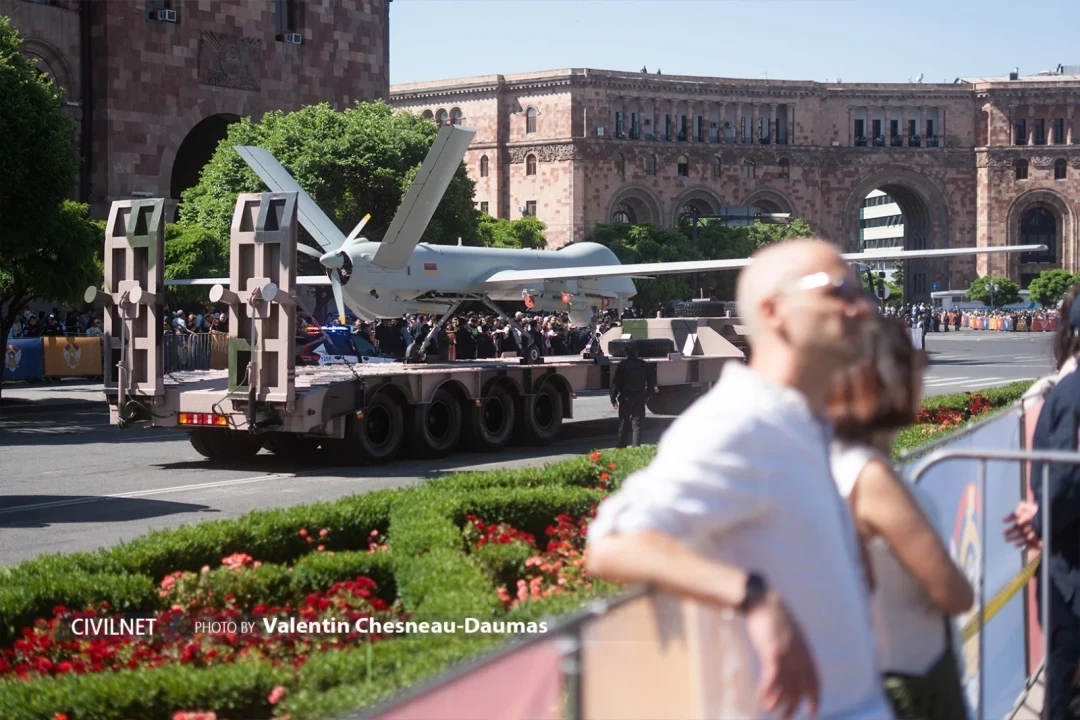
Nersisyan said Armenia has moved beyond simply recovering from the losses of 2020, and its armed forces now possess greater capabilities than they did before the war, particularly in artillery, drones and long-range strike systems.
That progress, however, should not be confused with having restored credible deterrence.
Nersisyan described Armenia as being “in the middle of transformation,” arguing that substantial work remains while neighboring Azerbaijan continues modernizing its own military. Rather than attempting to match Azerbaijan's larger defense budget, Armenia must become more efficient in both procurement and the way it would fight a future war.
Modern warfare requires more than new weapons
Nersisyan's central argument is that military modernization cannot simply mean buying new equipment. Warfare has changed rapidly, requiring armed forces to continuously adapt through experimentation, rapid learning and changes to doctrine and organization.
He argued that military doctrines designed to remain unchanged for a decade are increasingly unrealistic because technology and tactics evolve too quickly. At the same time, Armenia should not simply copy lessons from the Russia-Ukraine war, but adapt foreign experience to its own geography, military capabilities and likely conflict scenarios.
Communications and command-and-control systems, he said, may ultimately prove as important as the weapons themselves. Modern militaries increasingly need to process information, identify targets and make decisions within minutes or even seconds.
That requires resilient communications networks, digital battlefield management systems and software capable of linking sensors to weapons while helping commanders process large amounts of data. Artificial intelligence will increasingly serve as a decision-support tool, he said.
Command structures must also become more decentralized. Large headquarters and concentrated forces are increasingly vulnerable to precision strikes and drone attacks, requiring armies to disperse forces and delegate decision-making further down the chain of command.
Efficiency & reform needed
Azerbaijan continues to spend substantially more on defense, but Nersisyan believes the gap has been narrowing, and Armenia’s stronger future economic potential could allow it to further close the military imbalance if resources are spent effectively.
At the same time, Azerbaijan continues expanding important capabilities, making it necessary for Armenia to address remaining gaps. Nersisyan believes particular emphasis should be placed on affordable short-range air defense systems capable of countering drones, cruise missiles and loitering munitions.
Nersisyan said the current period of relative calm on the borders should not be interpreted as eliminating the risk of renewed conflict. Instead, he argued Armenia should use this period to accelerate military reforms, conduct experiments, test new operational concepts and train personnel while frontline pressures remain relatively limited.
As warfare evolves, the greatest danger is falling behind. But military reform alone also won’t ensure security; economic development, regional connectivity and diplomacy are equally essential to maintaining the peace.



 Stories