Anton Geissler
Since YouTube launched its partner program in Armenia this year, introducing ads to its platform in the country, the Church of Jesus Christ of Latter-day Saints, previously known as the Mormon Church, has heavily expanded its advertisements on social media.
Multiple residents in Yerevan have noted that these ads are constantly being recommended on YouTube and are very commonly shown.
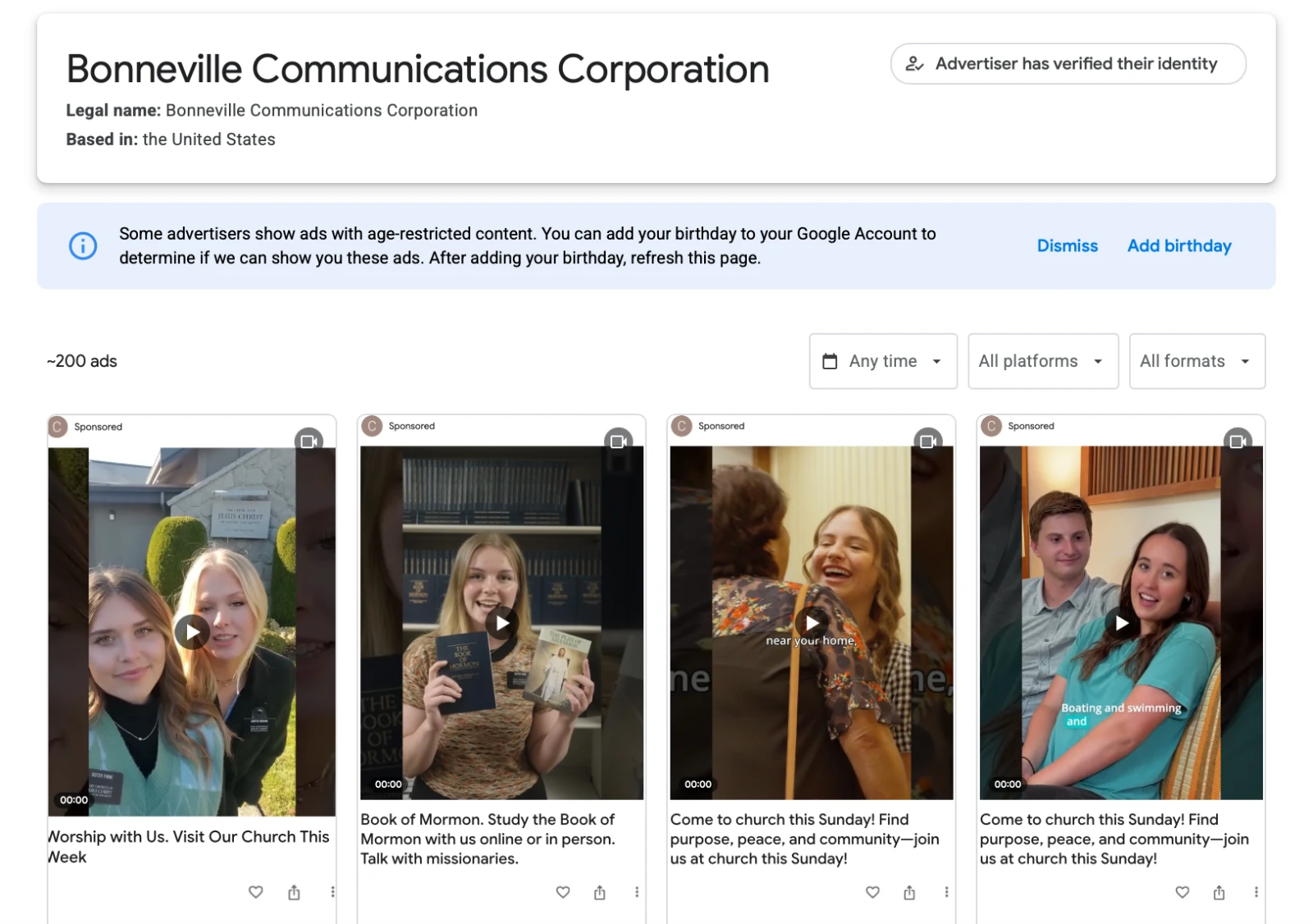
As of August 12, 2026, the Church has over 200 active short form video promotions on YouTube alone, posted by accounts such as Church of Jesus Christ | Come unto Christ.
The videos often invite viewers to church, describe the Book of Mormon, or encourage people to meet missionaries. They feature American or western-European Latter-day Saints, often female, promising peace in the Church of Jesus Christ.
Interestingly, the ads are primarily in English, Portuguese, and French, potentially limiting their effectiveness in Armenia, and bringing them into conflict with Armenian jurisdiction. Armenian law states that ads should primarily be in Armenian.
The promotions further draw attention to a gap in Armenian laws concerning the advertising activity of foreign entities. On YouTube, they are paid for by Bonneville Communications Corporation, a Utah-based media firm, and none of the seven administrators of the Facebook account Come Unto Christ - Armenia/Georgia are based in the region. There are no regulation in place to limit foreign advertising activity on social media in Armenia.
Advertising is only the latest iteration of the Church's proselytising activity in Armenia. Latter-day Saints have been in the wider region since the late 19th century, and the Book of Mormon was translated into Western Armenian in 1937. Beginning with the 1988 earthquake, the Church expanded its presence in the country. It provided funds for emergency relief, and two of its members established a concrete plant in Yerevan, staffed by Latter-day Saints, to aid the rebuilding effort. Following these developments, the Church was registered as a religious organization under the Law On Freedom of Conscience and Religious Organizations in Armenia in 1995.
The Church is especially known for its missionary work. Young volunteers travel to foreign countries for up to two years on missions, and the official church website reported a record 85,000 active missionaries worldwide in 2026.
Still, they have only had limited success in Armenia, with 3,579 members reported in 2026, many of which are non-Armenian expats and refugees from Europe and the Middle East.


 Stories