 Mariam Hoveyan
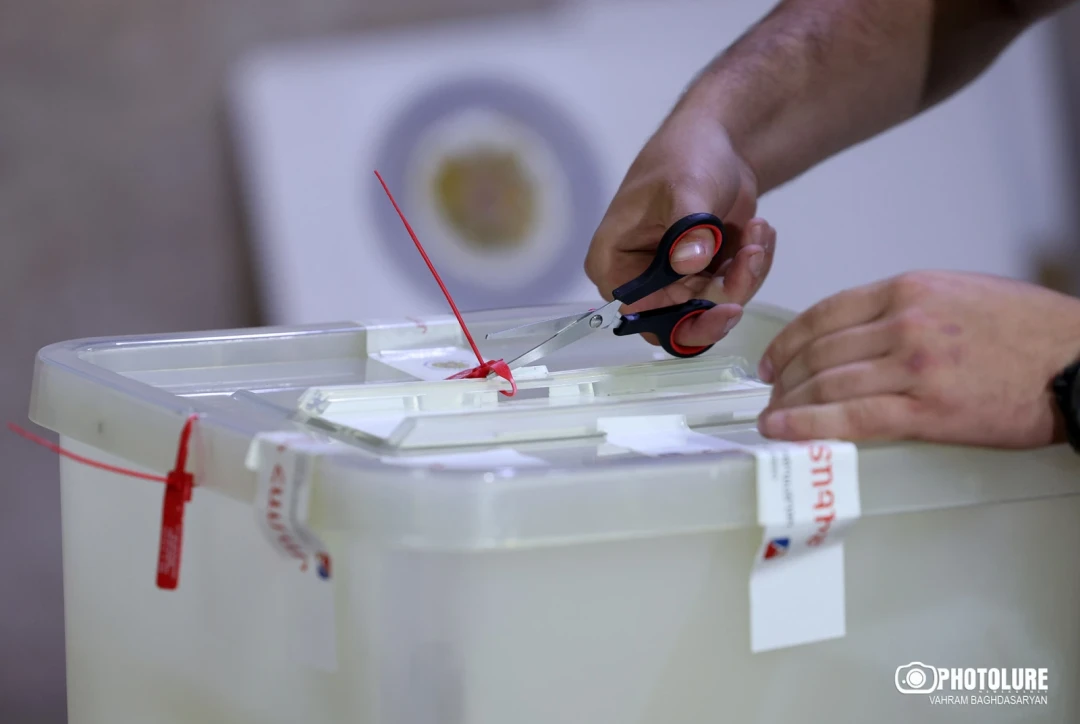
Armenia will hold local elections this fall to choose community heads and members of community councils. The votes are scheduled for the last Sunday of each fall month: Sept. 27, Oct. 25 and Nov. 29.
The full list of participating communities has not yet been published. But it includes dozens of large communities, among them several provincial capitals.
Who can vote
In early July, the National Assembly adopted new rules restricting voting rights. Civil society groups have repeatedly criticized the changes. A group of opposition lawmakers has also challenged their constitutionality at the Constitutional Court.
The rules will nonetheless be applied for the first time in the local elections. They will also effectively apply retroactively, which is a separate concern.
Under the new rules, voters must be at least 18 on election day and listed in the population register of the community holding the vote. Citizens registered in the community for at least six months before election day can vote if they were physically present in Armenia for at least 366 of the previous 730 days. That period is counted back from the 48th day before the vote, or the 28th day in the case of snap elections.
Citizens registered for less than six months can also vote if they meet the same presence requirement and registered in the community after completing compulsory military service or being released from prison.
Non-citizens may also vote in local elections. They must have been registered in the community for at least a year and meet the same presence requirement. This means that people forcibly displaced from Nagorno-Karabakh who hold refugee status, as well as legally registered foreign migrant workers, among others, can take part in community elections.
Past local elections show that residents sometimes express confusion when they see non-Armenian surnames on voter lists. At times, this has been exploited for political purposes. The authorities should do more to inform the public that non-citizens have the right to vote in local elections.
Who can run
Anyone eligible to vote can be elected community head or council member. While parliamentary candidates must be at least 25, the minimum age for local candidates is 18.
Party and alliance lists can include candidates who are not members, but they cannot exceed 30 percent of the total.
Lists must also observe a gender quota. In any group of three counted from the top of the list (positions 1-3, 1-6 and so on through the end), neither gender can exceed 70 percent. In practice, this guarantees women at least 30 percent representation in local government.
This does not support the common misconception that every third candidate on a list must be a woman. Women can also hold the first or second spot within each group of three.
In consolidated communities, party and alliance lists must include candidates representing at least one-third of the community's settlements. The exception is communities made up of fewer than three settlements. In Gavar, for example, which comprises 12 settlements, parties must field candidates from at least four of them. The goal is more balanced local governance.
Although non-citizens can vote and therefore run for office, the Electoral Code bans foreign citizens from campaigning or financing campaigns. The problem rarely arises in practice, but the contradiction needs a legislative fix.
The number of candidates on a list cannot be less than one-third of the number of council seats or more than three times that number. The number of seats depends on the size of the electorate:
Number of voters | Council seats |
Up to 1,000 | 5 |
1,001–2,000 | 7 |
2,001–4,000 | 9 |
4,001–10,000 | 15 |
10,001–25,000 | 21 |
25,001–70,000 | 27 |
70,001–300,000 | 33 |
Over 300,000 | 65 |
Electoral system
Local elections use either a majoritarian or a proportional system.
In communities with up to 4,000 voters, community heads and council members are elected under the majoritarian system. These are mostly non-consolidated communities, many of them populated by national minorities. Candidates can be nominated by parties or run as independents.
In communities with more than 4,000 voters, councils are elected proportionally. If a single party or alliance wins more than half of the council seats, the person at the top of its list automatically becomes community head. Otherwise, the council elects the community head by open vote.
Alliance names cannot include personal names, the names of state or local government bodies, or anything confusingly similar to them. Examples of names that would be barred include Mazmanyan alliance or Strong Noyemberyan.
Parliamentary elections have thresholds of 4, 8 and 10 percent. Local elections have two: 4 percent for parties and 6 percent for alliances. If more than three parties run, the law requires at least three to be represented on the council. Lowering the thresholds would be worth considering to broaden political representation and participation in local government.
Campaign finance
In parliamentary elections, parties pay an electoral deposit of 7.5 mn drams ($20,500) and alliances 15 mn drams ($41,000). Local elections use a sliding scale.
Under the majoritarian system:
Number of voters | Community head candidate | Council candidate |
Up to 500 | None | None |
501–1,000 | 50,000 drams ($137) | 10,000 drams ($27) |
1,001–4,000 | 100,000 drams ($273) | 15,000 drams ($41) |
Under the proportional system:
Number of voters | Party deposit |
Up to 10,000 | 200,000 drams ($546) |
10,001–25,000 | 500,000 drams ($1,366) |
25,001–70,000 | 1 mn drams ($2,732) |
70,001–300,000 | 1.5 mn drams ($4,098) |
Over 300,000 | 3 mn drams ($8,197) |
Spending limits are also lower than in national elections. In council elections in communities with 25,000 or more voters, excluding Yerevan, campaign spending is capped at 60 mn drams ($164,000). In communities with fewer than 25,000 voters, the cap is 40 mn drams ($109,000).
Unlike in parliamentary elections, where parties receiving at least 2 percent of the vote get state funding, local election results bring no public funding.
Other rules
Territorial electoral commissions are chiefly responsible for running local elections. They register candidates, oversee financial reporting and review complaints.
As in parliamentary elections, campaign platforms are encouraged but not required. In provincial capitals, Public Television of Armenia must hold at least one live televised debate during the campaign. A party running in more than one community appears under the same ballot number everywhere.
Mobile ballot boxes are not used in hospitals or detention facilities during local elections. Serving conscripts and prisoners do not vote.
In consolidated communities, voters can switch their polling station from one settlement to another. They must apply to the passport office no later than 12 days before the vote.
When only one party or alliance runs in a proportional council election, the ballot includes an against option. Unlike parliamentary elections, local elections have no runoff.




 Stories