By Antonio Reis
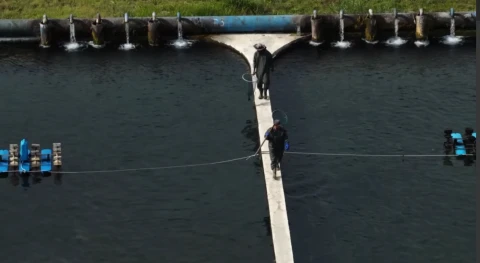
Since Russia began banning certain Armenian imports in June 2026, Yerevan has approved procedures for registering exporters in the European Commission's Trade Control and Expert System. It also issued the health certificates the EU requires and secured inclusion in a proposed two-year suspension of EU import duties on 80% of Armenian exports. The government also set up domestic compensation schemes, such as a one-time subsidy for 135 commercial fish farms in Ararat and Armavir.
CivilNet previously reported that the Armenian government is accelerating legal and regulatory reforms to allow more producers to export to the European Union, alongside temporary support measures including subsidised transport costs and loan repayment deferrals.
While these interventions address legal access to the European market, they do not tackle the issue of physically delivering these perishable products to the bloc.
Only one effective corridor
Two of Armenia’s four borders are closed. Azerbaijan to the east and Turkey to the west have been shut since the 1990s, leaving Georgia to the north and Iran to the south as the country's only operational links to the outside world
Armenian freight rail remains banned from entering Azerbaijani territory or accessing any part of the Baku-Tbilisi-Kars corridor. That land route, running from Central Asia through Turkey to Europe and bypassing Black Sea shipping entirely, is inaccessible to Armenian cargo.
A truck route through Turkey would be the strongest single-mode option to the EU if the border were open. As of September 2, trade restrictions with Turkey have been lifted, but the physical crossing, shut from Turkey’s side, remains closed.
The Iranian route is open. However, it remains trucking-only and constrained by international sanctions limiting direct maritime service, persistent heat which would harm perishable goods, poor transport infrastructure on the Iranian side, and the current U.S.-Israeli attacks on Iran.
As such, Armenian exporters would typically truck north through Georgia and the Verkhniy Lars crossing to Russia and the wider Eurasian Economic Union markets. Due to Russian export bans, that route is no longer available for perishable goods.
Challenges with existing links
The Georgian coastal city of Poti currently serves as Armenia's main port to the Black Sea and Europe. But it is a small port that does not attract major shipping lines directly, and the Black Sea functions as a secondary gateway for European trade in comparison with the Mediterranean and North Sea routes. Russia’s invasion of Ukraine and Turkey’s control of the Bosphorus Strait keep trade geopolitically fragile.
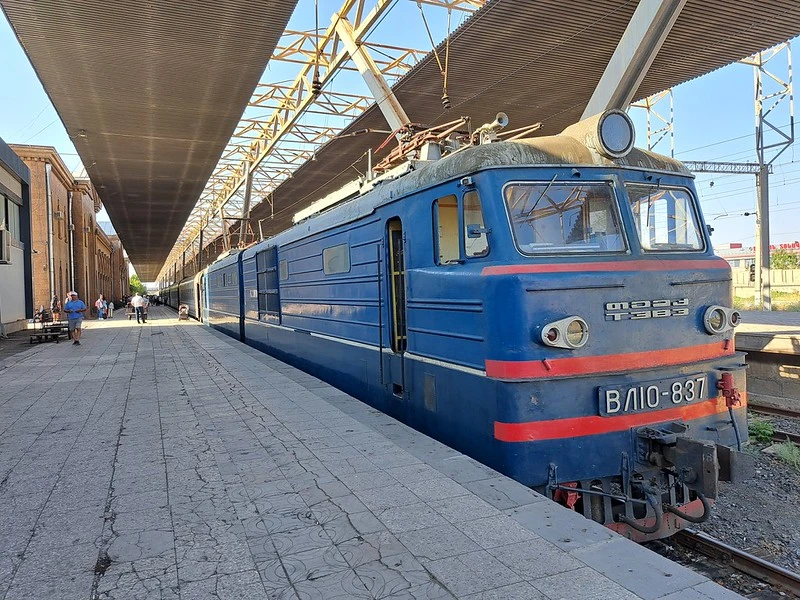
The South Caucasus Railway operates two scheduled container services between Yerevan and Poti.
A 2023 European Bank for Reconstruction and Development (EBRD) analysis of Armenia's cargo and logistics routes found that rail containers to Poti are not gen-set equipped, meaning that they lack an attached portable diesel or electric generator used to power refrigerated containers. No refrigeration capability exists on Armenia's rail freight to its main port.
Responding to a CivilNet inquiry, South Caucasus Railway General Director A. Melnikov confirmed that containerised freight to Poti and Batumi is "conducted exclusively using standard dry containers, with no reefer units being deployed." Traffic on the route, he wrote, "is limited to cargoes that do not require compliance with any specific temperature-controlled regime.”
The default alternative is trucking to Poti and loading onto a container ship, which is what most major shipping lines offer from Yerevan. It is more flexible than rail, but the Armenian trucking leg alone consumes more than 35% of both the total trip cost and the total trip time - $4,579 per container across a 20-day lead time.
The limits of air freight
Air freight would be better suited for perishable goods, but is also limited for Armenia. The only dedicated non-Russian cargo service is a single weekly flight from Zvartnots to Liège, Belgium, operated by Coyne Air, with ~20 tonnes of capacity.
Air freight also costs four to five times more than road transport and twelve to sixteen times more than sea transport. For example, Armenian fresh fish averaging ~$8.61 per kilogram would see freight costs alone consume roughly a quarter to half of its entire sale price. For frozen fish at ~$5.34 per kilo, the proportion is worse: freight eats a third to two-thirds of gross value. This is all before any producer margin, any buyer profit, or any road costs to reach the airport.
Despite the regulatory response to Russia’s June ban taking only weeks, the logistical gap has remained unaddressed. The European Union announced $56 million in funding on July 2, with total financial support to Armenia reaching $312 million. This funding aims to strengthen Armenia’s export capacity and infrastructure, and facilitate greater access to the EU market.
Scaling air freight would require improved airport operations, ideally a dedicated cargo airport with lower landing and service costs, and liberalised access for foreign airlines. These measures, as well as ongoing negotiations over border normalisation with Turkey, represent potential steps toward expanding Armenia's export logistics, but they are not yet realised. Armenian goods now have legal access to a market they cannot reliably reach.



 Stories