By Jan Limburski
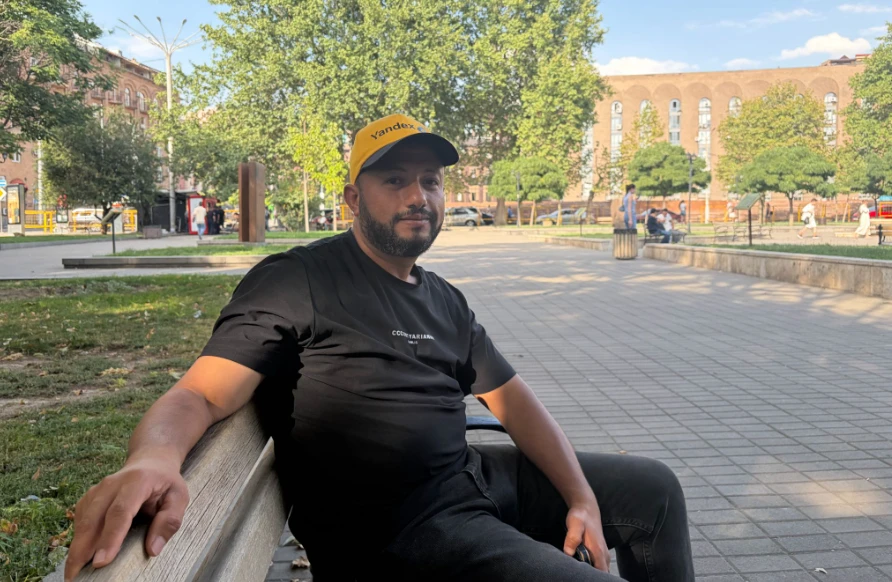
I meet Alaa, 37, in Yerevan’s Republic Square. He arrived from Egypt in January last year and started working as a deliveryman.
“It's so cold. I don't have a jacket. I don't have gloves. I work at Yandex - but I walk. I don't have money to get a bike,” he tells me. He walked 30 kilometers a day delivering orders for Yandex, a transportation company providing ride-hailing and food delivery services. Alaa says he was living in a hostel, and didn't have enough money to both buy food and support his family back home.
“I'm crying because my fingers are freezing.” He points to his fingers. “Maybe after five minutes of crying. I move my tears and... I receive a call from my family.”
“‘Dad, are you crying?’ I said, ‘No.’ She said, ‘Dad, I know you. I swear you're crying.’ [my daughter] told me, ‘Dad, trust in God.’”
Before arriving in Armenia, Alaa spent 15 years in Saudi Arabia working as a salesman in the poultry industry. He returned to Egypt because he wanted to escape the harsh working conditions in Saudi Arabia. “I needed to go to a country that respects humanity,” says Alaa. He looked up possible destinations and Armenia came up as one of the possibilities. “Armenian visa - it's so easy with Egyptian passport.” He came to Yerevan alone.
According to an assessment published by the International Organisation for Migration in February 2026, Egyptians were the sixth largest group of migrant workers in Armenia, following Russia, India, Ukraine, Iran and Sri Lanka.
Alaa tells me he didn’t speak any Armenian. Like many others, he started working as a deliveryman because it was the only available job that he could do without knowing the local language. Eventually, he met people who offered him a job and organised his work and residence permits. He now runs a one-man handyman business.
Armenia has become a destination for many migrant workers. While in recent years the majority of those immigrating to Armenia have been Russian citizens escaping military mobilisation following Russia’s invasion of Ukraine, the numbers of those arriving from elsewhere have also been growing. In 2023, 3,347 work permits were granted, a figure that rose by 23% in 2024. In both years, the majority of applications were from India and Iran. The growth and expanding economy have attracted labour migrants who work in sectors such as construction, deliveries and domestic work.
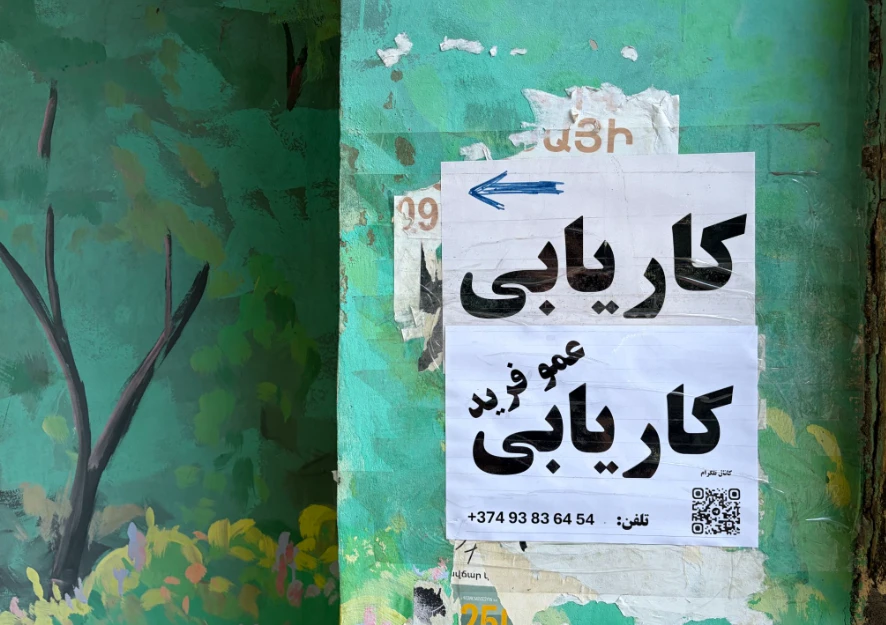
I meet Masoud in a park near what used to be the Firdus market - an area known to be multicultural and historically associated with Iranians. Despite recent demolitions and redevelopment I still find signs on the walls saying karyabi (job search) in Persian. This is where many Iranian migrants in Yerevan come to find employment.
Masoud arrived from Iran roughly four months ago, from his home in Khuzestan province. I struggle to arrange a meeting with him because his accommodation is temporary and dependent on the location of construction sites he works on. I finally manage to meet with him when he comes to Yerevan for an afternoon. During his four months in Armenia, he has been moved four different accommodations provided by his employer.
“My uncle works here because of his son; his son is studying in Russia. He told me about [Armenia]. The work here is good, and the income is decent. Food is cheap relative to the income. We're comfortable here now; we have security. The people here are very nice, they respect us,” says Masoud. He tells me he came to Armenia because of the recent U.S.-Israeli attacks on Iran.
“I'm here in Armenia to send money to Iran - to cover my father's debts and our debts.”
Masoud works through a contractor who acts as an intermediary between migrant labourers and construction employers. The contractor is Armenian and they communicate through an online translator. “We earn seven thousand drams ($19) a day, we do the work, and he takes half of it for himself. The share isn’t good. We work eight, nine, ten hours and more, he takes most of the payment, we take less, but we bear it for the sake of our families.”
Masoud doesn’t have a written contract. Despite the wage disparity he says Armenia is a good place with “respectful, good, and cultured people.”
The lack of formal regulation of labour migration and outdated systems impact people like Masoud. As of September 2026, Armenia has no work visa. Migrants arrive either visa free or on a tourist visa and are later reliant on employers to secure work and residence permits. According to the International Organisation for Migration February 2026 assessment, brokers sometimes charge migrants up to 1,600,000 AMD ($4,100) for their services and, often, provide false information on wages and working conditions.
Officially, any employer who hires migrant workers should apply for a work permit for them - which costs 105,000 AMD ($290) plus taxes. The worker can then apply for a residence permit with this work permit. In reality, because the costs are borne by the employer, many foreign workers are offered an informal service contract which falls out of the jurisdiction of labour laws and lets the employers escape the costs of legalising their employees’ stay. This virtually means foreign workers are rarely awarded labour protections.
The Armenian government adopted wide-ranging immigration reforms coming into force this November. These plans include introduction of a work entry visa, restructuring of the residence permit system, and a new quota system for work permits. This will completely change the current structure. The quota system will set a number of residence permits assigned to a labour category. Once these are exhausted, any further applications that year will be refused.
Once Alaa received a residence permit he set up a contractor profile on List.am. He’s now making upwards of 250,000 AMD ($690) monthly. He proudly shows me his debit card - opening a bank account as a foreign worker is not easy in Armenia. He was able to go back to Egypt and see his family. Now he’s back in Yerevan and says that he would like to stay here indefinitely. “Here people are so beautiful, so kind,” says Alaa.
He believes his success is thanks to his daughter and her encouragement. He says he wants to learn Armenian and Russian and work as an accountant. He has an accounting degree from Cairo University.
Alaa and Masoud represent the realities of labour migration in Armenia. Both of them feel respected here. But migrants also bear the inadequacies of the system - from the lack of a designated work visa to the reluctance of employers in securing proper work permits. The upcoming immigration reforms bring hope of structural change but so far the labour migration in Armenia is a grey zone without sufficient protections.

 Stories