By Anton Geissler
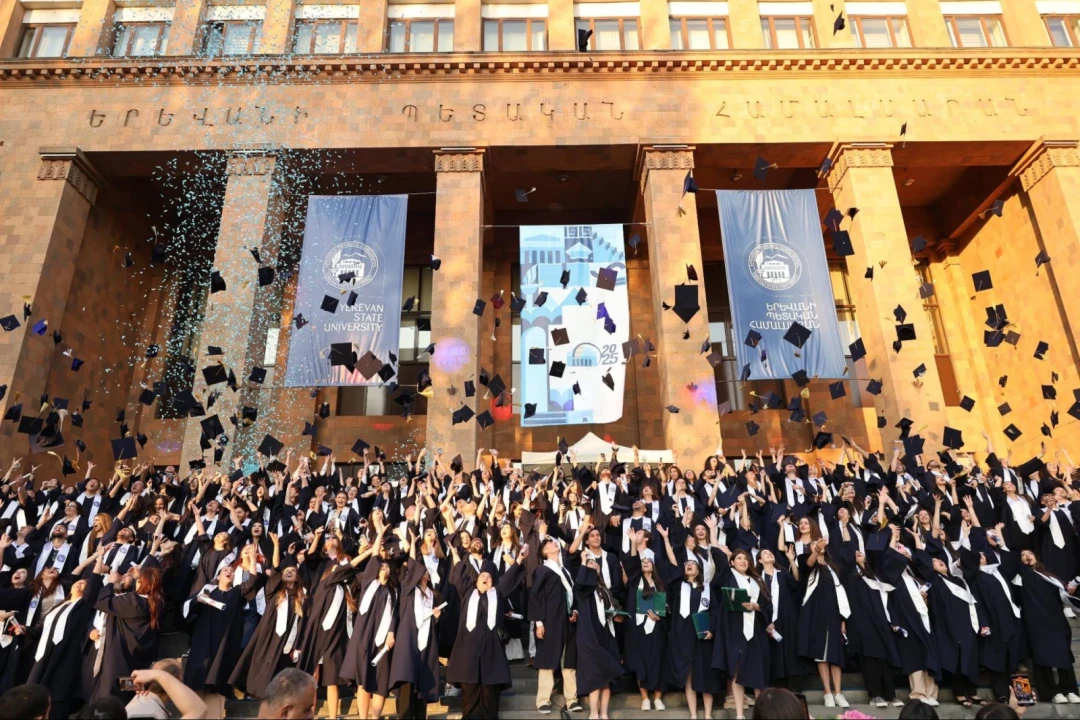
Armenia wants to nearly double the number of international students studying at its universities by 2031, but academics say language barriers, outdated courses and limited teaching capacity could make that target difficult to reach.
Under the government’s 2026-31 program, Armenia aims to increase the number of foreign students to 15,000 and create at least 50 foreign-language higher education programs.
There are currently around 7,800 international students in Armenia. That is similar to 2023, when around 7,000 foreign students studied in the country, divided roughly evenly between state and non-state institutions.
The number has risen from around 3,800 international students in 2015. Since then, enrollment by foreign students at private universities has mainly increased, but current figures remain well below the government’s 2031 target.
In 2023, Russia, Georgia and India were the main countries of origin for international students. The number of Indian students at Yerevan State Medical University has risen sharply since 2015. Students from Russia and, to a lesser extent, the Middle East have also contributed to the increase.
Khushboo Pannu, an Indian student at Yerevan State Medical University, said she chose Armenia because studying there was cheaper and competition for admission was less intense. She had also considered Georgia, China, Russia and the Philippines.
However, many Russians come to Armenia because of the political situation in their home country. Nicolai Ivanov, a Russian student at the American University of Armenia, whose real name has been changed due to privacy concerns, tells CivilNet that he decided to study in Armenia to avoid being sent to Ukraine. He believes that most Russian males are running from another draft.
Many international students, however, already have ties to Armenia.
Anna Gevorgyan, a lecturer at the American University of Armenia, told CivilNet that most of the international students she teaches are ethnic Armenians who come to the country because of family connections rather than its academic appeal.
One of her students, Lebanese-Armenian Armig Hakimian, studied at the American University of Armenia before returning to Beirut.
“I moved to Armenia fearing that the situation in Lebanon would escalate, but returned to my country in June 2024,” she said.
Hakimian also described discrimination against diaspora students. She said one classmate had called her “the wrong Armenian” and that some professors treated her differently.
Only one of the international students interviewed by CivilNet said they were considering staying in Armenia after completing their studies.
Language and teaching capacity
Language is another challenge for the government’s plan.
Gevorgyan said Armenia lacks the human capacity needed to attract significantly more foreign students. Many professors are not sufficiently proficient in English, she said, while some courses are outdated.
Aram Pakhchanian, an education specialist and lecturer at the American University of Armenia, agreed that language could be a barrier but said expanding English-language teaching was essential to improving Armenian universities and attracting foreign academics.
“International students might act as a catalyst by raising admission barriers and attracting better professors,” he told CivilNet.
Pakhchanian said attracting more foreign students also had financial and political benefits.
Armenian universities depend heavily on tuition fees, while foreign students can pay up to twice as much as local students.
“I think international students will put Armenia on the map,” Pakhchanian said. “It’s a sort of soft power initiative.”
Foreign students interviewed by CivilNet cited cost as one of the main reasons for choosing Armenia, though some also pointed to the rising cost of living in Yerevan as a potential drawback.
Pakhchanian and Gevorgyan said international students also differed from many local students in the classroom.
“They are more prepared and open to voicing their opinions about many different issues,” Gevorgyan said.
Vardan Voskanian, head of the Iranian Studies Department at Yerevan State University, said foreign students also tended to ask more questions.
“We don’t only teach them but learn from them as well,” he said.
The government has also taken steps to simplify the admissions process. It recently digitized higher-education applications, a change the Education Ministry said increased applications from foreign students by 90%.
Whether Armenia can convert that interest into enrollment, while improving the quality and availability of foreign-language programs, will be central to reaching its target of 15,000 international students by 2031.



 Stories