Sponsored content
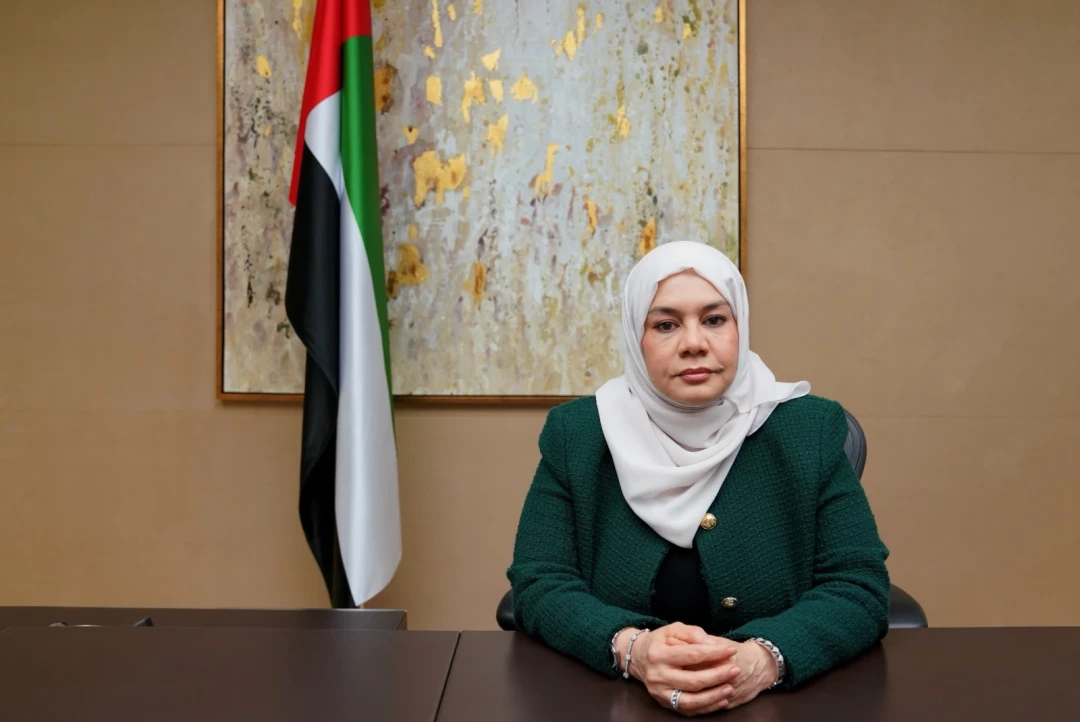
“Behind every woman’s success are many other women who paved the way for her, the family that supported her, and leaders who created an environment of possibilities,” shares the Ambassador of the UAE to Armenia, H.E. Dr. Nariman Al Mulla—a woman who once drastically changed her career trajectory from a specialist in cardiology to business and then diplomacy.
Still regarded among the leading experts across the Middle East, North Africa, and Asia in non-surgical cardiac interventions, H.E. Dr. Nariman Al Mulla radiates genuine excitement when speaking about women’s role in the life of her country and the policies adopted to keep that role strong.
It is a month she describes as especially meaningful for Emirati women.
On August 28, 1975, the UAE—then still a newly founded country—officially established an organization aimed at empowering women and removing social, legal, and cultural barriers to their full participation in society.
This organization, named the General Women’s Union (GWU), was founded by Her Highness Sheikha Fatima bint Mubarak, the wife of the UAE’s Founding Father, the late Sheikh Zayed bin Sultan Al Nahyan. For her commitment to social issues and state-building processes, Her Highness is often referred to as the “Mother of the Nation.”
That same year, the UN declared International Women’s Year and held its first World Conference on Women in Mexico City, as women’s equality was slowly becoming a major international policy agenda across the globe.
When Sheikha Fatima bint Mubarak began developing women’s societies in the 1970s, the female literacy rate in the country was roughly 38%. Today, after decades of committed work by the GWU and its educational campaigns, the female literacy rate has reached 95.8%.
Moreover, the country’s strategic approach toward women’s empowerment has positioned the United Arab Emirates 13th globally and first in the Arab region on the United Nations Development Programme (UNDP) Gender Inequality Index (GII), reflecting its low level of gender inequality, according to 2025 UNDP data. By comparison, Armenia ranks 59th globally on the same index.
Together, these figures reflect the strategic work carried out by the UAE government over the years.
This year, however, August 28 becomes more than a single-day celebration. For the first time, the UAE is expanding Emirati Women’s Day into a whole month of national celebrations and activities. The theme of this year, announced by Her Highness Sheikha Fatima bint Mubarak, is “We Emerge Stronger and Better.”
Beyond this, the 2020s have marked significant developments in the evolving social vision of the UAE, including the establishment of the Ministry of Family in 2024 and the designation of 2026 as the Year of the Family.
This, alongside the strong emphasis on women’s empowerment, demonstrates how the country views social development—integrating changes not through abrupt, one-dimensional interventions, but through gradual and interconnected progress across different aspects of people’s lives.
“Women’s empowerment does not happen in isolation,” shares H.E. Dr. Nariman Al Mulla, elaborating that creating an environment that gives women equal opportunities in education, employment, professional development, and leadership is what truly transforms society.
These statements are not merely words or social campaigns; they reflect the reality of the UAE. Women here are not just beneficiaries of social change, but decision-makers who are fully engaged in public life and hold leadership positions at the highest levels.
In the UAE, 50% of the Federal National Council is legally reserved for women, creating unprecedented opportunities for female leadership to flourish.
Paired with a strong emphasis on family values and balanced development, this framework creates a unique model of female leadership—challenging the conventional assumption that a political career requires women to sacrifice their femininity or family life.
Many women leaders in the UAE continue to challenge traditional ideas of leadership, creating new dimensions and examples for others. As H.E. Reem Al Hashimy, UAE Minister of State for International Cooperation, once noted: “Every person has a role to play in the journey ahead.”
Statistics and figures tell one part of the story regarding women’s advancement in the UAE. The fuller picture, however, is reflected in the women sitting at decision-making tables, representing the country abroad, leading institutions, and helping define its future.
“Creating the right environment for women’s growth requires delicate work with all parts of society. Everything is interconnected and grows in balance,” shares H.E. Dr. Nariman Al Mulla, emphasizing that beyond August celebrations and leadership opportunities, the country designs flexible policies supporting working mothers and those caring for children, older family members, and people of determination.
She noted that the UAE’s national policies are carefully designed to strengthen these support systems.
“Women’s empowerment may begin with women, but it touches every single part of society, and its impact stays present for decades,” concludes H.E. Dr. Nariman Al Mulla—a diplomat who understands both the human heart and the pulse of society.
She herself embodies her country’s strategic commitment to women’s advancement. Appointed in 2023, H.E. Dr. Nariman Al Mulla has played an active role in strengthening bilateral relations between the UAE and Armenia through cultural diplomacy, visa liberalization measures, and the launch of the UAE–Armenia Business Forum.
Increasing women’s involvement in these initiatives and expanding opportunities for cultural exchange between women leaders and entrepreneurs remain key priorities for her coming term.
As both countries continue to deepen their cultural understanding, these exchanges may well inspire women from both nations to build a world defined by opportunities rather than limits.
By Ella Kanegarian Berberian

 Stories