By Lia avagyan
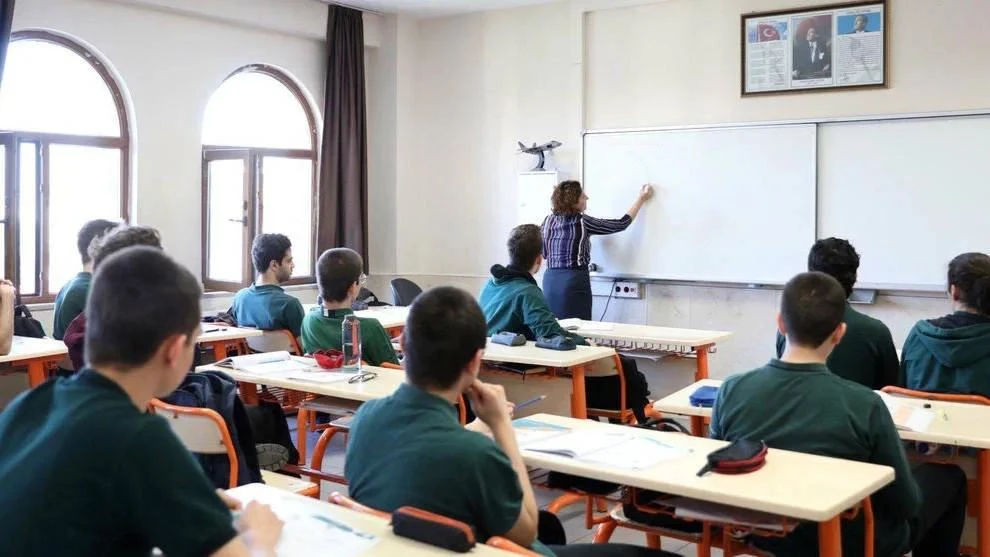
Armenia’s education minister has rejected descriptions of the country’s students as illiterate after an international assessment found that fewer than one in five Armenian 15-year-olds reached baseline proficiency in reading.
Education, Science, Culture and Sports Minister Zhanna Andreasyan said the results highlighted serious difficulties in applying knowledge to practical situations. She said curriculum reforms would improve performance in the next assessment.
“When people claim that our students are illiterate, that claim itself is illiterate,” she said in an interview with Infocom, urging a more precise discussion of which skills needed improvement.
Armenia participated for the first time in the Program for International Student Assessment, or PISA, in 2025. Organized by the Organization for Economic Co-operation and Development, the assessment examines 15-year-olds’ knowledge and skills in reading, mathematics and science, including their ability to solve problems and apply what they have learned.
The OECD’s Armenia country note presents a stark picture of academic performance alongside more favorable findings on teacher support and reported bullying.
Only 19 percent of Armenian students reached at least Level 2, the baseline proficiency threshold, in reading, compared with an OECD average of 69 percent. In mathematics and science, 28 percent reached that threshold, against OECD averages of 65 percent and 74 percent, respectively.
That means 81 percent fell below baseline proficiency in reading and 72 percent in each of the other two subjects. Falling below that threshold does not necessarily mean a student cannot read or has no mathematical or scientific knowledge.
The report says students reaching Level 2 in reading can “identify the main idea in a text of moderate length,” locate information using specified criteria and reflect on a text’s purpose and form when directed to do so.
In mathematics, baseline proficiency includes recognizing how an everyday situation can be represented mathematically, such as comparing routes or converting currencies.
About one percent of Armenian students reached the highest proficiency levels in mathematics. Almost none reached those levels in reading or science.
The assessment involved 6,804 students in 293 Armenian schools. The sample represented approximately 23,800 students, equivalent to an estimated 80 percent of the country’s population of 15-year-olds.
“In Armenia, all data met the quality standards set by PISA and were considered fit for reporting,” the report said.
Hopes for curriculum reform
Andreasyan said the students assessed in 2025 had largely studied under the previous approach to schooling, which she described as emphasizing knowledge rather than its practical application.
She pointed to a national curriculum framework adopted in 2021 that seeks to develop skills, attitudes and values alongside subject knowledge.
By the next PISA assessment in 2029, students would have spent a substantial period learning under the new framework, she said.
“I hope their results will be different,” Andreasyan said.
Asked for a numerical target, she said the central goal should be for all students to clear the minimum threshold, before describing the ambition as ensuring an adequate level for most or all students. She did not set a specific percentage target for 2029.
The minister said curriculum changes alone would not be enough. More than 900 schools had been equipped with laboratories, she said, adding that all schools should have them by the end of the year. Teachers were receiving training and video lessons to help them conduct experiments.
The report identifies material shortages as an obstacle. Some 49 percent of students attended schools whose principals said a lack of educational materials—including textbooks, computers, and library or laboratory resources—hindered instruction to some extent.
Supportive classrooms, high absenteeism
Other findings provide a more positive picture of students’ school experiences.
Nine percent reported experiencing at least one form of bullying a few times a month or more, compared with 20 percent across OECD countries.
Some 84 percent said that, in most science lessons, their teacher provided extra help when students needed it, compared with an OECD average of 73 percent.
The gap in science scores between the most advantaged and disadvantaged quarters of students was also smaller: 39 points in Armenia, compared with an OECD average of 85.
However, the report found high levels of truancy. Some 58 percent of students said they had skipped at least one school day in the two weeks before the test, compared with 22 percent across the OECD.
The OECD cautions that international comparisons based on student and principal questionnaires may reflect differences in reporting behavior, cultural norms and interpretations of questions.
The findings offer a baseline for assessing Armenia’s reforms. While Andreasyan argues that the new curriculum addresses the weaknesses exposed by PISA, its effect on students’ performance remains to be measured.

 Stories