By Olivia Mouradian
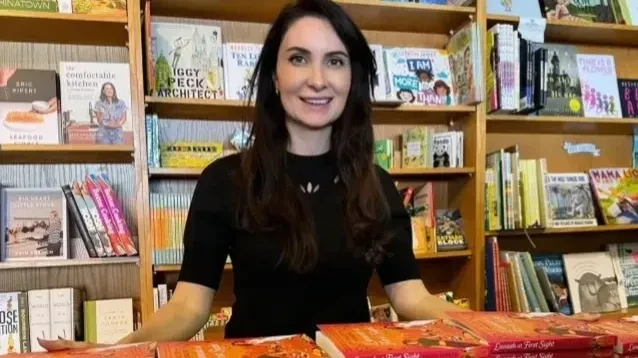
It’s hard to think about queer Armenian fiction without also thinking of Taleen Voskuni. The California-based writer is among the first to pen a queer romance novel featuring Armenian main characters - and one that has been released by a traditional publishing house. While the plots of each of her three novels are distinct from each other, they all are resolute in their Armenianness and, most often, their queer Armenianness.
Starting around the age of six, Voskuni saw herself writing. As a child, she spent her weekend mornings with her sister and a big stack of computer papers for them to draw stories on. After studying English at UC Berkeley, Voskuni started writing her first book while in law school. Although she wouldn’t end up doing anything with that book, the seed was planted. Even in the midst of taking classes that did not leave much room for reading or writing romances, she found that the romantic elements of her work were her strongest parts and the ones she enjoyed writing the most.
It would be years after this first novel before Voskuni would write again. About ten years ago, she decided to try to unlearn and relearn everything she knew about writing novels. She learned everything she could about getting a book deal without contacts in the publishing industry and eventually landed a mentorship with award-winning author Jesse Q. Sutanto. Fine tuning each step of the process, she showed her query letter to twenty different writers before she started querying agents in 2021. She learned the rules of the romance genre and followed them. In what she considers to be a byproduct of hard work and luck, she landed her first book deal for a sapphic Armenian rom com named Sorry Bro.
While writing sapphic Armenian romance novels has now become a key part of her brand, Voskuni says she did not set out with the goal of writing the first traditionally published queer Armenian romance novel. Instead, Sorry Bro was an accumulation of all of the ideas in her mind over the years about Armenianness: “It was the repressed story that was dying to come out of me and that I wanted to see play out on the page,” Voskuni says. This pandemic project that she worked on while her baby was sleeping ended up on the shelves and in the hands of readers and reviewers alike.
Prior to her 2023 novel Sorry Bro, she wrote two other romances that had no Armenian characters in them. “I had a lot to say about Armenianness,” Voskuni says, “but it almost felt like I was too close to the subject matter.” Nonetheless, the idea for a sapphic Armenian coming out story was never far from her mind. Coinciding with the 2020 war between Armenia and Azerbaijan, she started becoming more serious about this concept that had been sitting in the back of her mind. “I felt so silenced. No one was paying attention to us, no one cared,” Voskuni says. “And I just thought, ‘I want to tell everyone about us. And this is my way.’”
For Voskuni, it was important to share the day-to-day joys of Armenian life in such a heavy period—specifically the closeness of Armenian families, the humor, and friendship between Armenians. “We deserve happy stories too,” Voskuni says. Noting the somber focus of many Armenian stories and the importance of those stories, she hopes to see more Armenian stories spanning many subjects and genres, stating, “You limit yourself if your narrative is only constrained to a certain type.”
Voskuni’s most recent romance, Our Ex’s Wedding, was released in January 2026. Reflecting on the writing and publishing process, she cites audiobook production as one of her favorite steps. Christine Mirzayan has narrated all of her audiobooks, with Raffi Barsoumian joining in on her most recent publication to voice the male main character. Voskuni highlights how special it is to hear her words through Armenian voices.
In thinking about her next projects, she is ready to look to other genres outside of romance. She hopes her writing inspires other Armenian writers to both write and finish their stories, even if they are moved by a dislike of her writing. “I’m writing a tiny fraction of the Armenian perspective,” Voskuni says. “I’m painting one corner in and there’s a lot that is still unpainted in the Armenian canon that still needs to come to life.”

 Stories