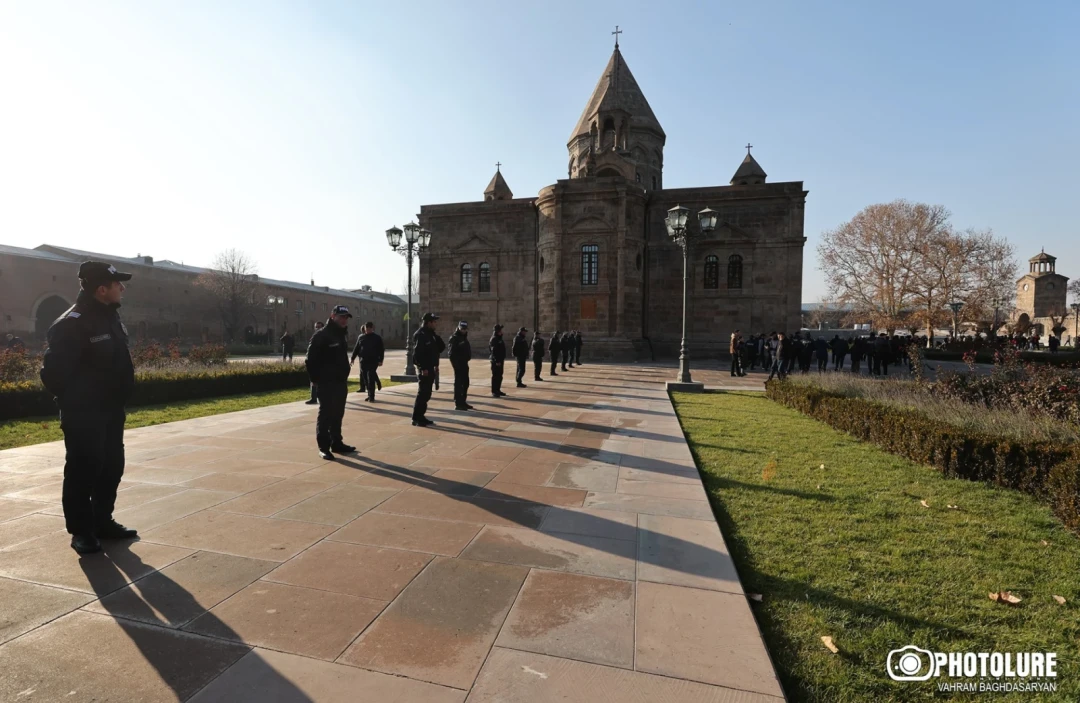
Prime Minister Nikol Pashinyan’s office published a report Thursday documenting what it describes as a crisis in the Armenian Apostolic Church and proposing ways to resolve it.
The report, titled On the Crisis That Has Emerged in the Armenian Apostolic Holy Church as a Result of the Activities of the De Facto Head of the Church and a Number of Senior Clergy, and Ways to Resolve It, was prepared on Pashinyan’s instructions as part of the government’s 2026-2031 program.
The prime minister’s office says the report is based on publicly available information and references the Armenian Church’s Book of Canons and other canonical documents, as well as Armenia’s legislation.
The report says it does not challenge the Church’s theological foundations or canonical order. Instead, it claims to document violations of those principles. It also says that reform should be carried out by the Church itself.
The report lists 16 findings that it says constitute the crisis. These include alleged violations of celibacy vows, breaches of integrity, arbitrary persecution and defrocking of clergy, financial opacity and misuse of Church property, as well as nepotism and foreign influence, among other issues.
The report also proposes a five-step roadmap for resolving the crisis, which essentially calls for removing the current Catholicos, Karekin II, and electing a new head of the Armenian Apostolic Church.
Isabella Sargsyan, the Program Director at the Eurasia Partnership Foundation and an expert on freedom of religion or belief, told CivilNet that the government has no authority to interfere in the internal affairs of the Church or to produce reports of this nature.
“This report is completely unacceptable by all international standards, whether viewed from the perspective of legality, ethics, or human dignity,” Sargsyan said.
The publication comes amid a protracted confrontation between Pashinyan’s government and Catholicos Karekin II, who has led the Church since 1999. Tensions escalated sharply in May last year, after Pashinyan publicly urged the Catholicos’s removal, accusing him of violating his vow of celibacy and calling for the “cleansing of the Church.”
Also read: How Armenia’s Church and government conflict challenges secularism
The remarks came amid government criticism of alleged mismanagement and using the Church's tax exemptions for illicit business activity. In the months since, several senior clerics who expressed support for Pashinyan were defrocked by the Church, that is, stripped of their ranks and removed from service.
Karekin II and six senior clerics are now facing trial over failing to comply with a civil court order temporarily reinstating a defrocked bishop. The Church has described the proceedings as unlawful interference in its internal affairs.
In November, a group of several regional leaders of the Church, including bishops and archbishops, issued a joint statement urging Karekin II to step down, effectively siding with Pashinyan in the standoff.


 Stories