By Elen Muradyan
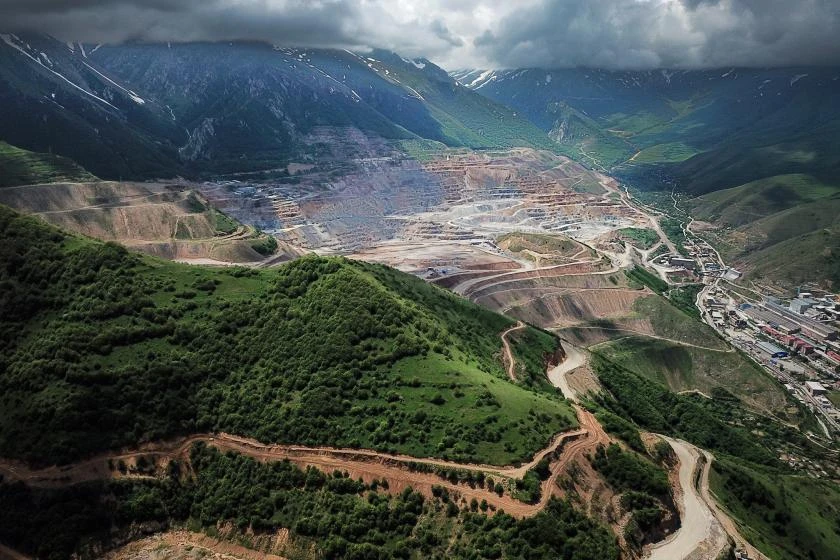
More than a hundred Armenian civil society representatives have demanded that the government withdraw draft legislation that would let environmental reviews of mining projects bypass local community councils.
In a joint statement, the 105 signatories said the draft endangers democracy in Armenia and restricts local self-government and socio-ecological rights in favor of the mining business.
The package was published for public discussion earlier this month by the Ministry of Territorial Administration and Infrastructure. It seeks to amend the Subsoil Code and the Law on Environmental Impact Assessment and Expertise.
Under current rules, a community council can give preliminary consent or objection to a proposed project after public hearings on its environmental impact. As of now, a preliminary objection blocks the state expert review from starting.
Under the draft, a council's objection would no longer be sufficient to reject a developer's documents, to refuse to start the review, or to halt it. Instead, the council's reasons would be examined during the review, and the state-authorized body would make the final decision on whether they are justified.
The signatories, who come from Yerevan and all ten of Armenia's provinces, say this would reduce community participation to a formality.
"With this legislative change, the participation of Armenia's communities in decision-making regarding the environment and subsoil use would be symbolic and formal, while real decision-making would be reserved for authorized bodies and the executive branch," the statement said.
The statement argued communities bear a significant share of the negative consequences of mining and other large-scale economic activity. Their position therefore cannot be treated as secondary or purely advisory, it says. The decisions at stake have long-term effects on residents' health, water resources, land, agriculture and biodiversity, according to the statement.
The signatories also argue that the package contradicts several international agreements Armenia has ratified. They say it would make the targets of the Kunming-Montreal Global Biodiversity Framework impossible to meet. They also say it would violate communities' right to take part in environmental decision-making under the Aarhus Convention and endanger implementation of the Armenia-EU Comprehensive and Enhanced Partnership Agreement (CEPA). Under these agreements, Armenia committed to strengthening public participation, not reducing it, the statement says.
According to the statement, the package clearly casts doubt on the government's sincerity in strengthening democracy and its European integration aspirations.
The signatories called on the ministry to withdraw the package. They asked the government to identify the motives of the draft's authors, including the authorized body, its relevant departments and specialists. They also asked it to establish the grounds for what they described as the authors' alleged bias toward the mining business, and to take steps to prevent similar practices.
They urged the Ministry of Environment to promptly draft new amendments, with public participation, that would expand and strengthen guarantees of public participation in line with the Aarhus Convention. They also called on both ministries to introduce additional direct democracy mechanisms, developed with broad involvement of civil society, rural residents, farmers, women and young people.
Signatories include representatives of the Transparency International Anti-Corruption Center, the Helsinki Citizens' Assembly Vanadzor office, EcoLur, the Union of Informed Citizens, the Yerevan Press Club and dozens of local organizations and initiatives. Opposition to mining projects has repeatedly mobilized Armenian communities, most prominently around the Amulsar gold mine near Jermuk.
Under the draft, the authorized body would be required to review the council's objections, the results of public hearings and comments submitted by citizens. If the council's reasons are found justified under the review criteria, the body must issue a negative conclusion. If they are found insufficient, or if the risks can be prevented or reduced, it may issue a positive conclusion but must justify its decision.
In its explanatory note, the ministry says current law does not clearly regulate how the review should proceed after a council objects. It says the aim of the change is to set a clear and predictable procedure.
The package would also exempt from state environmental review any reassessment of mineral reserves based solely on existing geological data, without new fieldwork.
Public discussion of the draft runs until October 30. The amendments have not been adopted.



 Stories