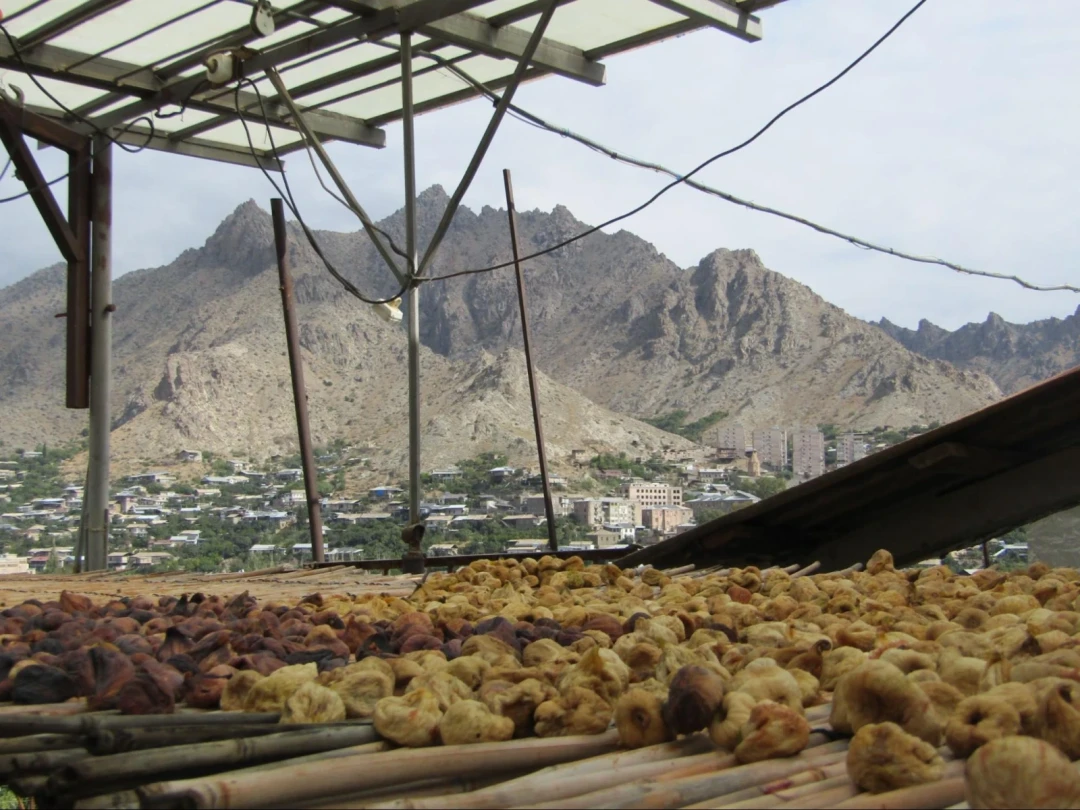
“Almost everyone in Meghri is in the dry fruit business, whether they want to or not,” says Vlad. His mother runs a guesthouse in Meghri and, similar to other residents, has a small fruit business. Vlad has a business in Moscow, but during harvest season he returns to help with the fruit.
It takes about seven hours in the car from Yerevan to reach Meghri, which sits in a remote mountain valley in the south of Armenia. Just a couple kilometres south of the town centre, the Araks river divides Armenia’s southern Syunik province and the Qaradagh mountains of Iran.
Syunik province is a narrow corridor bordered by Azerbaijan from the east and Azerbaijan’s exclave of Nakhchivan from the west. In the early 1990s, when travel through the exclave was still possible, the journey to Yerevan would take about three hours. Now, the road north through the mountains of Syunik takes more than twice as long. Since August 2025, the area has been under the spotlight as the proposed Trump Route for International Peace and Prosperity (TRIPP) is planned to run through the south of Syunik connecting mainland Azerbaijan with Nakhchivan.
Walking through the streets of Poqr Tagh – one of Meghri’s oldest neighbourhoods – I see wooden trays and drying beds of fruit filling the terraces and rooftops. But this summer, the Russian ban on imports of Armenian goods means the cases of dried figs are still without a buyer.
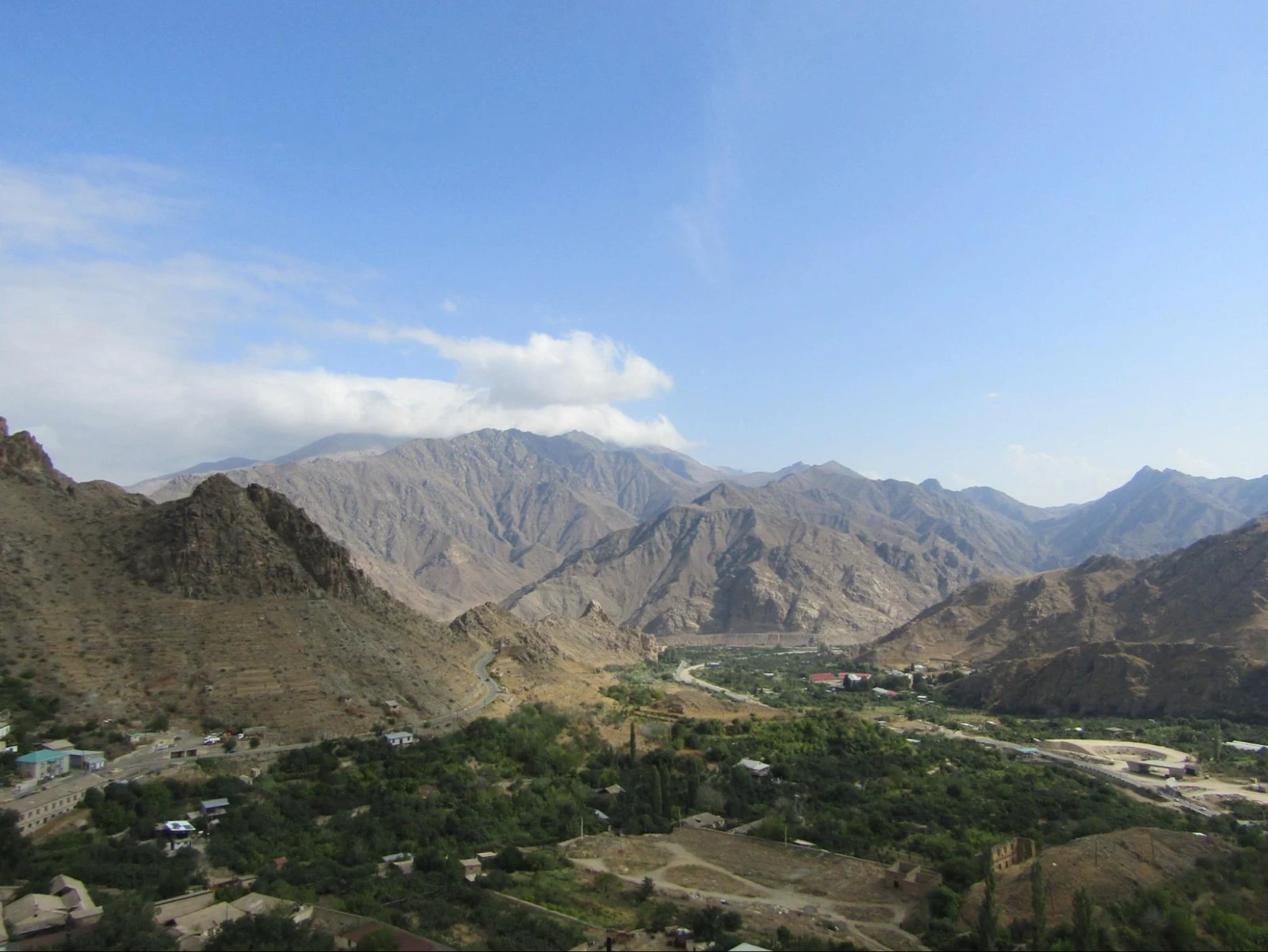
It’s a cold autumn evening and we’re sitting on a terrace just below Meghri’s Saint Hovhannes Church. Built in the 17th century, the church is known for the intricate frescoes covering its walls. Karine, a local teacher, is talking about the history of the town and its traditions. From the house’s terrace we can see the layers of communities climbing from the Meghri river up towards the nearby mountain peaks. As the fertile land was scarce, the bottom of the valley alongside the riverbed was left for orchards and the community slowly scaled the valley slopes with rows of houses clinging onto the rocks.
Silkworms for Figs?
“Many years ago – before the Soviet era – mulberry trees grew in Meghri, and silk was produced from them; people kept silkworms in their homes,” says Karine. She says that silk production was one of Meghri’s traditions. The mulberry trees are still in abundance and, as we are told by our driver, mulberry vodka is one of the must-try things in this southern town.
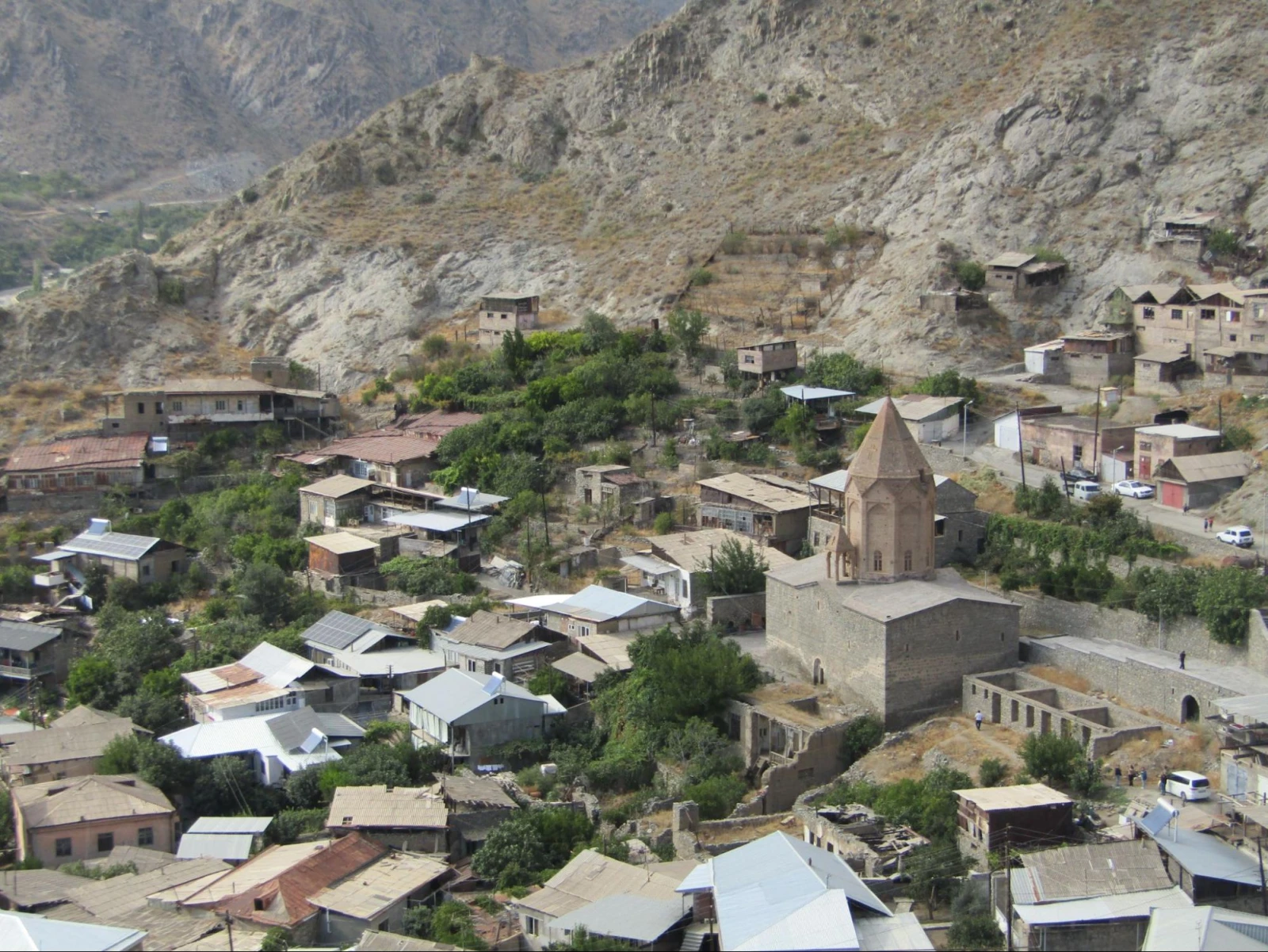
“The way these old houses were built is fascinating: the sun would travel through every room from dawn till dusk. This wasn’t done just for the residents’ benefit, but especially for the cocoons.” Silkworms need a lot of natural light to produce the silk thread and, according to Karine, the old houses in Meghri were built on mountain terraces to allow as much light as possible to let light pass through the rooms.
“During the Soviet era, they cut down all those mulberry trees – because the families [in Meghri], though few in number, were well-established and wealthy,” says Karine. According to her, this is how the story of Meghri’s fruit tradition starts, and although some mulberry trees still remain, the Soviet period meant there was more focus on other fruit in the area. Now, the Meghri dried fruit is one of the town’s trademarks.
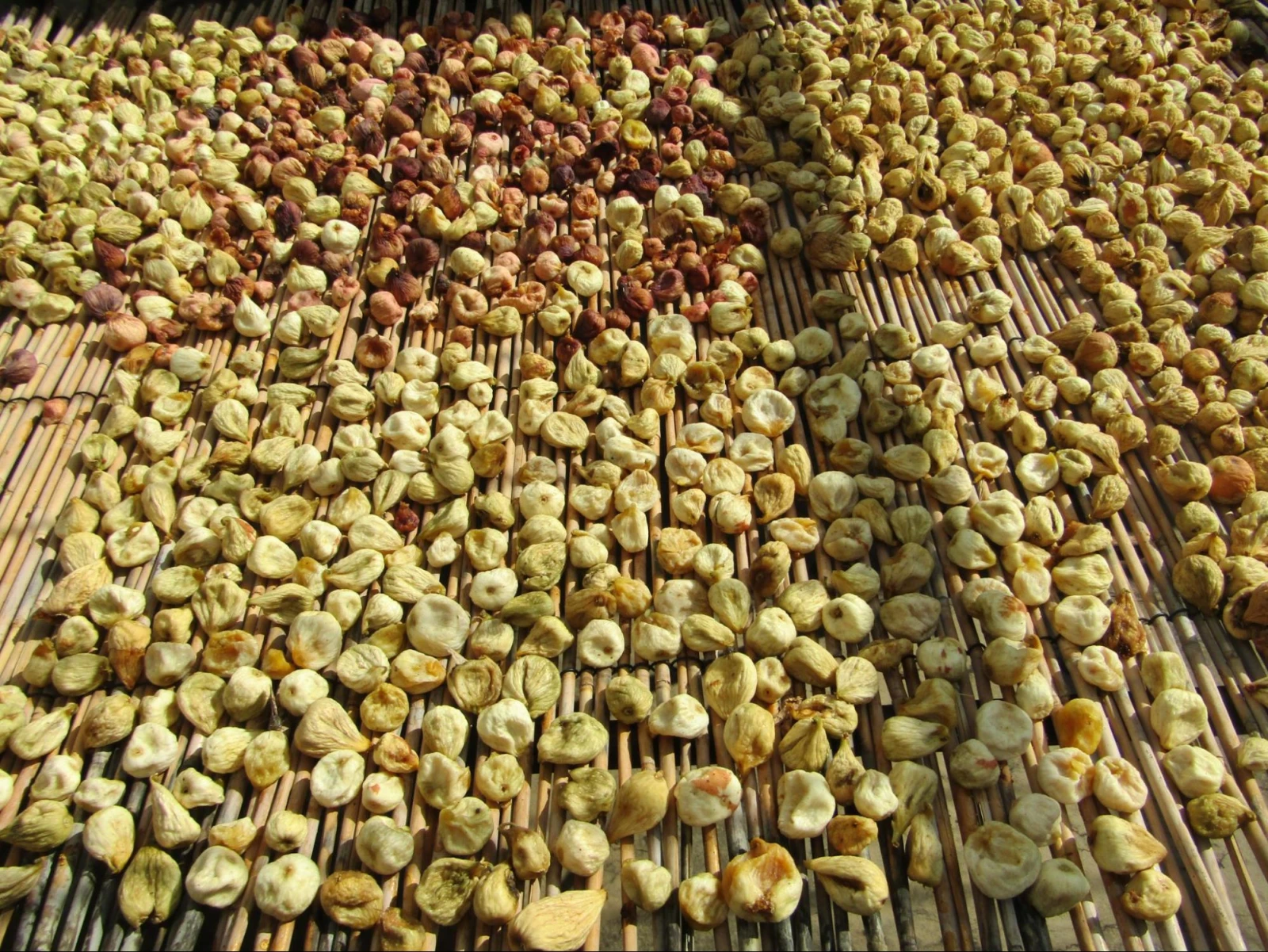
“When I’m buying dried figs, I always look for the ones from Meghri,” my colleague in Yerevan tells me. Meghri is famously warmer than the rest of Armenia – which many people warn me about as I tell them that I’m headed there. And although heated by the sun, it’s kept green by the Meghri and Araks rivers.
The Harvest Calendar
“There’s no club, no bar, no café here, nothing. In the evening, you sit and make dried fruit,” says Vlad. For him and his mother, Tereza, the yearly cycle is tied to fruit harvests. The harvest season starts with sweet and sour cherries which are picked in spring, as early as May. Spring also means the loquat tree yields fruit. Vlad explains his father brought the fruit from Moscow and told everyone to save the seeds, of which one rooted and now is a full-grown tree.
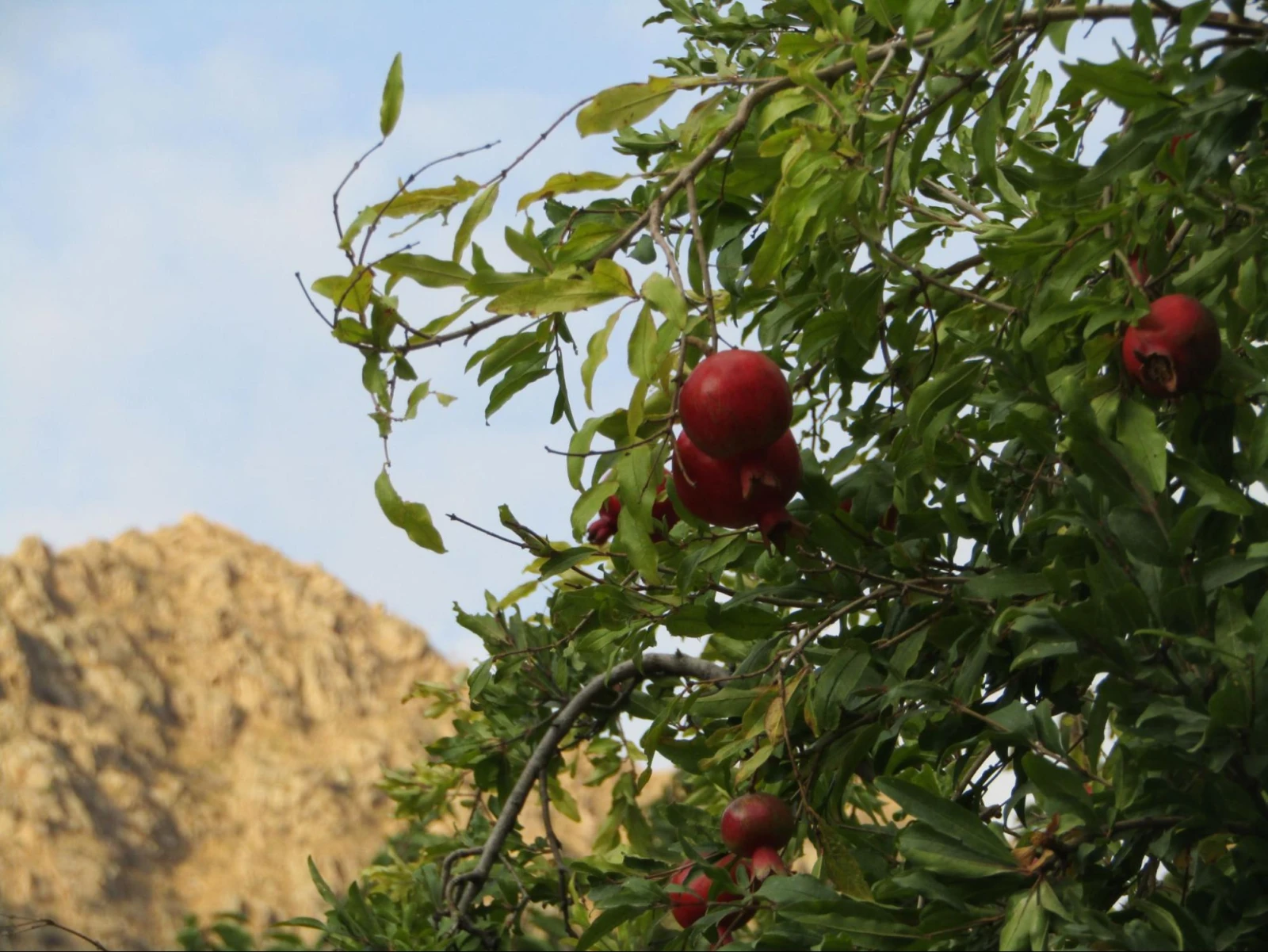
Late spring is the time to harvest green walnuts. They’re later made into enkuyzi muraba, an Armenian walnut preserve. “I didn’t use to eat this damn thing either,” says Tereza. “Now I’m not crazy about it, but when it’s there, I eat it.”
The summer is the time for peaches, apricots and, of course, figs. “I personally make dried peaches, dried apricots, we make all kinds of dried fruit,” says Tereza. In October, persimmons usually hang from the terrace railings stacked on thin strings. Every fruit has its own calendar and its own preservation method. Autumn also brings the harvest of grapes and olives – in late September, there is already a barrel of olives marinating in Tereza’s basement. The climate in Meghri is mild enough, making it one of the few places in Armenia where olives are grown.
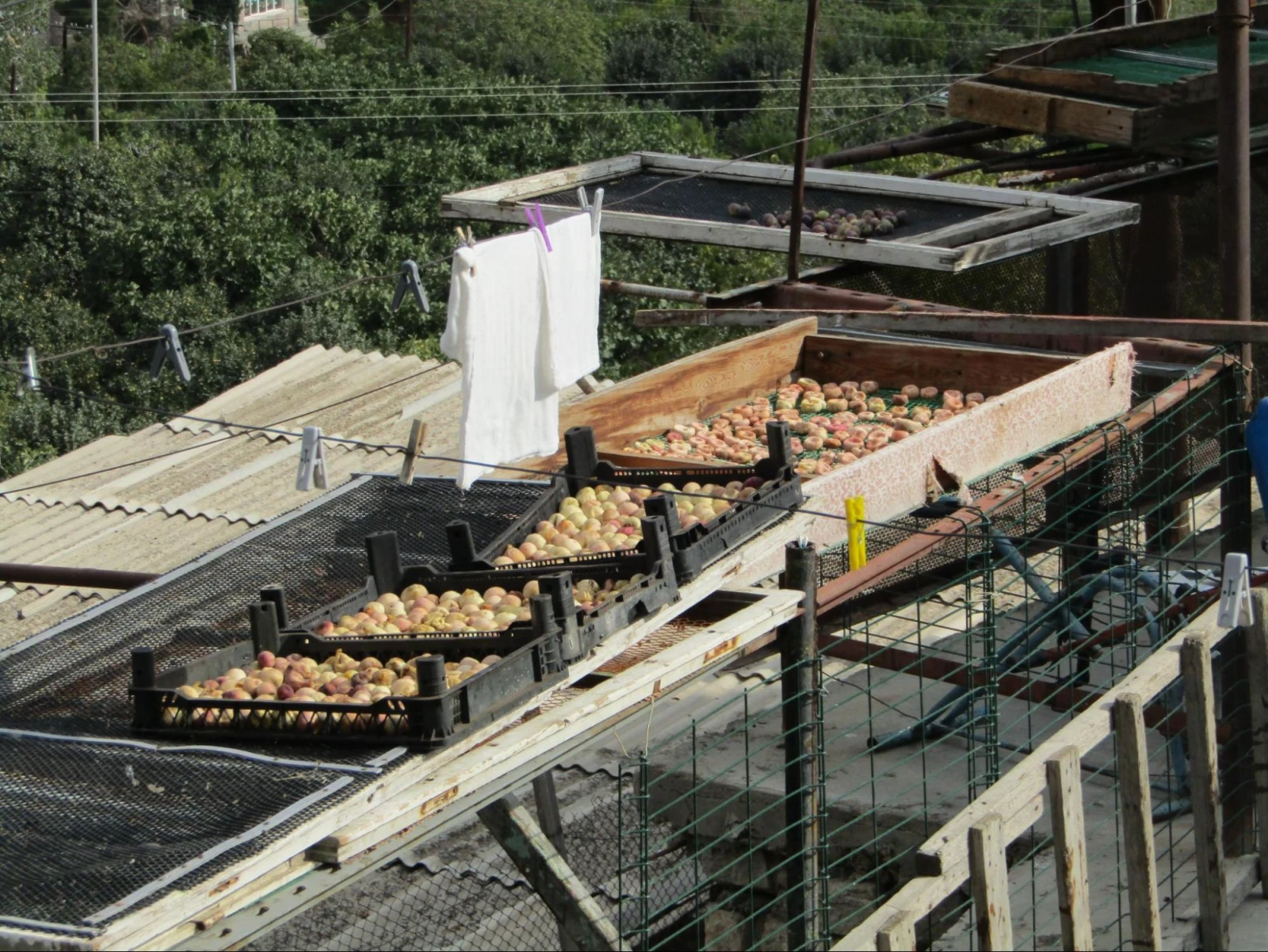
Fig Season
“Everyone says, ‘How great that it’s fig season!’ but if you meet people during fig season in August, at the absolute peak, on the 15th, everyone is tired, everyone is sleepy, everyone wants to die,” Vlad laughs. The fig season starts from late July and lasts until autumn. The day starts at 5 am before the late summer sun warms the fruit. “When you pick the fig at 5 in the morning, the stem comes off easily,” Vlad explains. When the figs get warm from the sun later in the day, they’re harder to pick. The fruit ripens starting from the bottom of the branch, with new figs ripening every day. “On the same branch, you picked yesterday, you’re picking today, you pick tomorrow, you’ll pick the next day too.”
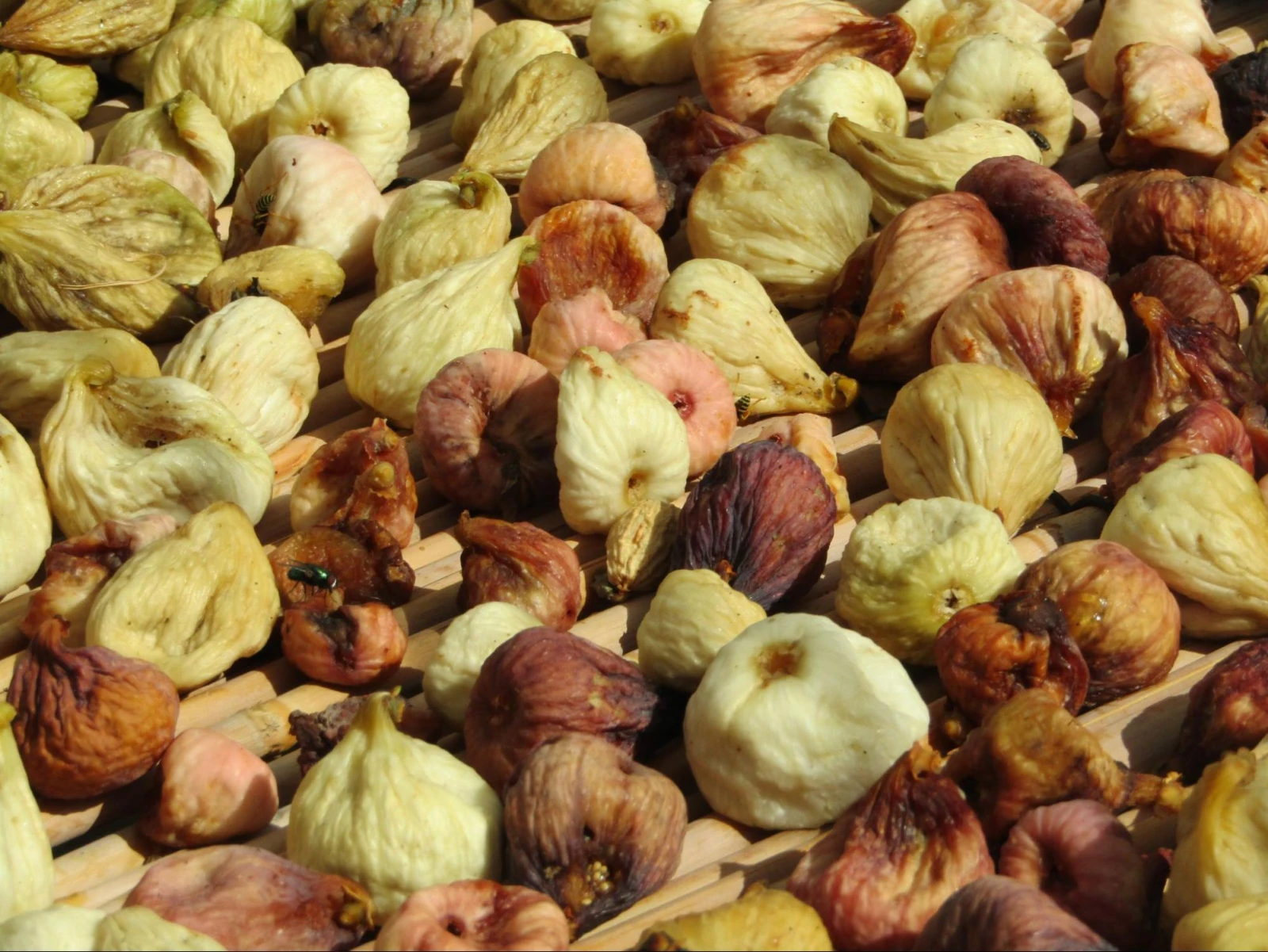
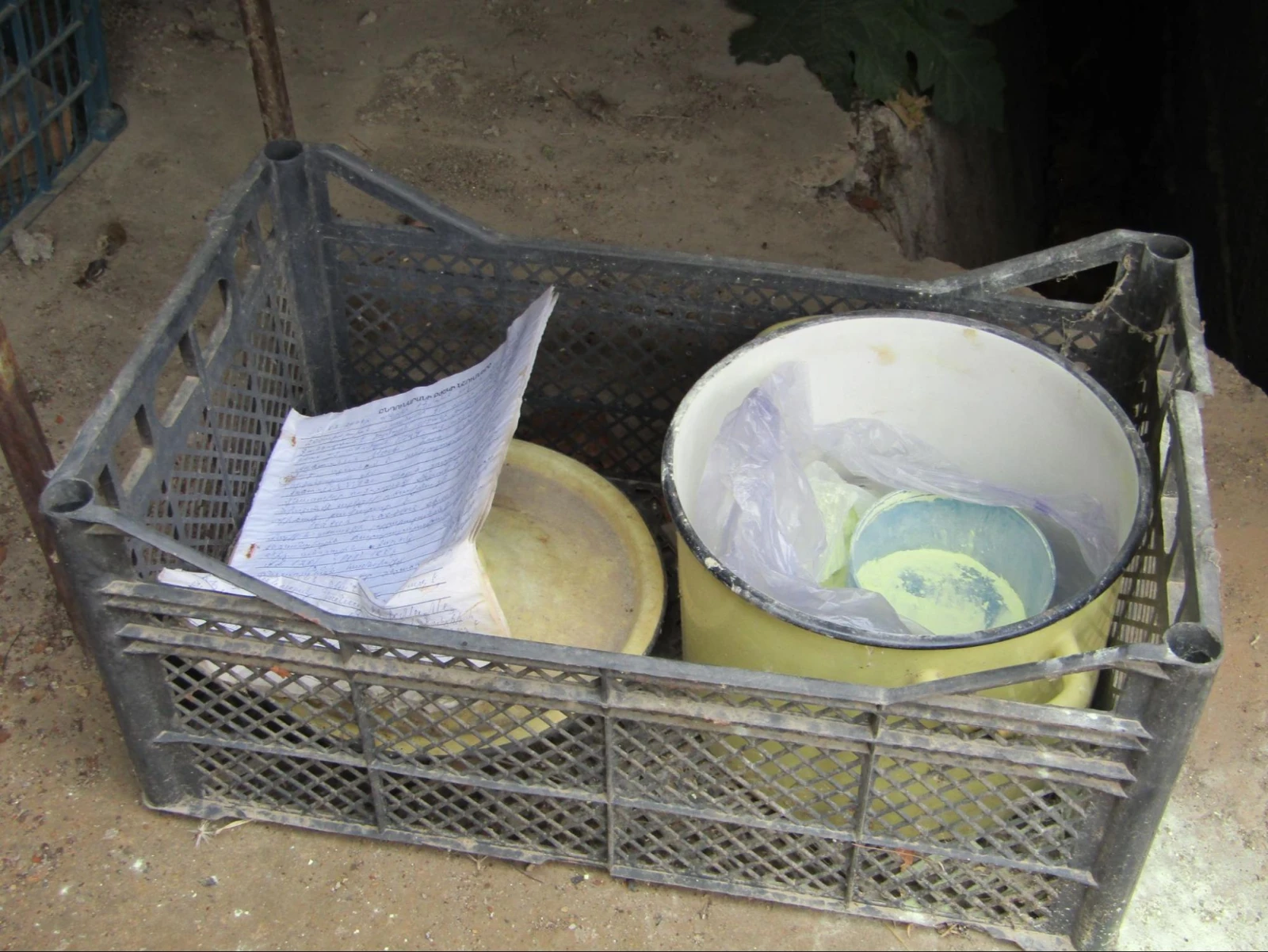
After the figs are picked comes the final step before they’re laid out to dry. Vlad takes me to the rooftop of the house, where built into the rock is the sulphur room. There, the fruit is fumigated with burning sulphur, which helps the figs retain their colour, preventing them from spoiling, and deterring pests. After roughly a day spent in the sulphur room, the family washes the figs and lays them out to dry in the sun on the rooftop.
“Today we lay them out, the next day we turn them, the following day we keep them again so they dry well, and we collect them,” says Vlad. Then, the figs are put in the freezer to keep them from spoiling. The process is repeated every day throughout August and further into autumn. According to Vlad, from around four kilograms of fresh figs he gets a kilogram of dried product. Local middlemen buy it and sell in Yerevan and abroad.
This summer, June and July were uncharacteristically cold, meaning the fig harvest only started around August 10. The drastic temperature change meant the fruit would ripen too quickly. “In the morning a fig is unripe, by the evening already ripe, already withered,” explains Vlad.
The Fruit Economy
Dried figs used to be a profitable part of the family fruit business. Vlad says when they used to cultivate a bigger orchard, before his father died, they would produce up to 500 kilograms of dried figs per season. Now, with the smaller orchard, that figure is closer to 100–150 kilograms from about 20 trees.
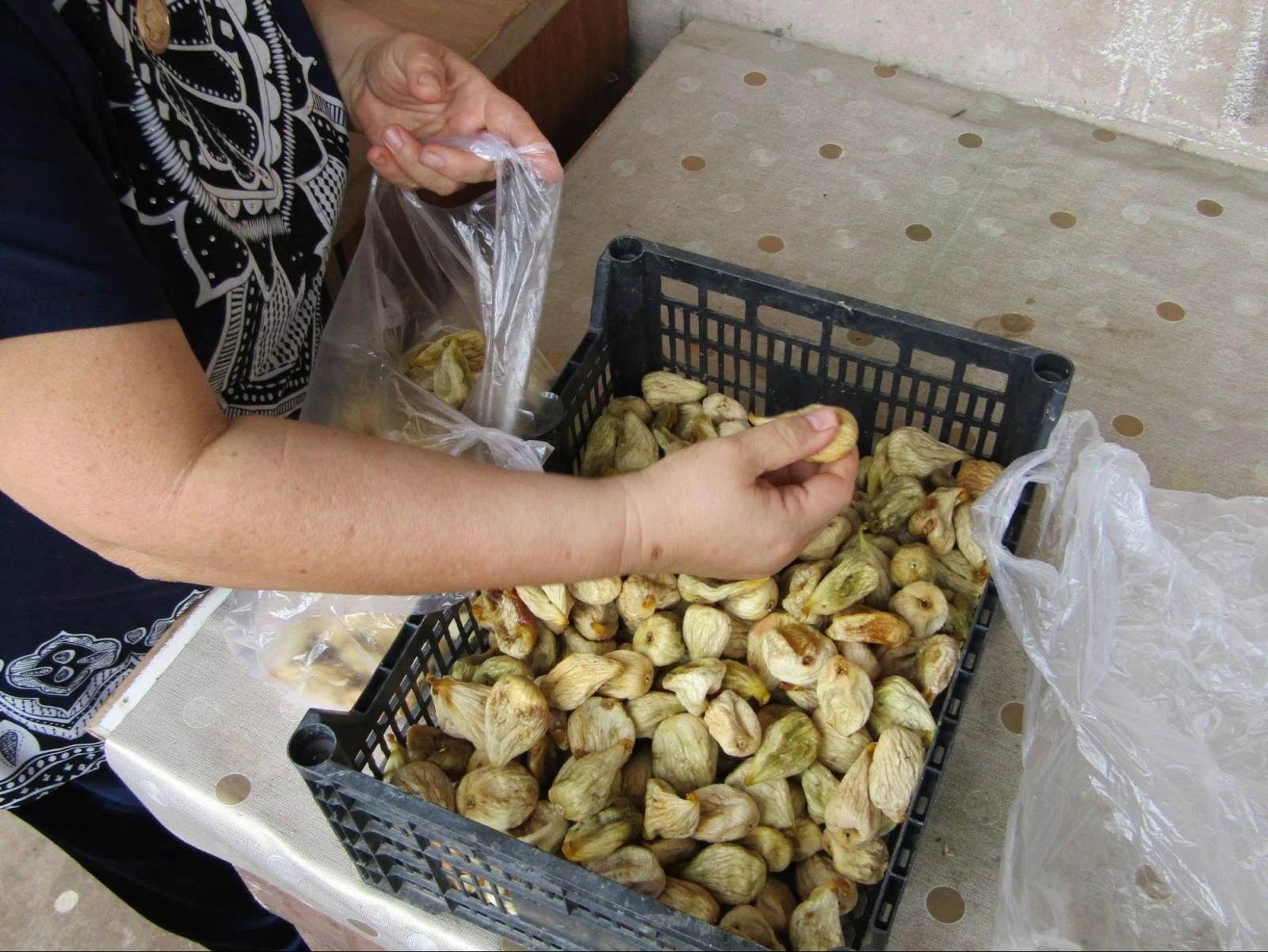
According to Vlad, fresh figs sold at around 500 AMD ($1.4) per kilogram and dried figs used to sell at 3,000 AMD ($8.3). With four kilograms of fresh figs equalling a kilogram of dried produce, it made more sense to go through the process of drying. Vlad says the majority of dried figs from Meghri are sold to Russia. “This year, because the border [for exports to Russia] is closed, they sell for 1,500 to 1,800 AMD [$4–5].”
Starting in May 2026, Russia imposed a series of restrictions on Armenian agricultural imports. Dried fruit was included in the list of banned products in June 2026. Russia presents the measures as sanitary and phytosanitary, while Armenian officials called them politicised. In previous years, Russia was absorbing 80–90 percent of Armenia’s agricultural output. The ban directly impacted Meghri, where, as Vlad recalls, this summer the prices dropped roughly 50 percent. For the local economy in the remote Armenian south, this ban meant that the fruit harvest would yield at most about half of the previous seasons’ income.
In response to the Russian ban, the EU provided tariff relief for Armenian exports starting October 10. The EU’s preferences remove duties on about 80 percent of Armenian exports to the bloc, including dried figs. With the fig harvest almost over, however, this may come too late to reverse the hit Meghri’s fruit economy took this summer.
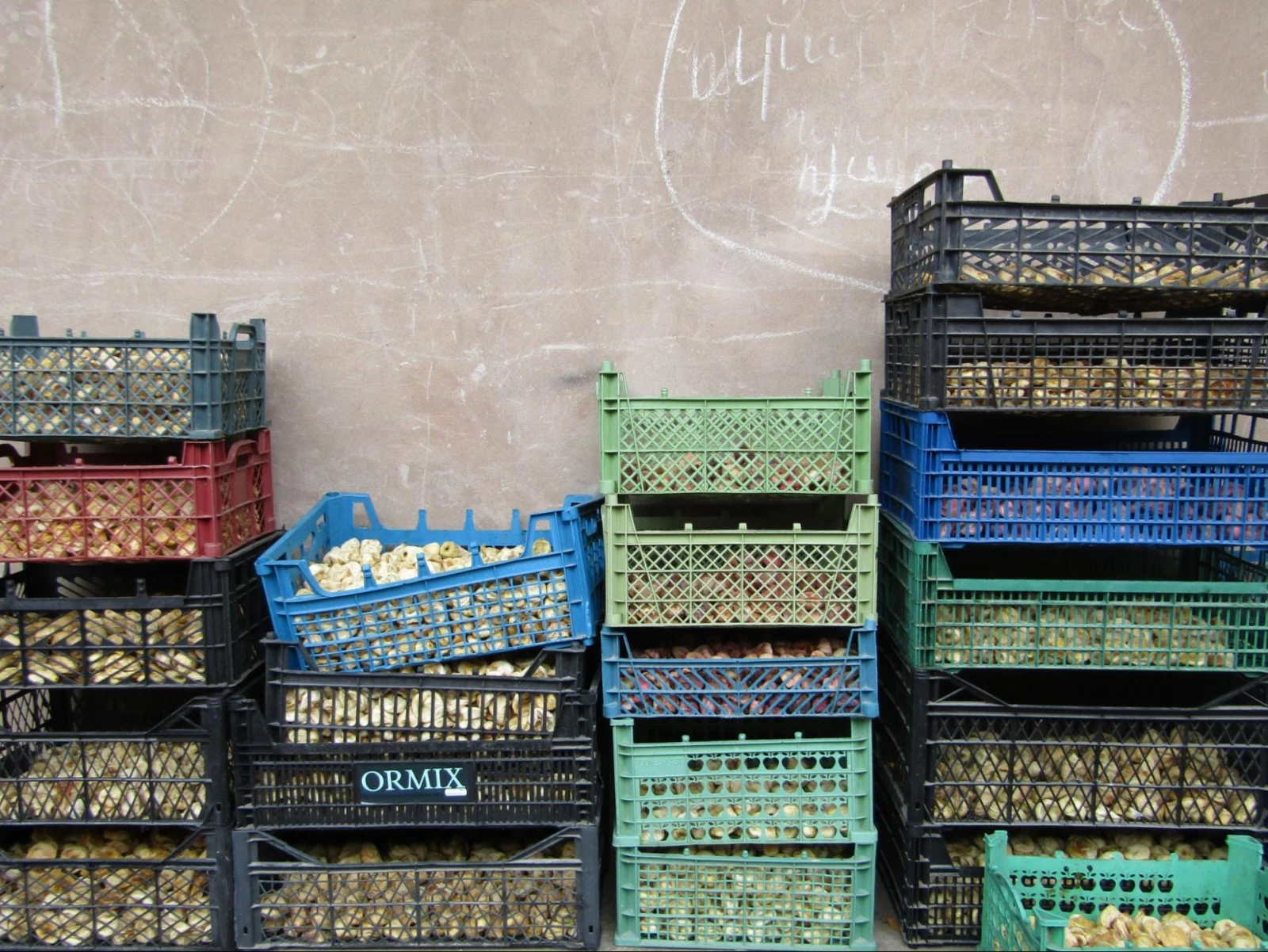
“This year we haven’t sold the dried fruit, and everything doesn’t fit in the freezer anymore,” says Vlad. Usually kept in the freezer for better protection, the unsold dried figs are stacked in cases outside. Before the ban, a 150-kilogram dried fig harvest would translate to about 450,000 AMD ($1,240) in sales. Now, at roughly half of that price, the fruit is still waiting for a buyer.





 Stories