 Lia Avagyan
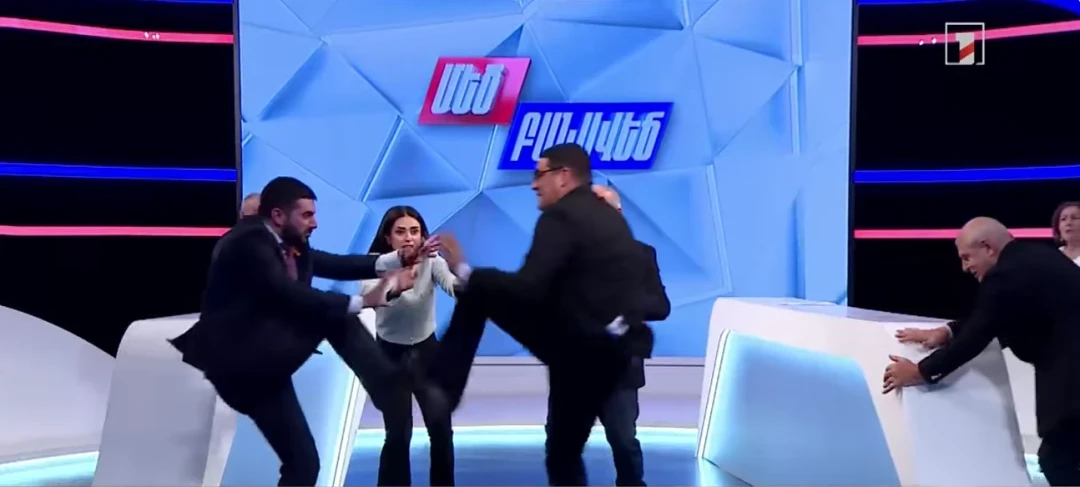
A debate on Armenia's Public Television turned into a physical fight between two guests, and the broadcaster aired the footage without cuts even though the show was prerecorded. The national broadcast regulator and a leading media watchdog have both criticized the decision.
The clash happened on November 13, while an episode of the talk show “Mets Banavech” (The Great Debate) was being recorded. Journalist Boris Murazi, who ran in the June parliamentary elections on the list of the opposition Armenia Alliance led by former President Robert Kocharyan, got into a fight with political analyst Harutyun Mkrtchyan. Mkrtchyan is a former member of the Republic Party and is known for posting on social media against the opposition and in support of the government.
Public Television broadcast the episode on November 15, including the insults the two men traded and the fight itself.
The episode was devoted to "The Agenda of the Consolidated Opposition." The other two guests were Azat Arshakyan and Vahram Atanesyan. The episode was about “The Agenda of the Consolidated Opposition.” The Consolidated Opposition brings together the opposition groups in parliament, Strong Armenia and the Armenia Alliance, and several parties that are not in parliament. They have joined forces to oppose the constitutional changes initiated by Prime Minister Nikol Pashinyan.
The argument started when Mkrtchyan asked Murazi about his alleged personal relationship with former President Serzh Sargsyan, citing press reports. Murazi often criticizes Sargsyan in public. He called the question offensive and unacceptable. The two men then traded insults, some of them aimed at each other's family members, and the confrontation became physical.
On November 14, Murazi spoke about the incident in a Facebook live stream. He said Mkrtchyan had crossed the line of acceptable behavior repeatedly and that he had warned him about it.
"When he finally crossed the line like that, I had to briefly take on the task of bringing that man up properly. I took certain actions. What his father should have done, I had to do," Murazi said.
Regulator: violence "cannot be justified"
The Television and Radio Commission (TRC) expressed concern about the broadcast. The TRC is a state regulator charged with protecting the freedom, independence and diversity of broadcast media and with overseeing whether TV and radio companies operate lawfully.
"Open violence and insults cannot be justified by the guests invited to a debate, by a heated discussion, by a vain drive for ratings, or even by formal impartiality," the commission said in a statement.
The TRC said a public broadcaster, which is expected to set an example for the rest of the industry, must comply with the law, avoid inflaming its audience's emotions and refrain from legitimizing violence on air.
"After all, there are professional techniques for withstanding provocations from debate participants, defusing tension, preventing violence and steering the discussion in a constructive direction, especially when the program is prerecorded rather than live," the commission said.
Ashot Melikyan, chairman of the Committee to Protect Freedom of Expression, told CivilNet that the program had no public value and that broadcasting it was not justified.
Melikyan said the incident was another sign of political polarization in Armenian society. He noted that similar clashes have happened before, both in parliament and in everyday life. Unless steps are taken to ease tensions, he warned, the polarization could have more serious consequences.
He also said the episode had organizational problems. In his view, Public Television did not maintain the intended debate format or ensure that guests with opposing views took part.
Melikyan said the broadcaster might have aired the incident to show how polarized society is and how people with different political views cannot hold a civil debate. In his opinion, that still does not justify showing the fight.
"Ethically, I think some part of the audience may perceive this as promoting violence," he said. He added that because the show was prerecorded, Public Television had every opportunity not to air it.
The show's host, Petros Ghazaryan, declined to comment. "I don't want to talk about it. It's not the Armenian Question, to be commented on yet again. Passions ran high, they hit each other. So what?" he said.

 Stories