By Tigran Shahverdyan
Three problems every Armenian knows. Our defense has to keep up with drones and other technologies that are changing war. Traffic in Yerevan comes close to a standstill at rush hour, and only this year did the city begin to count the cars entering and leaving it. Last winter, Yerevan's air was dirtier than the World Health Organization's guideline on 138 days out of 151, and nobody has yet measured how much of that pollution comes from heating, cars, dust or burning.
Each of these needs research and development (R&D). Each raises the same question: who in the state orders that work, pays for it and uses the result?
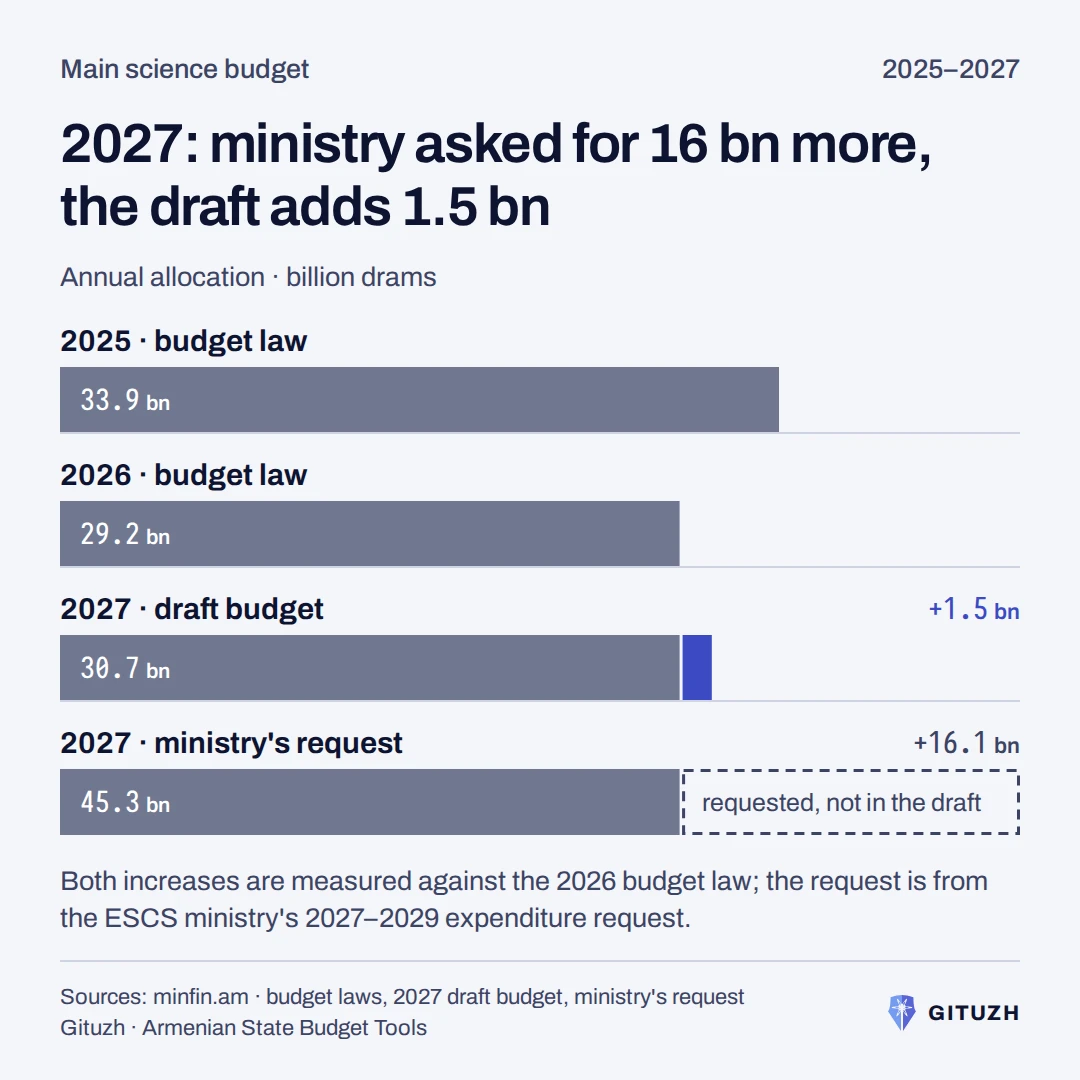
Armenia has begun to build the base it needs to answer it. Since 2018, the state budget's allocation for science and defense R&D has more than doubled. In January, the government adopted a 2026–2030 strategic program committing to raise public R&D spending to 0.75% of GDP. For 2027, the Ministry of Education, Science, Culture and Sport asked for about AMD 16 billion more than this year's science budget. The draft budget adds AMD 1.5 billion. The government and the National Assembly should fund the program in full, in 2027 and every year until 2030.
The money is being spent
In October, Finance Minister Vahe Hovhannisyan told Boon TV that science money has not always been spent as planned, and that the sector should "first absorb what we have" before asking for more.
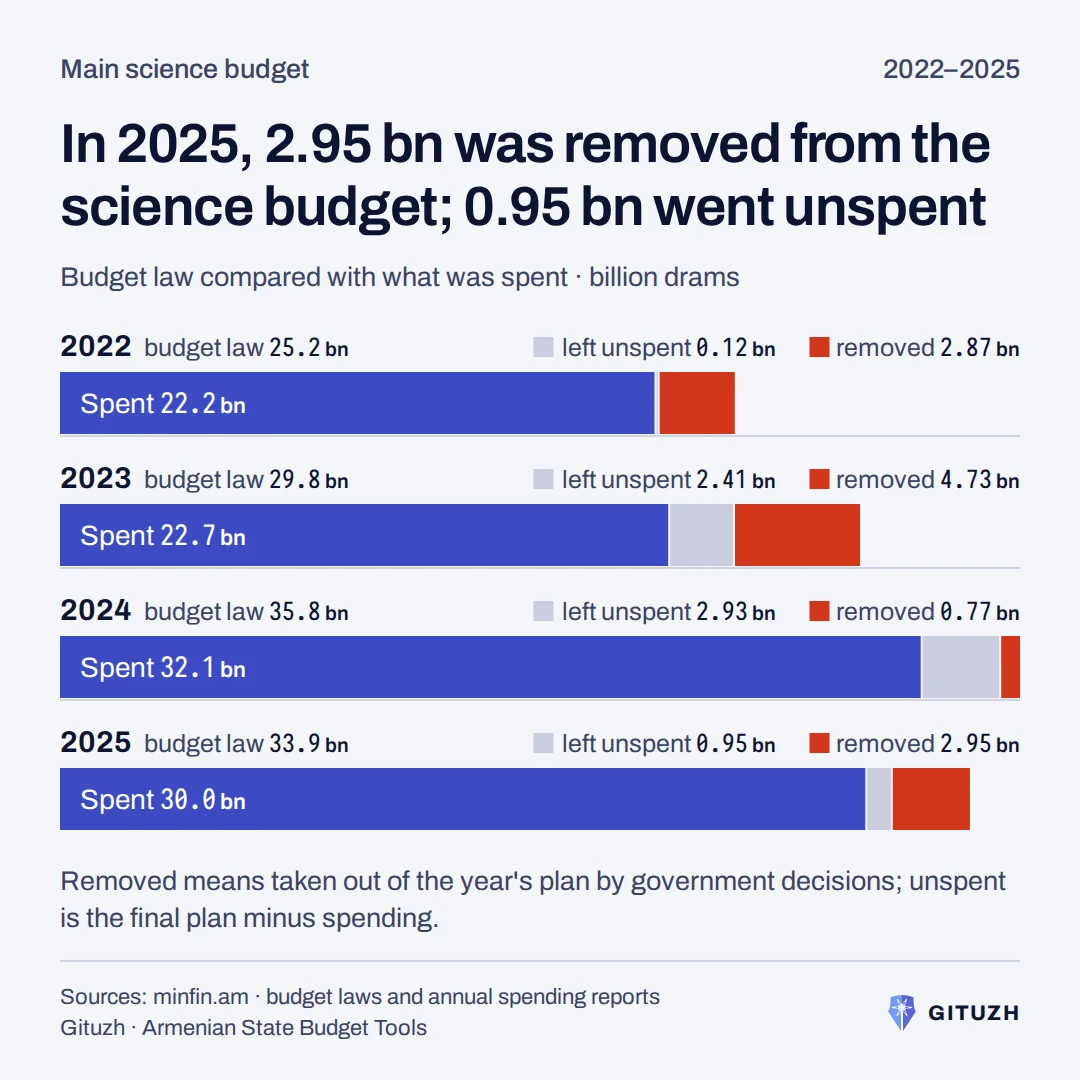
Some money did go unspent. But in 2025 the main science budget spent 97% of what it was finally given. Government decisions during the year removed AMD 2.95 billion from its allocation; only 0.95 billion was left unspent. Almost every budget program ends the year a little below its plan. By the minister's logic, almost nothing in the budget should ever grow.
The real problem is money that hasn't arrived. The 2026 budget law listed AMD 5.2 billion for research equipment as a priority. So far the government has allocated 1.6 billion. As of 22 November, signed contracts worth another AMD 1.65 billion, from a genetic analyzer to ultrafast lasers, had no funding amendment published on the state procurement portal. The five-year Advanced Research Grants, held by 49 groups led by Armenia's leading researchers, ended in September, and no new round has been announced.
The minister of science says funding has diversified: a tax benefit for researchers in private companies, and a separately financed USD 14 million Physical AI program. Both are welcome. But under international rules a tax benefit is not counted as public R&D spending, and it does not pay for the equipment, grants and research positions in the strategic program. The Physical AI program may pay for some of them, but its place in the budget has not yet been shown.
Two different jobs
Academic research builds knowledge and trains the people who can solve problems like the three above. It should be funded on its own merits, and the strategic program is a detailed plan for exactly that.
Ordering R&D for the country's needs is a different job. For the economy, Armenia has begun, though much remains to be done. In defense, an agency has that job, yet in 2025 it spent about half of the R&D money the budget gave it, and on 5 November the government cut AMD 1.6 billion from this year's plan, leaving half of what the budget allocated. A customer also needs programs and the ability to order them. Outside defense, no agency has the mandate to turn the state's needs into research and development, pay for it and see the results used. State bodies can propose research topics to the science committee. But the committee pays from the science budget, signs the contract and accepts the report, and nothing obliges the body that raised the problem to use the result. Yerevan's traffic and air are only two examples. The same is true of food security, energy or water: there is no one whose job it is to order the work.
Put simply, the state sponsors science, but is not yet its customer. A customer is no guarantee of funding. But it makes someone responsible for defining the need and using the result, and it gives science allies across the government.
The Prime Minister has recognized this gap and ordered a study to close it. Progress has been slow, but it has recently picked up, which gives hope that this essential issue will be resolved.
None of this is a reason to hold back the money. Giving the state a way to order R&D should sit on top of funding the strategic program, not replace it. The program must be funded either way.
What should happen now?
This year, the government should fund the equipment contracts already signed.
Before parliament votes, the government should show how each of the strategic program's 2027 measures will be paid for, and put what is missing into the budget.
Alongside this, not instead of it, the government should give an existing or new agency the mandate and the money to order R&D for the state's security and public-good needs.
On 15 October, the Prime Minister said the government will achieve all the goals it has declared, including on science funding. On 19 November, Minister Zhanna Andreasyan told the National Assembly that the strategic program remains in force. The 2027 budget is the first test of both.
Tigran Shahverdyan is a member of Gituzh, an initiative advocating for the advancement of science and research in Armenia, and co-founder and CTO of Robomart.




 Stories