 Civilnet
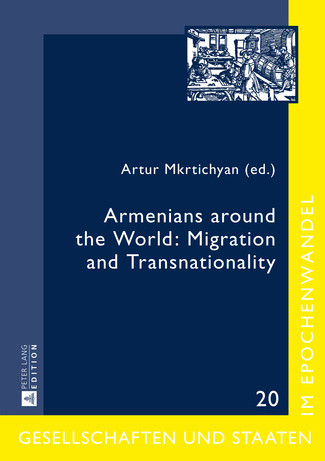
 Armenians around the World: Migration and Transnationality, a 280 page collection of sociological studies, published by Peter Lang International Academic Publishers in 2015, offers new insights into Armenian migration taking into account specific community structure, lifestyle, communication and adaptation, social, economic and gender aspects. The publication, edited by Dr. Arthur Mkrtichyan, brings together authors from Armenia, Germany, Italy, Poland, Romania, and the US who use various approaches to the subject such as case-study, in-depth interviews, surveys, comparative and network analysis, as well as migration and transnationalism theories.
In his article from the publication, “Towards the New Armenian Networks: Theoretical Considerations”, analysing the Armenian experience with nation-statehood, Dr. Arthur Mkrtichyan provides a detailed account of the multi-level social factors responsible for shaping contemporary Armenian society. Mkrtichyan explains, “currently Armenia faces a clash between old social rules, new social rules, and the reality of the social and economic landscape”, a trend found in essentially every post-Soviet country. The result of the transition period is an administratively weak state characterized by a skeptical population and insecurity at all levels.
According to Dr. Mkrtichyan, as Armenia struggles to modernize and consolidate democratically, new ideas and goals are difficult to realize as the infrastructure and resources are inadequate to achieve them. Consequently, civil society suffers from disillusionment, often culminating in emigration as a means of escaping the stress wrought by living in the limbo of two-worlds, the old and the new. Further to this point, the author points out that the norms of the post-Soviet era emphasize a highly materialist model of success. In the absence of strong institutions however, people pursue these aims through any means necessary, often leading to corruption and the strengthening of “shadow economies”. This unstable climate renders society distrustful, resulting the loss of social capital and therefore impeding hope for progression.
Mkritchyan’s article cites renowned political scientist Francis Fukuyama who outlines the effects of wary citizens; “a low social-capital country is not only likely to have small, weak, and inefficient companies; it will also suffer from pervasive corruption of its public officials and ineffective public administration…in such circumstances the dissatisfaction with the present is manifested in the mistrust toward the future”.


 Stories