 Civilnet
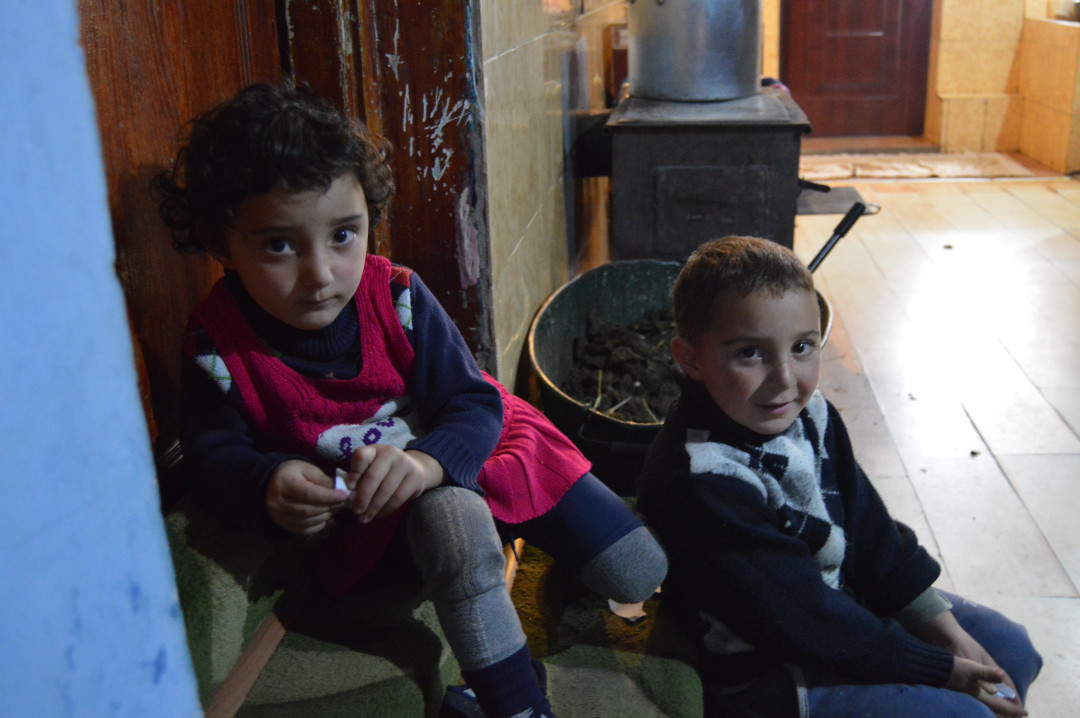
 Yazidi children in Armenia. Photo credit: Zuzana Matějková.
Among the Peacock People
Worshippers of Satan, the Peacock People, a sect, outstanding merchants, welcoming hosts: these are a few of many attributes ascribed to the followers of the ancient Yazidi religion. Recently, the world’s attention has been drawn to them in response to their suffering from atrocities committed by Daesh (the self-proclaimed Islamic State). But Yazidis do not only live in the Levant -- around 40,000 also live in the Armenian mountains.
What do we know about them, aside from brief media reports? How do they live? What do they believe in? What are their hopes?
Mraz's unfavourable outlooks
Many Yazidis in modern-day Armenia make their living by cattle breeding, with cattle being one of their characteristic signs. In spring, they drive their herds up the mountains, until winter approaches and they return to their villages near Mount Aragats.
We meet several herdsmen in Sipan, about 70 kilometres north of Yerevan. Mraz, a fifty-eight year old man, is one of them. Happy to meet new friends, he invites us for a cup of tea. He promises to butcher a ram in our honor, but we refuse with many thanks.
Mraz was born in Sipan. His life seems to tell Armenian history of the second half of the 20th century. Except for his two-year military service in Sverdlovsk (Ekaterinburg), he lived all of his life in his home village. After completing eight years in the local elementary school, he was working as a tractor driver in a local kolkhoz for fifteen years, a collective farm during the Soviet Union. When the kolkhoz declared bankruptcy, Mraz became a car mechanic, but eventually lost his job.
 Mraz with his family and friends. Photo credit: Zuzana Matějková
He is thinking about leaving for Sweden for a better life, as his brother has already done. “Nothing remains here. The kolkhoz is closed, factories are closed, people are leaving for better conditions. I have no idea what to do, so I sit around, sometimes I butcher a ram, and that's all. Our son supports us. He is a mason in Georgia. He returns home twice a year. No one can find a job here,” Mraz tells us, quite depressively.
His wife, grandchildren and daughter-in-law live with him in a small house. The daughter-in-law hides herself. According to tradition, it is not appropriate for her to speak with guests when her husband is not present.
Mraz’s family suffered many strokes of fate. “Half of all houses here collapsed during the earthquake in 1988. Our son was pulled out of the debris after several hours. Unfortunately, it was too late…” Mraz pauses for a moment, as his wife puts local delicacies on the table: dolma, outstanding pickled vegetables and delicious lamb shashlik. The landlady expresses regret that she did not know about our visit, insisting that she would have cooked khash, a traditional dish in the Caucasus, made with beef feet broth, entrails and garlic.
Sons and Daughters of the Peacock Angel
 Meleke Taus.
Yazidism is often considered to be a peculiar mixture of Christianity, Islam and Judaism. In fact, many elements of Hinduism, Zoroastrianism and Shamanism are present as well. According to many scientists, the Yazidi cradle is India, where the worshippers of the Peacock Angel originated and moved west. Thanks to contact with other religions, Yazidism became a unique combination in itself.
The Yazidi story of Creation is similar to that in the Book of Genesis, but there are some differences. For instance, the relationship between Adam and Eve was not so idyllic. There was a moment when the pair had to reproduce, but they began to compete and argue with each other, believing they could each reproduce without the partner's help. The quarrel resulted with each of them sealing their seed in separate jars. After some time, they opened the jars. Hideous insects flew out of Eve’s jar, but inside Adam’s jar was a beautiful boy. The boy, also known as Shehid bin Jer (the boy from the Jar), grew up quickly, married and had children who were called the Yazidis. Therefore, Yazidis claim themselves to be descendants of Adam but not Eve.
Yazidi society remains closed because Adam is thought to have been entrusted with holy wisdom handed down from generation to generation, so an outsider cannot become a Yazidi. The people marry within their society, rarely marrying people of other religions.
The first day was Sunday. That day, God created an angel known as Azrael. He is Meleke Taus, the Peacock Angel, the one who executes the will of God, the greatest of angels, the one who helped to create the other angels. God created the angel Darda'il on Monday, the angel Israfil on Tuesday, the angel Michael on Wednesday, the angel Jibril (Gabriel) on Thursday, the angel Simiel on Friday and the angel Nuriel on Saturday. Then, the Peacock Angel breathed the life onto the Earth. He created waters, trees, meadows, animals… And last, he breathed the life onto the mythical Yazidi land known as Lalish.”
 Murad. Photo credit: Zuzana Matějková
This is the Yazidi story of Creation. But what about their life in Armenia today?
In order to better understand the spiritual life of the Peacock People, we head towards the town of Aknalich located about fifty kilometres from Yerevan, where a new temple is being built with the support of a wealthy Yazidi benefactor. According to Murad, one of the building administrators, this will be the first such building outside of the holy area near Mount Sinjar. He tells us, “The building will be finished in 2017. Every temple tower will be dedicated to one of the angels. The main part will be dedicated to the most important angel – Meleke Taus, the Peacock Angel.”
While talking with Murad, several men in boilersuits are discussing the next steps. Aziz is one of these men. This short-statured, thirty-five year old man is one of the so-called wise men, or a ‘peer’ of the community. Murad translates Aziz's explanation of the Yazidi caste system: “We distinguish three castes: sheikh, peer and murids. A sheikh is somebody like a mayor, the community representative. A peer is a religious leader, a priest. He keeps and leads main celebrations such as weddings and burials. Murids are all the others.”
These titles are inherited from father to son. It is not appropriate for the sheikh's children to marry somebody from the other caste, but this rule is not strictly observed in Armenia. “They are much stricter in Iraq. It is important for us only that Yazidis marry Yazidis, so our people can share the wisdom of our ancestors among themselves.”
There is an interesting anthropological phenomenon. From an ethnic point of view, the Yazidis are Kurds with their own peculiar religion. However, Yazidis claim themselves to be an independent nation of the Peacock Angel Meleke Taus's descendants with unique language, traditions and culture. Nevertheless, the Yazidian and Kurdish languages are virtually indistinguishable.
Dreaming of the Lalish country
 Village of Sipan.
Aziz and many of his colleagues found sanctuary in Aknalich when their homes near Sinjar in Iraq were taken by Daesh, as radical Islamists consider Yazidis to be worshippers of Satan. Hundreds of men were killed, while women and girls were taken as sex slaves. Mass murdering of Yazidis was one incentive that prompted the US government to commence air strikes on Daesh positions.
Local Yazidis tell us that their Iraqi counterparts are much more religious. I ask our guide Murad what caused this and he explains, “During seventy years of Soviet rule, our religion and other religions were heavily suppressed. We were recognized as an ethnic group, there were even schools with Yazidian as a main language. However, our religion suffered. Some of our representatives even ended up in the Gulag. Thus, we return to our traditions with serious difficulties. Sometimes we don't even know what shall be followed.” Because of this, immigration from Iraq boosts the local Armenian community in some way.
Every Yazidi, no matter where he or she came from, dreams of visiting the holy land of Lalish. This valley, which is located in northern Iraq about forty kilometres from Mosul, has an important role in the religion. According to the spoken stories of the wise men (from which written records were created much later), this is where the Peacock Angel Meleke Taus created a paradise on Earth for his chosen people. Sheik Adi, one of the most important Yazidi reformers, is buried in the valley. To comply with tradition, every follower of his should carry out a seven-day pilgrimage to the sacred land.
Tears of the Bride or So Sayeth Tamada
 New Yazidi Temple to be built. Photo credit: Zuzana Matějková.
We have an opportunity to see some of the traditional ceremonies in Armenia. Since the temple is not yet built, all religious celebrations, including weddings, are held in a small prayer room about two hundred metres from the future temple complex. On the day of our visit, many guests were present for a wedding.
The groom’s family has lived in the Czech Republic for more than fifteen years. In line with tradition, the groom's father travelled to Armenia to seek out an appropriate bride -- meaning that she must be both a Yazidi and a virgin. He found her in a local community near the town of Ashtarak. From the moment her family agreed to marriage, the young pair had to wait several months to meet each other.
The seventeen year-old bride will go with her husband to the Czech Republic right after the wedding. She is expected to be a perfect wife and mother. Aware of long-distance separation and a completely new life in unfamiliar conditions, the bride cries several times during the wedding ceremony.
The celebration continues. After the ceremony conducted by the peer, guests move to a restaurant. They pelt apples at a bride as a symbol of maturity and fertility. Otherwise, the ceremony would be incomplete.
In addition to musicians, people are being amused by a tamada. He is a toastmaster, an inseparable aspect of Caucasian weddings and feasts.
The tamada, a lawyer who works with words every day, explains to me that becoming a good tamada is not easy: “A good tamada needs to know the history of his people. He has to be talkative but not babbling. He must know the right moment to raise the glass and what to say. He must know traditions and dances. He just needs to know a bit of everything. He can't learn it in schools, he has to be a natural.” He then leaves us to lead the party.
 Yazidi wedding. Photo credit: Zuzana Matějková.
People dance many ring-dances. Everybody is dancing, regardless of age. Waiters are having a hard time keeping the tables full. There is every sort of alcohol one can imagine. Vodka and cognac, the Armenian speciality, dominate. Cheery guests stuff musicians' pockets with banknotes.
At a Yazidi wedding, everybody has their role. Men and women are seated at separate tables, but the dance floor is a place for them to meet.
The clock strikes midnight and it is time for a wedding cake. After that, it is time to congratulate the newlyweds, and the party seems to be over. The guests leave for their normal lives, the pair for their new life.
New Fighters are Growing
Yazidis in Armenia are not only living in the traditions and heritage of their ancestors. Recently, a new generation of young and educated men has been growing. They have decided to no longer be a closed community, but rather to represent their people in wider public society.
 Boris Murazi. Photo credit: Zuzana Matějková
Boris Murazi, a twenty-five-year old man, is the chairman of the Sinjar Yazidi National Unity (SYNU). He acknowledges that there are different movements within the Yazidi community: “There is a Kurdish issue, there is an issue of tradition, there is an issue of relationships with current Armenian representatives. I agree with our tradition but we must not stagnate. For instance, the social status of women is changing. They are allowed to study and develop their abilities. They are not only to bear children and do chores.”
Boris emphasizes that the relationships between Yazidi and Armenians are very good. “The Armenian government doesn't persecute us. On the contrary, we have a long common history and good relations. We died together during the genocide, we fought together during the Nagorno-Karabakh war. Nevertheless, we are facing many issues. There was the Yazidi Cultural Union during the Soviet era, but it ceased to exist because the government lacks funds to support us. The greatest problem of all is that young people cannot study in their language, as there is no Yazidi or Kurdish state. A Georgian, who wants to study in Georgian, can leave for Georgia. But where can a Yazidi leave for?”
With this, he enters politics, to represent and defend his community. At the end of our interview, I ask Boris to describe the Armenia of his dreams, the Armenia of his children. “I wish for an Armenia where all the communities respect each other, where they don't compete but instead support each other….And thus contribute to a common cultural history. I wish for an Armenia, where my children will not hesitate to say: ‘I am the Yezidi from Armenia.’”
Martin Ocknecht



 Stories