 Civilnet
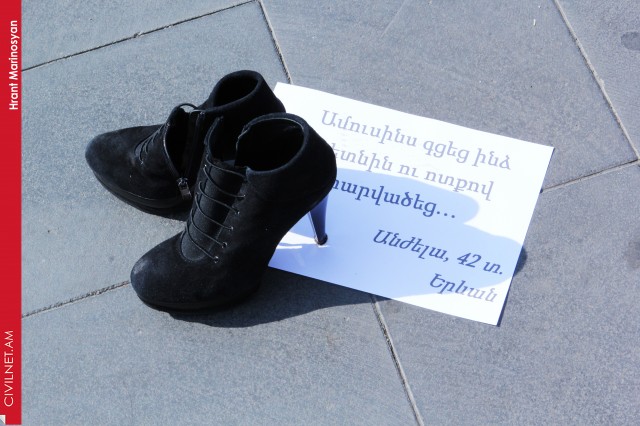
 A pair of shoes for each victim of domestic violence in Armenia. This one reads, "My husband threw me to the ground and began hitting me with his feet." Angela, 42 years-old, Yerevan.
October 1 has been selected as the National Day against Domestic Violence in Armenia. The date was chosen by the Coalition to Stop Violence Against Women in Armenia to commemorate the death of Zaruhi Petrosyan, who was killed on October 1st, 2010 by her husband.
Each year, the seven NGOs comprising the Coalition organize public events to raise awareness on the issue of domestic violence in the country, and to call on the government to take action.
In Armenia, domestic violence is a hushed topic, although several independent reports have found it to be a widespread issue across the country. According to survey data collected by Amnesty International in 2008, as many as one in four women may at some time experience physical violence at the hands of husbands. Maro Matosian, the executive director of the Women’s Support Center, says the estimates range up to 60% of women being abused by their partners. The sole sources for data concerning domestic violence in Armenia are surveys and estimations conducted by international organizations, NGOs or scholars.
There is a reason behind the lack of official government statistics concerning domestic violence in Armenia. Despite the active campaigning of several NGOs, and despite Armenia’s international obligations as a CEDAW signatory, Armenia still does not have a law specifically on domestic violence.
Several grassroots organizations are doing indispensable work - raising awareness, collecting data, assisting the survivors, but Armenia still desperately needs a legal framework if it wants to deal efficiently with domestic violence. At the moment, perpetrators can be held accountable under several provisions of the Armenian criminal code, and many cases that go to court are investigated on charges of “battery.”
The Importance of Semantics
Because of this legal vacuum, women who go to the police to report being abused by their partners often see their case reported by police officers as “family with conflict” - a confusing term that can also be used to define financial conflicts or inheritance disputes…. This semantic vagueness can be accounted, in part, for the lack of official data on domestic violence.A few years ago, departments with the specific aim of dealing with child welfare and domestic violence were created within the police and municipalities. But the absence of clear government guidelines, and the workers’ lack of training mean they are poorly equipped to efficiently handle cases of domestic violence. “Having no national legal framework means there is no standard operation procedures at any level,” outlined Maro Matosian.
One year ago, the Women’s Support Center helped draft a law on domestic violence, and made appropriate changes upon the government’s comments. Since then, the political process has come to a halt, and the law was never passed. Yet in the past three years, there has been a definite rise in media attention concerning domestic violence, in particular due to two very high profile court cases.
“As long as the victims are invisible, the extent of domestic violence in Armenia will not be known,” says Maro Matosian. The Coalition to Stop Violence Against Women in Armenia hopes that combined pressure from the media and civil society will eventually force lawmakers to act.
Many in Armenia and in the Diaspora still fail to comprehend the extent and gravity of domestic violence in the country. Armenians are likely to perceive themselves as “family-minded;” strong family bonds are considered a central feature in Armenian society. Yet according to an Amnesty International report of 2008, this “hides an institutionalized culture of silence on violence within the family.”
Suffering in Silence
 Shoes symbolizing victims of domestic violence are placed in Republic Square on October 1, 2015, the National Day against Domestic Violence in Armenia.
Women abused by their partners are pressured to keep silent and not involve the authorities in “private” family matters. If they dare speak up and report their abusive husbands, they are sometimes accused to be the one pulling their family apart. In some cases, “women are deterred from leaving their partners because they think their children should grow up with a father, no matter how violent and abusive he is,” explains Matosian.
The consequences of intimate partner violence are devastating for the whole family. Research shows that domestic violence has a traumatizing psychological impact on children witnessing it. When they see humiliations, threats and battery being part of their parents’ daily life, there is a risk that the children, and especially boys, might emulate that behavior later in life with their own partner, thus continuing an unhealthy cycle of violence. In Armenia, this risk is particularly heightened, as abusive husbands tend to put pressure to keep custody of the male children when the mother wants to separate.
“Domestic violence is fueled by gender stereotypes, and a culture of violence,” explains Maro Matosian. “It is all about power and control over the victim, and that control is made possible by gender inequality.” She also outlines that the issue has been emphasized right after Armenia’s independence. “When the Soviet Union collapsed, all the structures collapsed with it – there was no more surveillance, no more law enforcement, no rule of law, and bizarre habits resurfaced.”
Breakdown of Values
The OSCE’s domestic violence survey from 2011 offers a similar analysis: “The collapse of the value system existing in the Soviet society […] brought about an anomie and a sharp increase in the dynamics of violent crime.” An anomie is defined as a period of social instability resulting from a breakdown of standards and values. In Armenia, the disappearance of norms established during the Soviet Union produced this period of deep instability, in which individuals were provided little moral guidance from society and reprehensible behaviours flourished. The downfall of the economy in the 90s also meant that women found it difficult to get a job outside the home, or could only secure blue-collar jobs, typically with very low salaries. They could no longer benefit from the social services of the Soviet times; their financial dependence to their husbands increased, making them more vulnerable.“There are many forms of domestic violence,” explains Maro. “But all cases of physical abuse also have an emotional abuse and sexual abuse component.” Psychological abuse can include belittling, isolating the victim from her network of friends and family, controlling her whereabouts, gas lighting (or “mind games”), with power being the ultimate goal of the abuser. “Surveys indicate that up to 12% of domestic violence in Armenia is life-threatening,” specifies Maro Matosian.
“What the abusers take away, we help reconstruct.”There are structures in Armenia to support the survivors of domestic violence, protect them and help them rebuild their lives. Those structures are typically NGOs, either grassroots associations or privately funded organizations, and sometimes struggle to secure funding. Amnesty International reports that a few domestic violence hotlines, centers and shelters opened in the last few years, just to be closed down several months later for lack of funding.
Among them, the Women’s Support Center (WSC), a Yerevan-based NGO, has managed to stay afloat. They provide a safe environment for victims of domestic violence, where they can get legal, social and medical assistance if needed. The WSC also provides safety for survivors of abuse by offering them to stay at a shelter or “safe house” - a temporary place for them to get back on their feet. Through posters and media announcements, the NGO managed to get its message across to hundreds of women in dangerous situations. “We now get around 90 phone calls a month,” says Matosian, “and the numbers keep on rising.”
Their work method with victims follows the standard model of empowerment. “What the abusers take away, we help reconstruct.” For the survivors, it means that after months or years of isolation they start restoring their social life, and start to see a way out after seemingly hitting rock bottom.
Breaking the Cycle of Violence
At the WSC, survivors can also participate in-group sessions and share their experiences with other women. There, they come to realize that the cycle of violence that they’ve endured – the controlling behavior, the forced isolation, the self-blaming, was by no means due to a wrongdoing on their part. “There is a special methodology to follow when dealing with a victim of domestic violence,” insists Maro. “The first step is to believe them, to empathize, and never judge.” Then the healing process can begin.The WSC tries to work as closely as possible with government agencies and social services providers to train them with this methodology, and increase the number of victims they can reach. They signed memorandums of understanding with the Ministry of Social Affairs, with the Defender’s office, with the police, and with city halls and marz offices around the country. But to really help victims at the top of their capacity, the WSC and the other NGOs forming the Coalition to Stop Violence Against Women in Armenia need the law to be on their side.
Today on Republic Square, the Coalition is organizing its annual event to inform the public about domestic violence, denounce it and help prevent it. It is also the occasion for all concerned citizens to call on the government to finally set up a plan for action: include provisions for domestic violence in the Armenian criminal code, allocate a budget to fight it, create procedures for social workers and police officers to efficiently detect and protect the victims. At 8PM tonight, the National Day against Domestic Violence will end in Republic Square with a vigil in memory of the victims.
Charlotte Poulain



 Stories