Several Azerbaijanis Attempt to Destroy Armenian Artwork at the Beijing Biennale
 Civilnet
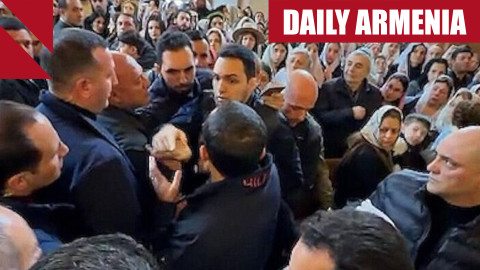
 Three Azerbaijanis have attempted to destroy Armenian artwork on display at the 6th Beijing International Art Biennale on September 24.
According to Anna Gargarian, the curator of the Armenian pavilion, three Azerbaijani men posing as officials came to the pavilion and tried to destroy artwork by well known Armenian artist Karen Mirzoyan.
The organizers of the Beijing Biennale have decided to temporarily shut down the Armenian pavilion for security reasons. According to CivilNet’s sources, the Armenian Embassy in Beijing is trying to resolve the issue.
On September 24, the Armenian pavilion opened its gates to visitors at the Beijing International Art Biennale. Created in 2003, the Beijing Biennale is a relatively new international event in the arts scene.
It was originally implemented as part of a national initiative to open China to the rest of the world. Since its first edition, the Beijing Biennale gradually grew to become a major event in the contemporary arts world, with over a hundred artists from all around the world participating this year.
// (function(d, s, id) { var js, fjs = d.getElementsByTagName(s)[0]; if (d.getElementById(id)) return; js = d.createElement(s); js.id = id; js.src = "//connect.facebook.net/en_US/sdk.js#xfbml=1&version=v2.3"; fjs.parentNode.insertBefore(js, fjs);}(document, 'script', 'facebook-jssdk'));//
Azerbaijani officials creating probelems in the #Armenian pavilion at #beijing #international #biennalePosted by Dreamscapes - Beijing International Art Biennale on Wednesday, September 23, 2015
Five countries had been selected to showcase a special exhibit at the Biennale, Armenia among them. In the Armenian Pavilion, the Ministry of Culture of the Republic Armenia will present “Dreamscapes,” a special exhibition that explores the biennial theme “Memories and Dreams” through the metaphorical and physical landscape.
Despite the quality of the “Dreamscapes” artwork selection, and the close collaboration between the biennale organizers and the Armenian team over the last year, some of the content of the Armenian special exhibit seems to have stirred a controversy in China.
According to our information, the Chinese Ministry of Foreign Affairs had been putting pressure on the Biennale organizers to remove “sensitive words” like “massacre, Armenian genocide, mass atrocities” from both the catalogue of the biennale, and the exhibition itself.
The Biennale organizers were asked to modify wall captions under two of the artworks in the Armenian pavilion, and to edit Anna Gargarian’s preface about the Armenian special exhibition in the Biennale’s catalogue.
Ironically, upon being asked to purge her preface of any mention of the genocide, curator Anna Gargarian was told that “art is not politics” by her Beijing counterparts. “It is not a political exhibit at all”, she insists. “It’s not an offensive exhibition. It’s about how memory is linked to space and the environments we live in.”
The exhibit does not wield a political message on international recognition of the genocide, but rather focuses on how Armenian identity is made up of many different layers and subcultures. The Armenian global community has been able to maintain its sense of identity through prolific creative output. Our music, art, language and traditions have been the keystone to preserving and transmitting our cultural identity even while abroad. “We Armenians have a particular situation”, says Anna Gargarian. “We are global community – because of the genocide – which means that we have many different environments contributing to our sense of identity.”
Removing “sensitive words” from a caption can seriously undermine the public’s understanding of the art, as is the case with Hrair Sarkissian’s work “Construction” (2010). The internationally recognized photographer’s contribution for “Dreamscapes” is a series of images of different structures made of Kapla, toy wooden blocks of identical size and shape. The artist constructed from his imagination the houses of the village his grandfather was forced to flee during the Armenian Genocide in 1915.
“Sarkissian’s search for his grandfather’s home embodies not only his individual and family memory, but also the collective Armenian memory of a lost homeland,” underscores Anna Gargarian.


 Stories