 Civilnet
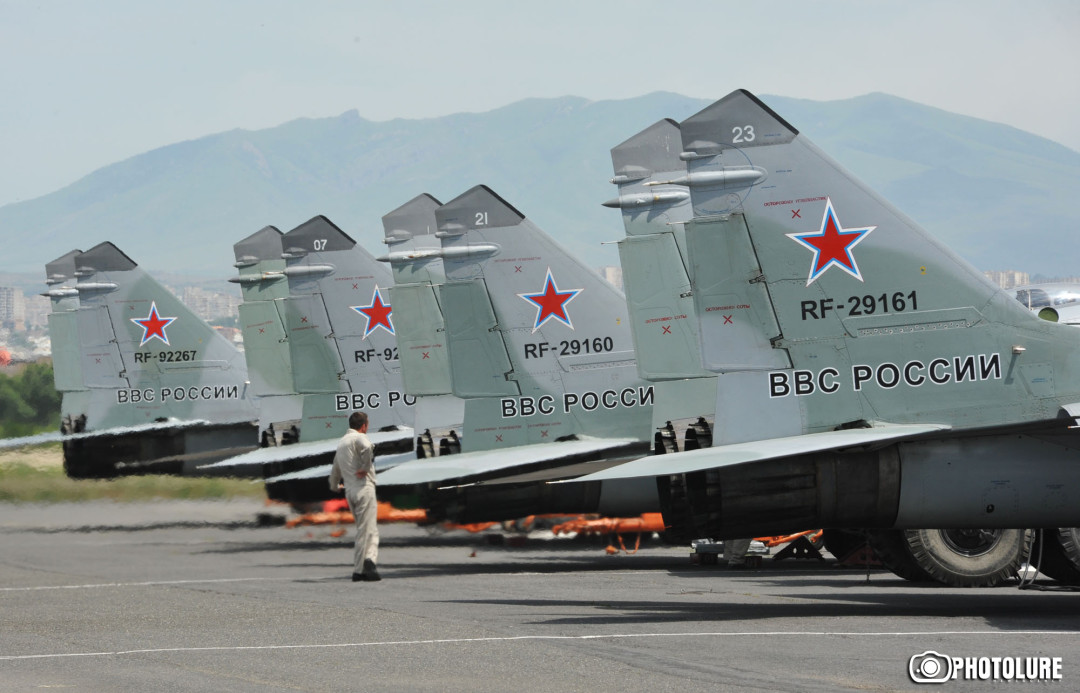
 Russian Military Jets in Gyumri, Armenia.
During a speech at the summit of the Collective Security Treaty Organization (CSTO), Serzh Sargsyan made an unexpected suggestion to strengthen the “peacekeeping component of the organization and create basic organization for preparing peacekeepers.”
This idea was also enshrined in the final statement of the summit adopted on September 15, which comes to prove that the issue had been agreed to well in advance.
A question arises -- where are CSTO peacekeeping forces going to be stationed? Peacekeeping operations are mainly conducted within the framework of the United Nations; Armenia also has a peacekeeping brigade as a contribution to UN peacekeeping efforts, and in this respect another question comes to mind -- what is the purpose of the creation and use of CSTO peacekeeping forces?
The success of peacekeeping is largely driven by the mandate, which is given by an organization with an unconditional international reputation. Any peacekeeping operation aspires to obtain the relevant resolution of the UN Security Council, to give the highest political legitimacy to the action. It is also important to take into consideration the security aspect of the peacekeeping operation - any threat or attack against peacekeepers can be considered an encroachment on the decision of the UN Security Council members and punitive measures will not wait long.
To understand the objective of Serzh Sargsyan's initiative, we need to answer the following questions:
- Who will authorize (give a mandate) a peacekeeping operation of CSTO?
- Where will CSTO’s peacekeepers be deployed?
- Why was it Serzh Sargsyan who made such a suggestion?
Apart from CSTO, other global or even regional organizations are unlikely to provide a mandate to CSTO’s peacekeeping operations. Taking into consideration the complexity of relations between Russia and other members of the UN Security Council, it's practically impossible to get a UN mandate.
The only location for a possible deployment of CSTO peacekeepers remains the territory of the member-states of the organization. Actually there is no possibility of deploying CSTO peacekeeping forces outside of the boundaries of the organization.
The most difficult question here is why Serzh Sargsyan made the suggestion. Sargsyan could not have been unaware of the answers to the first two questions, but nevertheless he made a suggestion which has a limited geographical application – given the existing realities today, CSTO peacekeepers can be placed only in Nagorno-Karabakh.
Serzh Sargsyan's suggestion becomes even more perplexing when we consider a by no means unimportant nuance. According to the suggestion, the peacekeeping organization will be created/trained on the basis of the Armenian Training Center for peacekeeping troops. It is important to mention that the center was established with the active support of the USA and NATO. Cooperation agenda was part of the Armenia-NATO Individual Partnership Action Plan, and the United States has provided a significant assistance to the Centre.
In 2004, for the first time ever, a platoon of the Armenian Peacekeeping Brigade was deployed as part of a NATO force to maintain stability and peace in Kosovo. Since that time, Armenia has deployed soldiers to support NATO peacekeeping operations in both Iraq and Afghanistan. In November of last year, Armenia sent troops to Lebanon as part of a UN International Peacekeeping Force. In 2013 Armenia has become a partner country in the U.S. Government-funded Global Peace Operations Initiative. The initiative aims to improve the capabilities of Armenia to contribute to UN peace operations. And now the largely U.S. and NATO-funded Training Center is being offered for the “establishment of a base organization for training CSTO peacekeepers.”
Over the past several weeks, Russia initiated active consultations with the parties having primary interest in the settlement process of the Nagorno-Karabakh conflict. On September 1, Russian Foreign Minister Sergey Lavrov visited Baku, a few days later, on September 7, Serzh Sargsyan met with Vladimir Putin in Moscow, a week ago, Lavrov held negotiations with his Turkish counterpart, who had arrived to Sochi concluding negotiations in Baku. Today, the Turkish President is visiting Russia. And Serzh Sargsyan’s initiative just followed his meeting with the Russian President.
Let us try to analyze the reasons for the initiative and consider possible approaches of the interested parties.
- Russia apparently is very much interested in Serzh Sargsyan's initiative, as the core of the peacekeepers should be the Russian forces. Presence of Russian peacekeepers in the conflict zone would definitely strengthen its positions in the South Caucasus;
- Conditionally Azerbaijan may also benefit from the presence of peacekeepers in the conflict zone. However, these conditions imply a significant change in the current status quo. It is possible that these changes were discussed in detail during the above mentioned meetings;
- Armenia could also be interested in a peacekeeping operation, if it does not imply any change in the layouts of the forces. Against this background, we believe that Serzh Sargsyan shouldn't have been the first person to speak about the CSTO peacekeeping component, leaving it to the “interested” sides;
- The US and France, the co-chairs of OSCE Minsk Group. At least twice, the State Department and the U.S. Co-Chair of the Minsk Group spoke about the escalation of tension on the Line of Contact and urged the sides to refrain from military actions. Certainly the Co-chairs are closely following the developments and they will issue a statement after the meeting of the foreign ministers of Armenia and Azerbaijan in New York this week;
- Turkey, who has recently increased its role in the Nagorno-Karabakh conflict settlement process, will surely support Azerbaijan’s position. To a great extent, Turkey would hardly welcome such a strengthening of Russia's positions in the South Caucasus.
Now it is up to Russia to decide the importance of becoming a “main mediator” for the conflict and therefore to what extent it may agree to Azerbaijan's demands. Taking into consideration the continuing immigration from Armenia, economic decline and Serzh Sargsyan's deepening international isolation, Azerbaijan most probably will reject the initiative or will demand a high price from Russia.
The issue is becoming more complicated due to the actual absence of the document for negotiation. Since 2011, the authentic version of the Madrid document (presented to the sides in 2007) doesn`t exist as a main paper for negotiation. And the so-called updated version of the Madrid document (which first appeared in 2011) is not recognized by the Armenian side. Such a fragmented peace process is hardly conducive for a breakthrough in the negotiations. Against this background the meeting between the foreign ministers of Armenia and Azerbaijan in New York acquires additional importance.
Vladimir KarapetyanChairman, Foreign Relations Committee, Armenian National CongressFormer Spokesperson of the Ministry of Foreign Affairs

 Stories