 Civilnet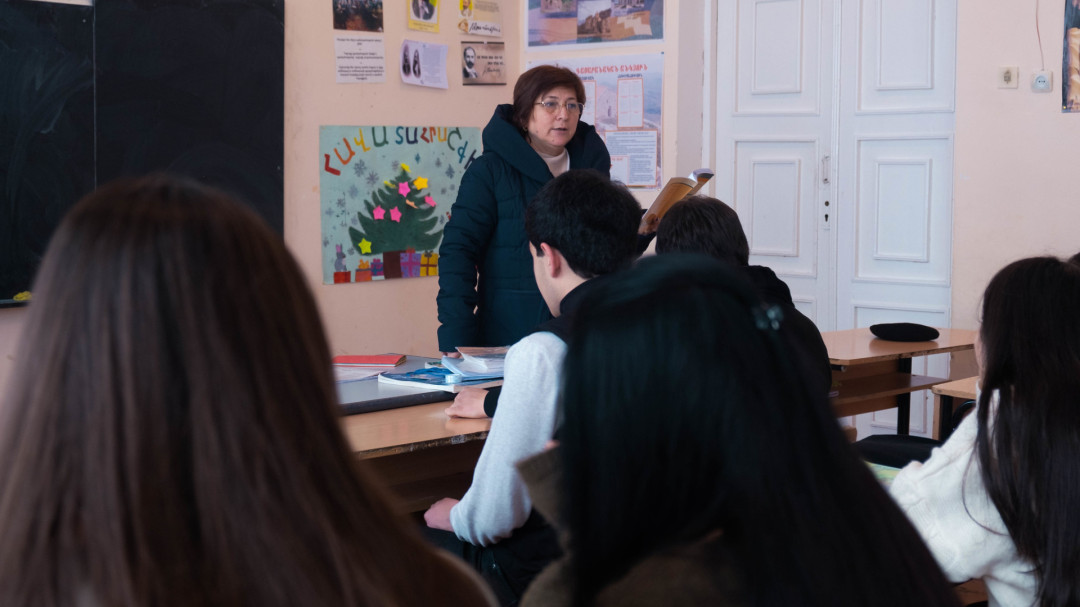
By Lia Avagyan
Around the world, the teaching profession is overwhelmingly dominated by women. According to data from the Statistical Committee of Armenia, as of the 2023-2024 academic year, the country had approximately 29,000 teachers, with women making up 89.5%. While these numbers provide clear evidence of the gender disparity in schools, they do not explain why or how teaching became a predominantly female profession.
In The Teacher, a Woman: Fused Personal and Contested Professional Biographies study, Sociologist Sona Balasanyan argues that in Armenia, the role of a teacher is often perceived as an extension of caregiving rather than a purely educational function. Given the global expectation that caregiving is a woman's duty, teaching has naturally become a “woman’s job.”
However, this raises an important question: Are women overrepresented in the teaching profession because they are seen as better caregivers, or because men are unwilling to work for the salaries offered in education?
The financial challenge of teaching
Garik Tsatryan, a history teacher with 15 years of experience, has frequently heard parents of his students express both admiration and concern: “Why would a skilled professional stay in this job with such low pay?” He himself has wrestled with this question. Despite his love for teaching, he has tried alternative jobs to compare income levels. At one point, he worked six-hour shifts as a waiter’s assistant at a café, earning the same salary as he did at school.
“In one job, I was dealing with fries and sandwiches; in the other, with children’s futures,” he remarked.
This mismatch between responsibility and remuneration discourages many from staying in the field. In Armenia, education ranks as the third lowest-paid sector for men and the fifth lowest for women.
Many male teachers, unable to support themselves and their families on their school salaries, are forced to take on additional jobs. Tsatryan, for example, has worked as a tour guide and private tutor. He eventually found a way to balance his passion and financial needs by joining the Teach for Armenia program, where he now works as a leadership development coordinator. However, he notes that most dedicated teachers do not have this opportunity and often leave the profession. “I have a friend who taught geography at a school while also working as a store clerk. In the end, he left teaching because the store offered a better financial future. Many men simply seek other jobs because, at the end of the day, they are expected to provide for their families.”
Currently, there are only about 3,035 male teachers in Armenia, and Tsatryan doubts this number will grow. He believes the educational process will continue to rest largely on women’s shoulders.
Not all breadwinners are men
For many women, teaching is not just a secondary income but their primary means of supporting their families. Mary Avagyan, a teacher with 26 years of experience, earns $330 per month. While this is considered a high salary in her profession due to her long tenure, she still struggles financially.
Avagyan teaches at a vocational school in Yerevan, where the standard workload is 18 hours per week, with a maximum possible load of 1.5 times that amount. Depending on the academic term, she teaches between 23 to 25 hours per week, though many teachers work fewer hours and earn even less.
She dismisses traditional stereotypes about why women dominate the teaching profession: “People assume this is an ideal job for women—working in an all-female environment where husbands won’t be jealous, having a short workday to balance household chores, and earning a small ‘pocket money’ salary. But that’s not my reality.” As a single mother, she is the sole provider for her child, who is in the second grade. “Prices are rising, my child’s needs are growing, but my salary has remained unchanged for 10 years. I love my job, but if I find a better opportunity, I will leave.”
Like many teachers, Avagyan once worked a second job, spending nights at a pastry factory and mornings in the classroom. However, with increased demands from both her job and her child, she can no longer manage multiple roles. “If I tried to combine jobs now, my work and my family would both suffer.”
Government promises and reality
Education policymakers insist that teachers deserve dignified salaries, and some reforms have been introduced. According to the Ministry of Education, the minimum teacher salary has been raised to 119,000 AMD (around $300). However, many argue that this is still insufficient, considering the responsibilities involved.
Garik Tsatryan stresses that teaching extends beyond classroom hours. “Many dedicated teachers spend additional time at home preparing lessons, printing extra materials, creating tests, and designing interactive activities to engage students. This work is unpaid but essential.”
For teachers like Avagyan, the challenges are even greater. She teaches subjects for which there are no Armenian-language textbooks, requiring her to search for, translate, and adapt content herself. “Continuous self-education is necessary, but it’s demoralizing when our extra work isn’t even acknowledged,” she says.
While new assessment mechanisms aim to improve the situation, Avagyan believes they are only partial solutions. Reflecting on her struggles, she jokingly blames her supportive colleagues for keeping her in the profession: “If my workplace wasn’t such a positive environment, I might have left earlier for a better-paying job.
”This article is based on a report by Ampop Media, authored by Arusyak Kapukchyan.



 Stories