 Civilnet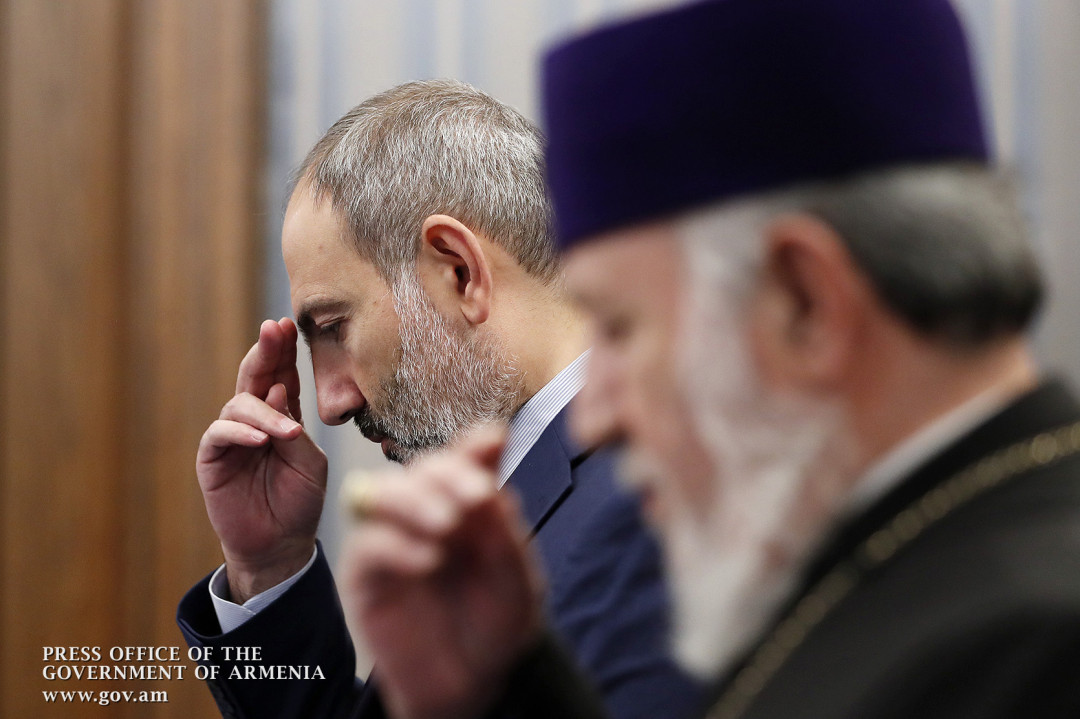
By Alexander Pracht
Tensions between Armenia’s Prime Minister Nikol Pashinyan and the Armenian Apostolic Church reignited last week after Pashinyan launched a profanity-laced tirade against the Church and its clergy. The confrontation, simmering for years, flared up during a government session on Thursday when Pashinyan abruptly turned a routine speech into an attack on Church leaders.
The following morning, he and his wife, Anna Hakobyan, escalated the rhetoric online, accusing specific clergy, most notably Hovnan Hakobyan, Primate of the Gougark Diocese in northern Armenia, of violating their celibacy vows and calling for defrocking priests found in violation.
The Church responded swiftly as Bishop Hakobyan called the prime minister “deranged,” while others warned of the dangerous precedent set by targeting religious institutions with personal accusations and threats.
Later on Monday, Prime Minister Nikol Pashinyan publicly targeted Catholicos Karekin II in a Facebook post.
“If it turns out that Karekin II has broken celibacy and has a child, he can't be Catholicos. I state this with full respect for everyone’s right to personal and family privacy,” Pashinyan wrote, “but the Catholicos of All Armenians cannot have this kind of personal life. I raise the issue as a follower of the Armenian Apostolic Church because I see a spiritual security issue, and also as the Prime Minister of Armenia because I see a state security issue. The Mother See of Holy Etchmiadzin must take a position on this situation, after which the matter will be further clarified,” he concluded.
While Armenian clerics in lower ranks are allowed to marry and have children, the Catholicos is expected to remain celibate. Pashinyan, however, did not provide any evidence that Karekin II had broken his vows.
The latest clash comes amid a broader deterioration in Church-government relations. After Armenia’s defeat in the 2020 war, Church leaders openly urged Pashinyan to resign. Last year, Archbishop Bagrat Galstanyan led a nationwide protest movement, also demanding the prime minister’s ouster.
Since then, the government has questioned the Church’s legal and financial privileges. Parliament Speaker Alen Simonyan suggested last year that the Church should be exempt from taxation only if it complied with stricter oversight, citing “widespread shadow incomes.” Just this past Friday, Pashinyan proposed that future candidates for Catholicos undergo background checks.
For writer and commentator Karpis Pashoyan, the government’s recent tone reflects a dangerous collapse of institutional boundaries. “The current government often treats the Church as an opposition force by default and considers it not just a religious body, but a political actor,” he said in an interview with CivilNet, published Friday. “However, the Church is not a monolithic or neutral institution; it’s part of public life and cannot remain indifferent to developments in the country.”
While Pashoyan is no defender of clerical power and has openly criticized the Church’s leadership in the past, he argued that Catholicos Karekin II is not a confrontational figure. “He has no major political ambitions. That’s why dialogue with him is possible. Even after serious confrontations, he invited Pashinyan to the opening of the [newly-renovated Etchmiadzin] cathedral [last fall]. That was a signal: the bridges haven’t been burned.”
To Pashoyan, the ongoing public feud is about how Armenia negotiates power, faith, and dissent. “This is a crisis of content,” he said. “People are responding with emotion rather than ideas. Politics has turned into emotion, not reason.”
Recent polling by the Caucasus Barometer demonstrated the public’s lingering trust in the Church. It ranks as the most trusted institution in Armenia, far ahead of political parties, government bodies, and the media.
Pashoyan pointed this out as proof that institutions like the Church serve a broader social function, even despite being imperfect. The Church is still trying: it invites officials, reaches out, but there’s no will so far on the other side. “For now, the red lines have completely vanished. But we live in an absurd reality. One day, the Church and the government might find common ground again,” he concluded.



 Stories