 Civilnet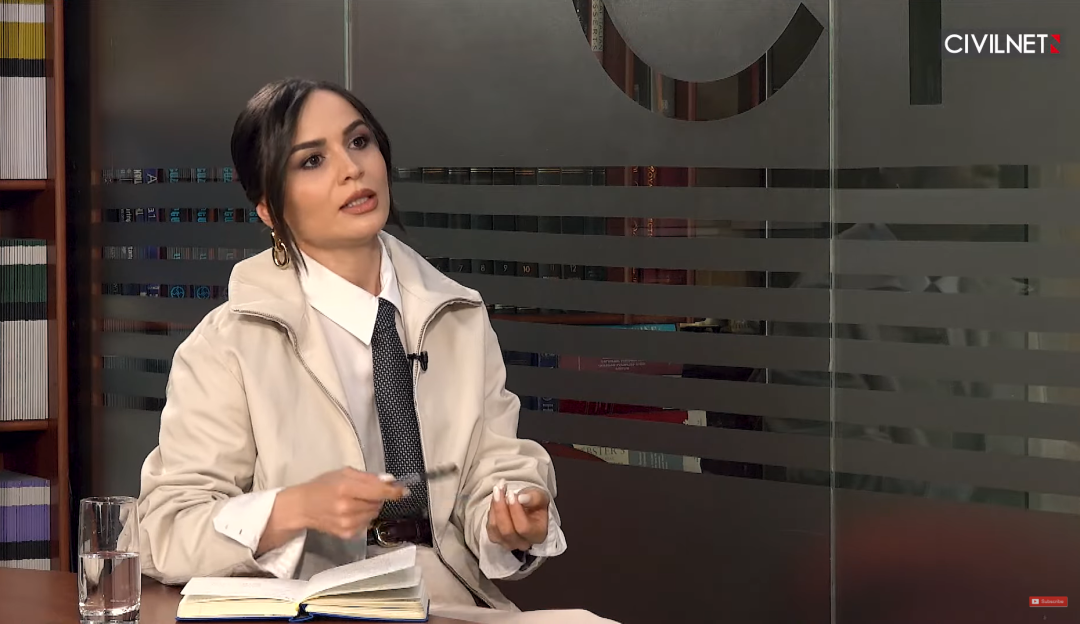
By Arshaluis Mgdesyan
Armenia should focus on deepening integration with the European Union rather than pursuing full membership, according to European integration expert Mane Adamyan. In an interview with CivilNet, Adamyan described the recent law on EU accession as serving primarily domestic political objectives.
"In my opinion, the decision made by the authorities to vote in favor of the law was serving a domestic political agenda, considering that these authorities have done significant work to deepen relations with the European Union," Adamyan said in the interview.
Armenia's parliament fully approved a bill on launching the country's European Union membership process on March 26, after it was introduced following an initiative by the civil movement Eurovote that collected 60,000 signatures. Prime Minister Nikol Pashinyan supported the legislation while cautioning that a formal application would require a nationwide referendum.
Adamyan, who previously worked as an advisor to Deputy Prime Minister Mher Grigoryan and now serves as an independent expert on EU projects, suggested that Armenian authorities feared political consequences if they opposed the legislation.
"They were afraid that if they voted against it, they would cease to be perceived as offering an alternative to Russia, including in terms of foreign policy, economic policy, and security policy priorities," she said.
According to Adamyan, Armenia is not ready for EU membership discussions and should instead pursue a model similar to Switzerland, Norway, and Iceland, which are deeply integrated with the European Union without being members.
"We cannot distinguish between two things when formulating our foreign policy: EU membership or the desire for membership, and our integration with the European Union. These are two very different things, and I believe Armenia should be talking about integration with the European Union," she emphasized.
The expert warned that EU membership would require Armenia to join sanctions against its neighbors Russia and Iran, something she believes has not been properly explained to the Armenian public.
"We're not just talking about leaving the Eurasian Economic Union; we're talking about joining sanctions against Russia, we're talking about joining sanctions against Iran," Adamyan said. "Democracy doesn't mean simply presenting a question to the public with two alternatives in a very one-sided way and then saying 'well, this is what the public wanted.' The full implications of European Union membership haven't been presented to the public."
Armenia's geographic location and geopolitical predicaments make integration rather than membership the only realistic path forward, according to Adamyan.
"I believe this is Armenia's path because it's the only path that will allow us, given our geography and geopolitical relationships from which we have no escape, to maneuver in certain areas while recognizing static factors, including our geography and neighboring countries," she said.
Armenia has yet to fully implement the Comprehensive and Enhanced Partnership Agreement (CEPA) with the EU, with only "over 50 percent" of its provisions considered implemented, according to the latest assessment. Signed in November 2017, CEPA aims to strengthen political and economic ties between Armenia and the European Union through reforms in areas such as justice, rule of law, and market regulation. Adamyan noted that implementation is in progress for about 20% of provisions, while "absolutely no work had been done" on approximately 4–5% of provisions.
The expert described CEPA implementation as technically challenging. "Often these documents are called directives, and they're legislative acts that we need to approximate. They're often written in such complex language that we sometimes have difficulty engaging experts from the European Union," she said, adding that it can take "months, sometimes even a year" to find appropriate experts.
Following the bill's passage, the European Union's Commissioner for Enlargement, Marta Kos, announced that the EU will thoroughly examine Armenia's potential membership application as the country takes significant steps toward initiating its EU accession process.
Meanwhile, Moscow has been critical of Armenia's EU aspirations, with Russian Foreign Minister Sergey Lavrov warning in January that Armenia's bid for EU membership would require it to leave the Russian-led Eurasian Economic Union and would lead to major price increases across all sectors.
Adamyan cautioned that political trends within the EU itself might make expansion increasingly difficult. "Taking into account these trends, I believe this process will continue to become even more complex, generating internal debates within the EU in light of stricter processes, and we certainly cannot expect simplifications, but quite the opposite," she concluded.



 Stories