 Civilnet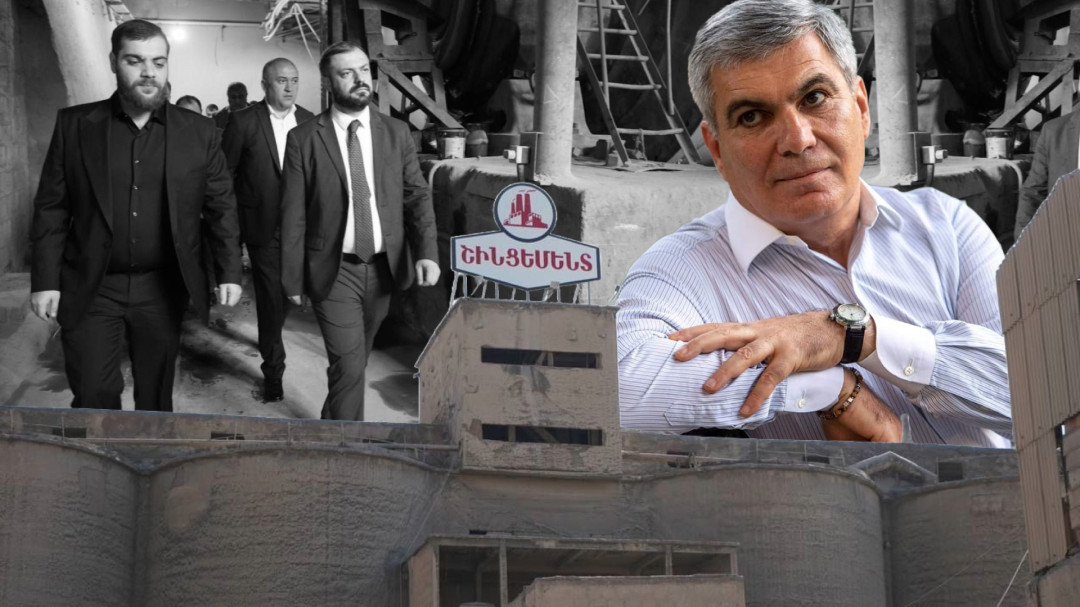
By Gevorg Tosunyan
Armenia’s parliament approved a government-backed bill last month, quadrupling the state import duty on cement, while keeping the import duty on clinker, the raw material used to produce cement, at zero. The move has since raised questions over possible business advantages for a company co-owned by the son of a prominent political figure allied with the ruling party.
The National Assembly passed amendments to the Law on State Duties on May 29, raising the import fee on cement from roughly $5 to $20 AMD per 100 tons. The country’s Economy Ministry argued the measure was necessary to protect local producers from competition with cheap cement from neighboring Iran, where prices have recently dropped sharply. Currently, Iranian cement sells for about $76 per ton in Yerevan, while the domestic cost of production ranges between $110 and $115, excluding VAT.
The measure favored local cement producers that import clinker duty-free and process it domestically, particularly the Shincement company, which is 50% owned by Gurgen Sargsyan, son of Aram Sargsyan, former prime minister and leader of the Republic Party which has no seats in parliament but is a coalition partner of the ruling Civil Contract party on Yerevan’s city council. Aram Sargsyan is a vocal supporter of the government on various issues.
According to the Economy Ministry, only two companies currently import clinker into Armenia: Shincement and Homol LLC. Shincement, founded in 2018, has significantly stepped up its operations in recent years, increasing tax payments from $0.8M in 2019 to $3.6M in 2024. The company produces about 15% of Armenia’s cement and now operates three mills, importing over 200,000 tons of clinker annually.
The other clinker importer, Homol, has a low public profile and has not ranked among the country’s top 1,000 taxpayers since 2018. Its sole shareholder is Aram Arakelyan, a little-known businessman.
The new legislation prompted criticism during parliamentary debate from both opposition and some ruling party lawmakers, who raised concerns about unequal market conditions. The law nonetheless passed with full support from the ruling Civil Contract faction.
Cement manufacturer Araratcement relies solely on domestically sourced materials and does not import clinker. CivilNet reached out to the company for comment but has so far not received a response.
The policy shift also follows a visit by Economy Minister Gevorg Papoyan to the Shincement factory earlier in March, accompanied by Deputy Minister Edgar Zakaryan and co-owner Gurgen Sargsyan. According to the official statement, the visit aimed to assess production expansion, with Shincement reportedly planning to triple its output.
The Economy Ministry has also indicated that a new player, Dragman LLC, is entering the clinker processing market. The company is majority-owned by David Sedrakyan, son of former Republican Party (not to be confused with the Republic Party) MP Mher Sedrakyan.
Responding to CivilNet’s inquiry, Aram Sargsyan denied any wrongdoing or special treatment for his son’s business. He argued that clinker-based cement production is more costly due to Armenia’s higher energy and additive prices, and that the zero import duty on clinker does not create unfair advantages.
Sargsyan also emphasized that his party’s cooperation with the Civil Contract in Yerevan’s city council had “a purely political objective to prevent pro-Russian forces from taking control of the capital.” He also stressed he does not interfere in his son’s business affairs.
Sargsyan further claimed that the import of clinker supports healthy market competition. “Clinker is a basic commodity that is being turned into a finished product in Armenia. This should be encouraged,” he said. “More than a dozen companies process clinker, and I’m proud my son’s company is among the top taxpayers.”
CivilNet has requested import volume data from Armenia’s State Revenue Committee to better assess the impact of the recent policy changes.



 Stories