 Civilnet
By Alexander Pracht
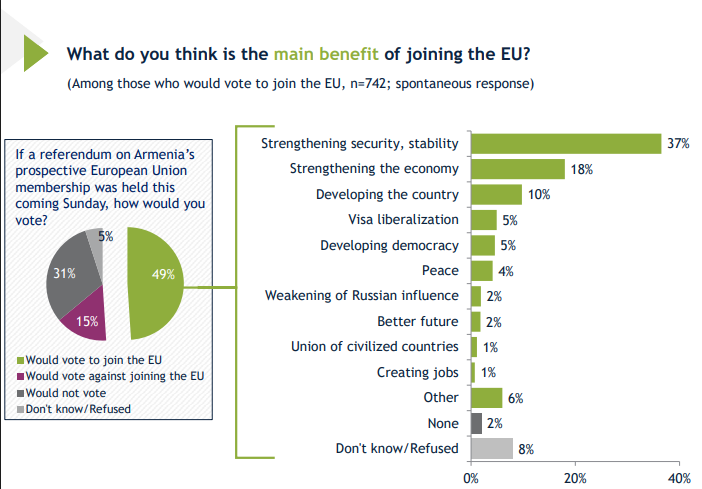
Nearly half of Armenians, 49%, say they would vote in favor of joining the European Union if a referendum were held next Sunday, according to a new nationwide survey conducted by the U.S. International Republican Institute between June 16 and 26 among 1,505 respondents, published Monday.
Asked about their primary motivation, most pro-EU respondents (37%) cited improved security and stability as the main benefit of accession, a consistent trend seen in previous years. Only 18% said their main reason would be strengthening the country’s economy, a figure reflecting the limited public discourse around potential economic impacts of EU membership. Instead, EU countries are often perceived as well-protected and safe, even invulnerable to foreign aggression, an image that appeals to many in Armenia’s current security environment. Just 5% each pointed to better prospects for democracy or easier travel to Europe.
Support for EU membership, however, has dropped from 58% recorded in IRI’s previous poll conducted in September 2024, when public attention was high due to the Eurovote campaign, a grassroots initiative that collected signatures calling on Armenia to apply for EU membership. That petition was later accepted by parliament and enshrined into law in February.
Opposition to EU accession rose slightly to 15% from 13%, while the share of undecided voters grew from 25% to 31%, suggesting a cooling-off period after the Eurovote campaign’s initial momentum.
Support for EU integration is strong both in Yerevan (52%) and rural areas (49%), but age differences are striking. Sixty percent of people aged 56 and older said they would vote “yes” in a referendum, compared to just 42% of those under 35. The generational gap echoes remarks made last September by Tigran Khzmalyan, one of the leaders of the Eurovote initiative. “People of my age have provided most of the signatures so far. The young people seem indifferent to our cause,” he told CivilNet at the time.
Among those opposing EU membership, the most commonly cited reasons were concerns over the “deterioration of Armenian family norms” and preserving national identity (14% each), followed by a desire to avoid “angering Russia” (8%).
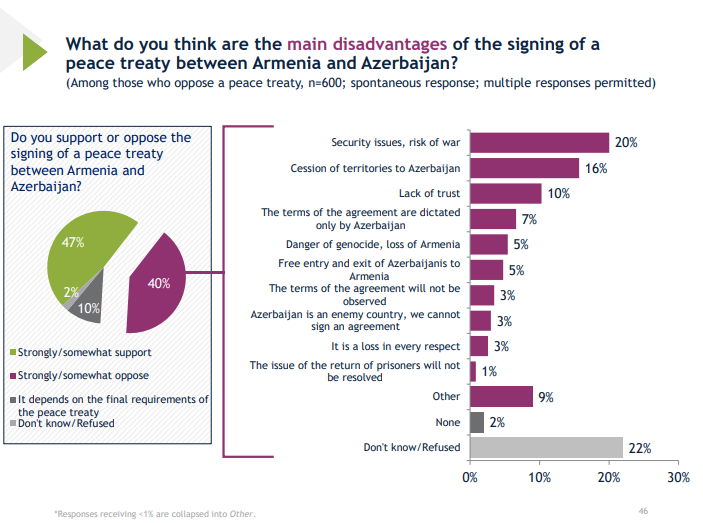
On other foreign policy issues, 47% of respondents said they support signing a peace treaty with Azerbaijan, while 40% were opposed. Again, older citizens were more in favor of a deal (56% support among those 56 and older), whereas only 38% of respondents under 35 supported such an agreement.
The top concerns among skeptics were potential new security risks (20%), fears that the treaty would lead to land concessions (16%), and the lack of trust (10%).
Azerbaijan remains the top perceived threat to Armenia, named by 87% of respondents. However, perceptions of Turkey have shifted somewhat: while 65% still describe relations as bad, a record low, 30% now say ties with Ankara are good, a record high.
When asked about Armenia’s broader geopolitical alignment, 45% said the country should follow a pro-Western course, though two-thirds of that group emphasized the importance of maintaining ties with Russia. Meanwhile, 34% said Armenia should adopt a more pro-Russian policy, with most of them also favoring balanced engagement with the West.
Public perception of Armenia-Russia relations has worsened notably: 55% now describe the relationship as bad, compared to 43% who see it as good. Back in 2019, that figure was nearly unanimous as 93% rated the relationship with Moscow positively.
The growing disillusionment with Russia among Armenians was triggered by Azerbaijan’s September 2022 invasion of Armenia’s internationally recognized territory, when the Russian-led Collective Security Treaty Organization alliance, to which Armenia remains a member, declined to intervene despite its mutual defense clause that considers an attack on one member an attack on all.
The rupture widened further in 2023, after Russian peacekeepers stationed in Nagorno-Karabakh failed to act during Azerbaijan’s military assault that led to the ethnic cleansing of the region and the complete exodus of its Armenian population. Russia’s unwillingness to honor its security commitments has contributed to its declining influence in the South Caucasus and a notable shift in Armenia’s foreign policy orientation toward the West.




 Stories