 Civilnet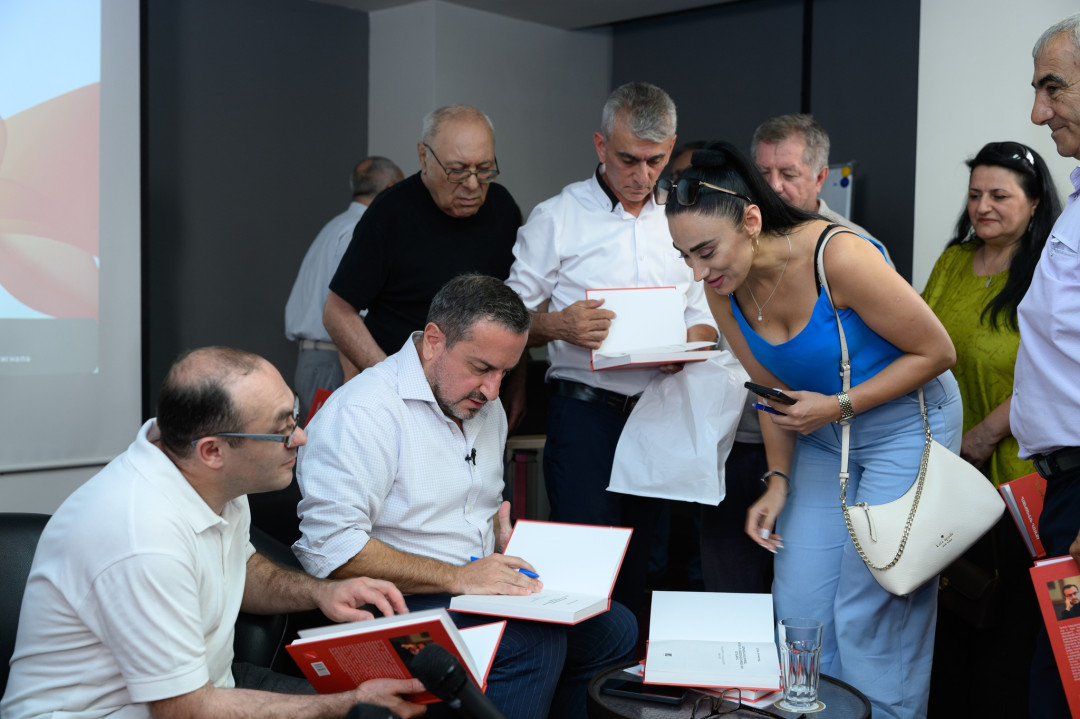
By Karen Harutyunyan
“One side reduces politics to Nzhdeh-style laments and fantasies about the Armenian Cause. The other substitutes democratic clichés and illusions of Western rescue for serious thought. They appear to be enemies, but are actually twins—both hostile to realism.”
With this sweeping indictment of Armenia’s political discourse, Arman Grigoryan, professor of international relations at Lehigh University, set the tone for the launch of his new book Between the Hammer of Nationalism and the Anvil of Liberalism in Yerevan on Wednesday. The volume is a curated collection of essays and interviews written between 1998 and 2025, addressing themes of war, diplomacy, identity, and ideology across nearly three decades of Armenia’s modern history.
The event drew a standing-room-only crowd and was hosted by journalist and Aravot online editor Anna Israelyan, who also led a Q&A session with the author. Grigoryan opened the evening by reading the book’s preface and offering a broader assessment of the intellectual atmosphere in Armenia—one he described as “trapped in an iron cage” of false choices.
“This collection is a modest attempt to break that cage,” he said, “and to revive a rationalist tradition that has all but disappeared from Armenian public life.”
Breaking the Binary
At the heart of Grigoryan’s critique is the argument that Armenian political thought is dominated by two shallow and mutually reinforcing ideologies: a romantic nationalism rooted in myth and martyrdom, and a hollow liberalism echoing Western slogans without substance or strategy.
He described both as “philosophically and methodologically identical in their denial of reality,” noting that each side casts the other as treacherous while failing to produce viable alternatives to Armenia’s strategic dilemmas.
Instead, Grigoryan advocates for a “third position” grounded in realism and rationalism—an approach that prioritizes capabilities over aspirations, accepts the limits imposed by geopolitics, and avoids moral grandstanding.
“We have reduced every debate to a test of loyalty,” he said. “You’re either a patriot or a traitor, a Kremlin agent or a liberal savior. There’s no space left for thinking.”
Russia in the Region: Forecasts and Limits
In the Q&A session, Grigoryan elaborated on his long-standing analysis of Russia’s role in the South Caucasus, describing Moscow’s policy as one of instrumental pragmatism.
“Russia’s goal in the region is to maintain maximum control at minimum cost,” he said. “Its alliances are conditional, its security guarantees transactional.”
He emphasized that Russia’s relationship with Armenia has always been shaped by strategic calculus, not sentiment, and warned against both vilifying and romanticizing Moscow.
“Our debates around Russia swing wildly between betrayal and blind faith,” he said. “Neither is useful. What we need is strategic clarity.”
Grigoryan urged Armenian policymakers to treat all external actors—including the West—with the same realist lens.
Holding Pashinyan to Account
Grigoryan offered a harsh assessment of Prime Minister Nikol Pashinyan’s government, especially its framing of the 2023 loss of Artsakh as a “restoration of sovereignty.”
“I never imagined Armenian leaders would describe the ethnic cleansing of Artsakh as the true realization of independence,” he said. “That’s not just cynical—it’s dangerous.”
He argued that the Pashinyan administration has compounded Armenia’s security vulnerabilities by simultaneously weakening traditional alliances and failing to secure credible new guarantees.
“You can’t exit a security framework and still expect its benefits,” he said. “Strategic realignment without preparation is not reform—it’s exposure.”
Peace and Missed Opportunities
A central theme of Grigoryan’s book, echoed throughout the evening, is that Armenia has repeatedly missed opportunities for a negotiated peace by clinging to maximalist goals or unrealistic assumptions.
He argued that earlier proposals—particularly in the late 1990s—offered imperfect but credible international guarantees that could have prevented the disastrous outcomes of 2020 and beyond.
“We went from being a negotiating party with leverage to a defeated actor without agency,” he said.
Grigoryan acknowledged that no diplomatic guarantee is ever absolute, but insisted that discounting partial guarantees in search of perfection was a strategic mistake.
“Diplomacy is never 100%,” he said. “If you wait for certainty, you’ll wait until your position collapses.”
Turkey, Liberalism, and Consistency
Asked about his earlier writings on Turkish-Armenian normalization, Grigoryan reaffirmed his support in principle but emphasized that timing and context are crucial.
While he supported normalization in a 2015 Washington Post op-ed, he warned that postwar overtures—made after military defeat and under growing Azerbaijani pressure—cannot be viewed in the same light.
“What’s happening now is not normalization—it’s capitulation,” he said. “It’s being done not from a position of strength or strategy, but from exhaustion.”
He also criticized the current government for making that pivot after years of anti-Turkish rhetoric, calling the reversal not just inconsistent but strategically incoherent.
Defending the Realist Tradition
Grigoryan closed the event by paying tribute to the intellectual tradition of rationalism and realism that briefly gained ground in Armenia during the late 1980s.
“This book is for those who still believe ideas matter,” he said. “Not slogans. Not rituals. Ideas.”
He positioned Between the Hammer of Nationalism and the Anvil of Liberalism as an attempt to reopen a space for strategic thinking in a political culture that often punishes nuance and rewards certainty.
“We’re in a moment when shouting is easier than thinking,” he said. “This book is my way of refusing to be silent.”
Between the Hammer of Nationalism and the Anvil of Liberalism («Ազգայնականության մուրճի ու ազատականության սալի արանքում») is now available in Armenian bookstores.

 Stories