 Civilnet
By Lusine Vardanyan
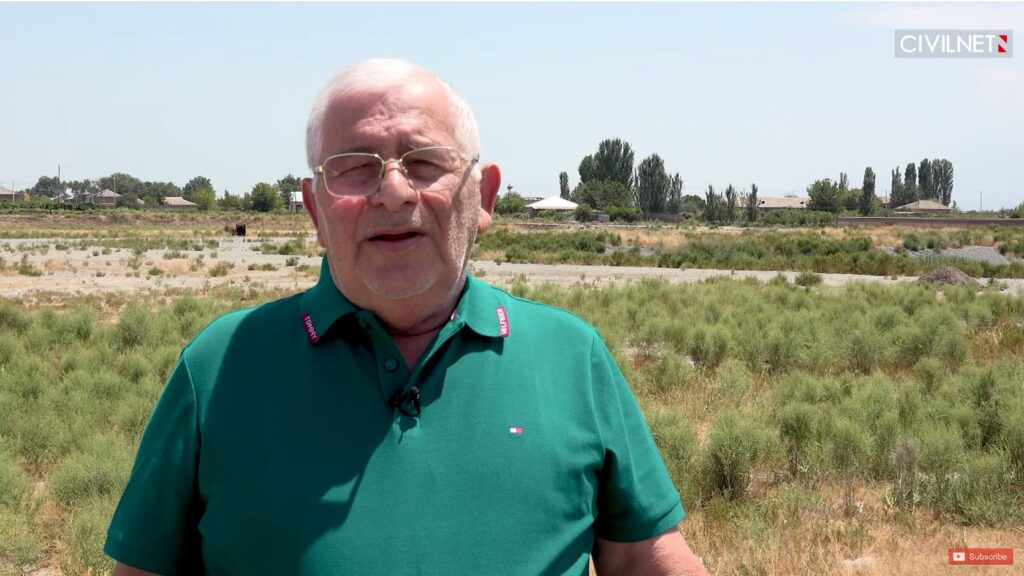
“About 150 hectares here are saline,” says farmer Samvel Aghajanyan in Zartonq village. “Thirty percent severely, seventy percent moderately. Until today, we cannot cultivate these soils because the necessary material does not exist.”
From a distance, the land looks covered in frost. Up close, it is salt. The Ararat Valley, Armenia’s breadbasket, continues to yield apricots, wheat, and vegetables, but many plots are barren. The problem is not drought, but salinization — the accumulation of mineral salts in soil that makes farming impossible.
During the Soviet era, thousands of hectares of saline land were reclaimed, primarily using sulfuric acid imported from Russia. Aghajanyan remembers how the mixture worked: “We would add the acid to water, it destroyed the salt, and the soil became alkaline, favorable for crop rotation. Within a month, we could sow and harvest.”
After the collapse of the USSR, the imports stopped. Later attempts were limited to laboratory studies or small plots. Aghajanyan himself once attempted to use liquid chlorine from the Nairit plant in Yerevan, but it yielded no results.
Salinization appears in two forms. Primary salinization affects soils that are naturally poor in water and have an imbalanced chemical composition. Secondary salinization develops due to human activity, climate change, or improper irrigation practices. “Every water that contains household waste or detergents worsens soil quality,” says Nare Darbinyan, a biologist at Yerevan State University. “That brings secondary salinization.”

According to Marina Barseghyan of Yerevan’s Institute of Soil Science and Agrochemistry, evaporation leaves minerals in the soil. “It happens because of poor farming practices,” she says. “But climate change also has an effect, with higher temperatures increasing evaporation and leading to more secondary salinization.”

For farmers, the outcome is stark. “Salt burns the roots of the young plant, dries the leaves, and kills it,” says Aghajanyan. Barseghyan explains that high sodium and pH levels close soil pores, suffocating plants. Most saline soils in Armenia are in the Ararat Valley, across Armavir and Ararat provinces. Several laboratories continue research. At Yerevan State University, Anahit Atoyans’s group uses the tradescantia plant, brought in the 1980s from the U.S. Brookhaven National Laboratory, to test soil, water, and air quality. Another laboratory in the Biology Department of Yerevan State University is experimenting with nanopriming — treating seeds with nanoparticles to study their effect on germination.
“Nanoparticles and biochar have not been applied in Armenian agriculture,” Darbinyan says. “We use organic waste that becomes a high-value product. This is a new method to reduce salt stress.”
The Armenian National Agrarian University reclaimed about 5,200 hectares before the 1990s, including 200 hectares in Eraskhahun, Armavir province. Today, scientists continue experiments with natural minerals and industrial waste. “By using waste we both protect the environment and apply it as a soil conditioner,” a researcher explained.
The goal, Darbinyan says, is to provide farmers with new methods that raise yields and reduce salt stress. She warns that wheat and barley, Armenia’s most widespread crops, could pose problems for the food industry. “This is not a one-year job,” Barseghyan says. “Years of work and a strong team are needed.”
The Environment Ministry has confirmed that secondary salinization has increased in recent years due to human factors. Farmers continue working on the basis of old data, as no new large-scale research has been conducted. The most recent figure put the affected irrigated land at 15,000 hectares.
Reports about saline soils often use words like “many,” “most,” or “significant.” That is because no Armenian authority has complete and precise data on the extent of the problem.




 Stories