 Civilnet
By Gevorg Tosunyan
“EU testing drugs on Armenians,” “viruses developed in Armenian biolabs,” “a new miracle pill discovered to cure ulcers.” These are among the recurring false claims spread about Armenia’s healthcare system.
The health sector has long been a frequent target of disinformation campaigns — driven by political, geopolitical, or commercial motives. CivilNet investigated this field to understand how these narratives emerge and circulate. This article focuses on one of the most persistent themes — the alleged “American secret biological laboratories” in Armenia. Future parts of the series will examine other waves of health-related disinformation.
Every year, often without an apparent trigger, Armenia becomes the focus of a new information attack around “American secret biolabs.” Such stories usually originate from Russian sources — including state media — before being amplified locally and, at times, leading to orchestrated protests. CivilNet’s investigation shows that this is part of a broader, coordinated campaign whose claims have little to do with the actual work of Armenia’s laboratories.
“American biolabs,” “combat mosquitoes,” “ethnic weapons” — these are not taken from a science fiction movie but are central to a years-long information war waged against Armenia and other post-Soviet countries. This is not a random rumor, but a politically driven operation aimed at spreading fear, undermining trust in public institutions — particularly in the healthcare system — and casting doubt on cooperation with Western partners.
Armenia is far from alone. The same narrative has been recycled almost word-for-word in Georgia, Kazakhstan, Moldova, and Ukraine. The purpose of this article is not to refute every individual claim, but to unpack the anatomy of this campaign — showing who drives it, how it operates, and why Armenia’s public health system is one of its main targets.
Protests built on disproved claims
In 2022, demonstrators in white coats and old Soviet gas masks gathered outside the National Center for Disease Control and Prevention in Yerevan. Although organizers insisted the protest was “non-political” and aimed at promoting transparency, their slogans echoed long-debunked conspiracy theories. Political statements were made, and Russian propaganda talking points repeated.

The protest was no coincidence. Months earlier, following its invasion of Ukraine, Russia had launched a high-level campaign claiming it had discovered “biological weapons components” in Ukraine — allegations for which no evidence was ever presented. That narrative soon reached Armenia and materialized in the form of a protest.
Stepan Atoyan, director of Armenia’s National Center for Disease Control and Prevention and a veteran public health expert, says he is still puzzled by such claims.
“All of these are utterly unscientific and absurd. My first reaction was to push back and fight the lies head-on. But when you start refuting every falsehood, you risk legitimizing it. We decided instead to demonstrate through our work that there is no such thing and never could be,” Atoyan told CivilNet.
The disinformation intensified in 2016–2017, coinciding with the opening and modernization of new laboratories. According to Ani Grigoryan, editor of CivilNetCheck, CivilNet’s fact-checking unit, the propaganda narratives were not new — they were imported from other countries.
“The main claim was that these were U.S. military labs staffed by American soldiers and developing biological weapons against Russia — and even Armenia. The same story had already been used in Georgia, Ukraine, and Kazakhstan,” Grigoryan explained.
Since 2016, disinformation has spread through multiple channels, including Russian state outlets and locally organized protests. Demonstrations have been staged outside both the U.S. Embassy and the National Center for Disease Control and Prevention, where the reference laboratories operate.
The information flow is two-way: Russian media reports trigger local reactions in Armenia, while Armenian protests are amplified by major Russian outlets.
The anatomy of falsehood
The campaign against Armenia revolves around a few recurring themes that are periodically updated with new, often fantastical details.
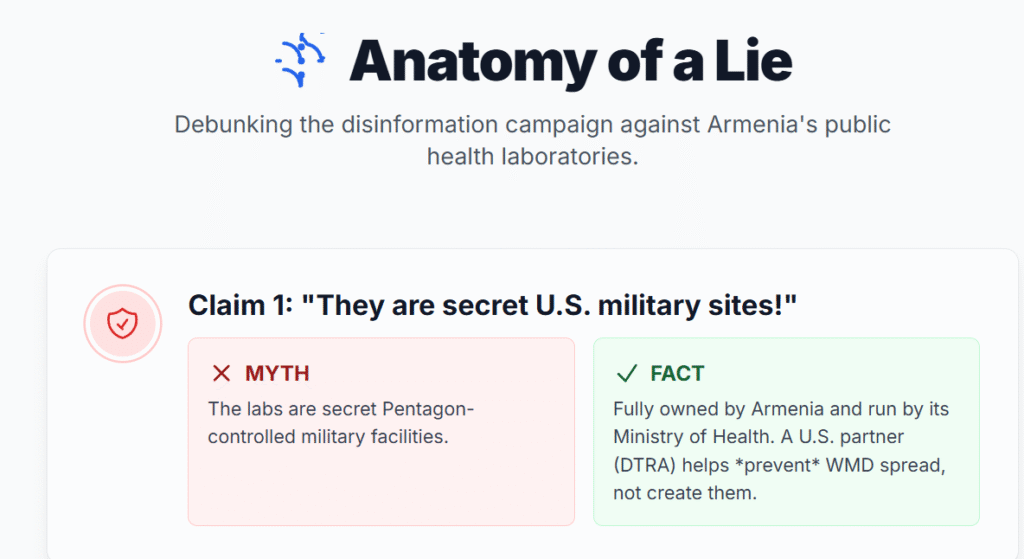
Claim 1: These are military sites.
Propaganda claims that laboratories in Armenia, as in Georgia or Ukraine, are secret U.S. military facilities controlled by the Pentagon. This myth stems from the fact that one of the modernization partners was the U.S. Defense Threat Reduction Agency (DTRA). But DTRA’s mission is not to create weapons — it is to prevent the spread of weapons of mass destruction, including securing dangerous pathogens inherited from the Soviet era. The laboratories are fully owned by the Republic of Armenia and operate under the Ministry of Health.
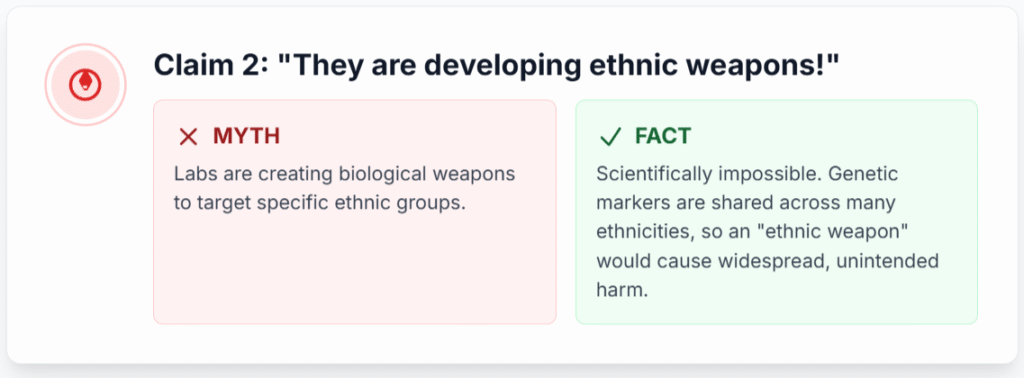
Claim 2: Development of biological weapons.
The most alarming and scientifically baseless claim concerns the alleged creation of “ethnic weapons” targeting Slavs or Russians. Modern genetics makes this impossible. Genetic markers define haplogroups, not ethnicities. For example, the R1a haplogroup, present in about half of Russians, is also common among Poles, Ukrainians, Czechs, Kyrgyz, Tajiks, and many others across Eurasia. Any “weapon” targeting such a group would harm multiple unrelated populations.
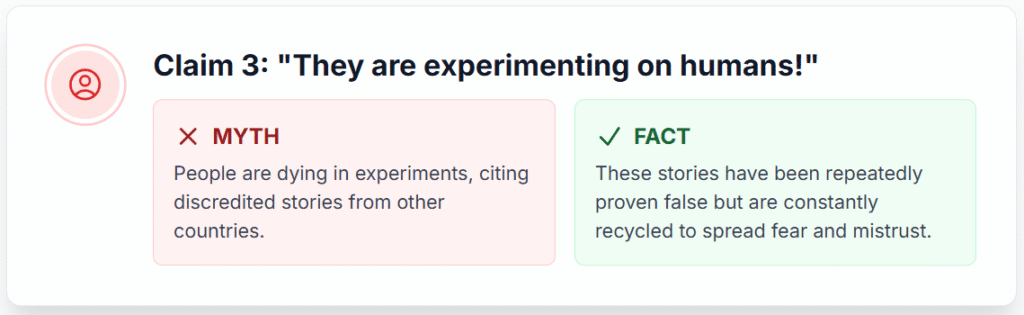
Claim 3: Human experimentation.
This claim is often backed by discredited stories, such as the false report that 248 people died in Georgia’s Lugar Center. Although repeatedly debunked, the story continues to resurface, sometimes repeated by Armenian public figures.
Disinformation spreads through a layered system. It often begins on obscure “Western-looking” websites created to promote pro-Kremlin conspiracy theories, giving the story a veneer of international credibility. Russian state media — such as Sputnik, EADaily, and TASS — and officials like Foreign Ministry spokesperson Maria Zakharova then cite these fake sources. Finally, the same narrative is picked up and circulated in Armenia by sympathetic outlets and commentators.
Another recurring element is the claim that Armenia has no control over the laboratories. In reality, the National Center for Disease Control and Prevention is a state-owned, non-commercial organization fully controlled by the Health Ministry. It cooperates with various international partners but remains under Armenian jurisdiction.
What actually happens inside the labs
The National Center for Disease Control and Prevention — the main target of these narratives — is tasked with protecting public health.
“Our key functions are public health protection, immunization, and laboratory diagnostics,” Atoyan said. In practice, this means that when an infectious disease is detected, the center’s specialists carry out epidemiological investigations to identify the source, trace contacts, and prevent further spread — breaking the chain of transmission. “This is a continuous process; the COVID-19 pandemic was only one large-scale example,” Atoyan noted.
Not American — international cooperation
The disinformation campaign also distorts Armenia’s cooperation with the United States. Officials do not deny U.S. involvement but clarify what it actually entails.
The Yerevan center, along with the Food Safety Inspection Body’s main facilities, was opened in July 2016 by the health and agriculture ministers and the U.S. ambassador. Between 2016 and 2017, regional branches were established in Shirak, Tavush, Lori, Gegharkunik, and Syunik.
The centers were modernized and equipped with funding from the U.S. Defense Threat Reduction Agency, which invested nearly $14 million.
The Armenian–U.S. Biological Engagement Program focuses on reducing risks from dangerous pathogens and strengthening Armenia’s ability to detect and respond quickly to outbreaks affecting humans or animals.
Atoyan emphasizes that Armenia also works closely with Russian and Eurasian institutions:
“We cooperate with several institutes under Rospotrebnadzor, conducting joint training and field work,” he said.
Laboratory upgrades are also supported by non-U.S. donors. “Right now, two of our regional labs are being modernized with funding from the Eurasia Partnership Foundation for Development and Stability,” Atoyan added.
According to Ani Grigoryan, the labs have always operated transparently — even with Russian involvement.
“Years ago, the Health Ministry confirmed that Russia had donated certain equipment to these reference labs,” she said. “And in 2018, Prime Minister Nikol Pashinyan stated that Russian experts had inspected the labs and confirmed that there was nothing dangerous inside.”
The reality, then, is not a secret Pentagon outpost but a modern public health network collaborating openly with partners from the U.S., Europe, Russia, and the Eurasian Union — for the benefit of Armenia’s citizens.
International parallels: the same playbook everywhere
The “American biolabs” narrative is one of Russian propaganda’s longest-running disinformation tropes. Its targets are post-Soviet states accused of hosting U.S.-backed biological weapons programs. The supposed “vectors” of infection range from migratory birds to drones carrying “combat mosquitoes.”
The goal is to discredit these countries, and the same storylines are repeated by senior Russian officials. In reality, the labs operate transparently, and the propaganda is full of factual errors.
In Kazakhstan, for example, false claims circulated that the Central Reference Laboratory in Almaty was spreading coronavirus via bats.
In Georgia, former state security minister Igor Giorgadze told RT in 2018 that he possessed 100,000 pages of documents proving deadly human experiments at the Richard Lugar Public Health Center — a claim echoed by ex-Saakashvili adviser Jeffrey Silverman, who called Georgia “a walking laboratory.” Two years later, the same lab was again accused of spreading coronavirus through bats.
Moldova was likewise targeted with reports of “secret U.S. deals” to open new labs testing lethal viruses — claims later denied by the Moldovan government.
Across the region, these campaigns rely on the same formula: the false assumption that laboratories are controlled by the United States and develop biological weapons, rather than safeguard against dangerous Soviet-era pathogens and strengthen public health security.
The main photo and some infographics were created using artificial intelligence (Gemini).





 Stories