 Civilnet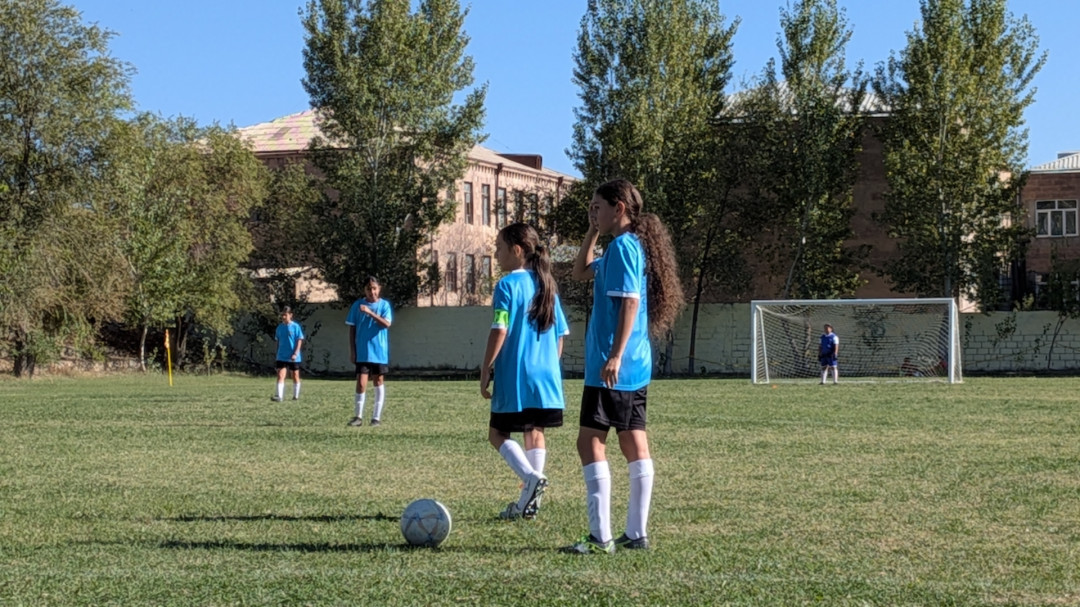
By Alik Garibian
The football field next to the school in Surenavan village, in the Ararat region, is busy this Friday afternoon. Groups of children—boys and girls—and adults watch from the sidelines. Some chants echo across the field: “Shoushan! Shoushan!” The crowd has gathered to support the village’s U15 girls’ team. Ten years ago, no one would have imagined this scene. Back then, football was not a game for girls—at least, that was the very vocal opinion of some previous leader of the Armenian football federation.
“Many people say that soccer isn't for girls, but every time we play, every time we practice, we prove them wrong,” says Lucine, 13, one of the players.
“Soccer has made me stronger and more resilient and taught me about friendship,” shares Mané, 11. “GOALS has given me the opportunity to play sports, specifically soccer. Before, I never imagined that such opportunities existed for me.”
Surenavan is one of many villages where GOALS is engaged. “Before five years ago, there were no youth tournaments, no youth teams in the regions. We had to organize everything ourselves,” recalls CEO Teny Avakian. The organization launched regional and national competitions, later merging with federation programs, and now serves as a talent pipeline for clubs and national teams. In ten years, Goals has expanded to more than 80 communities across all ten regions outside Yerevan, and recently introduced a basketball section.
“Daughters aren’t always seen as a source of pride at home,” Avakian notes. “But when an all-girls team represents a village and the community comes out to cheer, it shifts people’s minds.”
Convincing the parents
“In the very beginning it was extremely difficult. We would have to literally go door to door talking to every single parent, convincing them to allow their daughter to play,” recalls the CEO of Goals. At first, parental reluctance often came from the belief that football was a “manly” sport, or that playing could somehow harm a girl’s body. Today, the objections have shifted: many parents simply see sports as a waste of time for teenage girls.
“Given the socioeconomic circumstances of many communities we work in, I understand their concern,” Avakian says. “If a girl spends her time learning sewing, for example, that could lead to a job and income, which families need to survive. Playing sports is a long-term investment about what being a Goals girl can open up for you.”
“There are obvious benefits,” she adds. “Over 90% of female CEOs and Fortune 500 executives played team sports. There’s a clear link between playing sports and developing skills to succeed later in life. I like to think that life is a team sport and if you haven't played as a kid, you're probably not going to do well as an adult.”
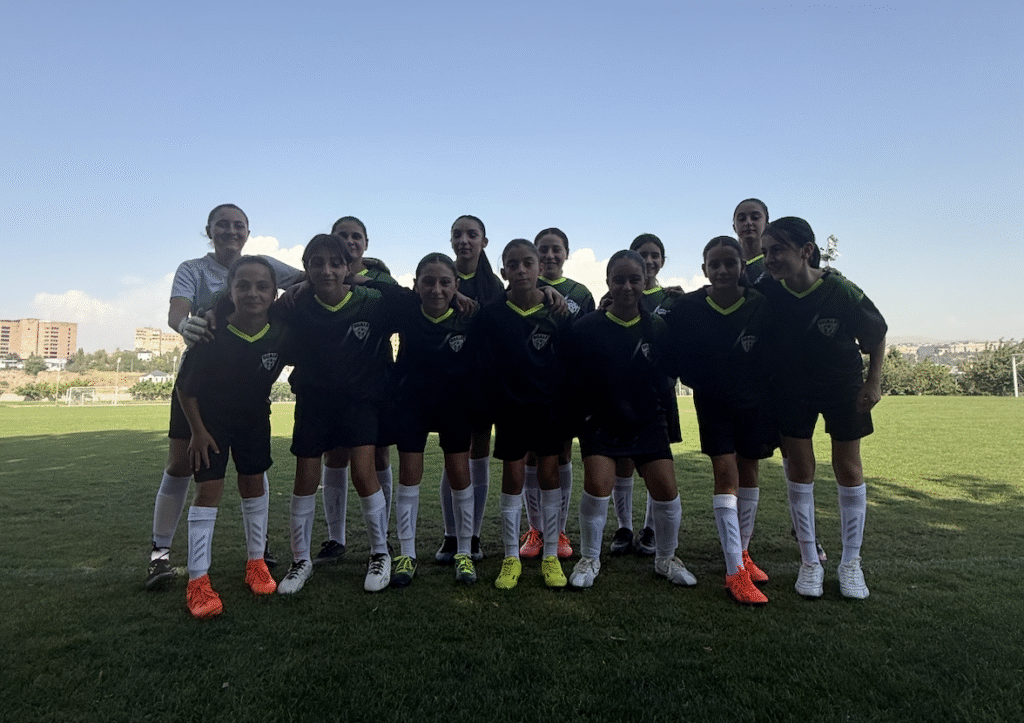
The Goals Surenavan u15 team (PHOTO : GOALS)
For the girls themselves, the change is visible. Nare Hovanessian, 13, recalls her mother’s initial refusal: “No, soccer isn't for girls. Your feet will get all twisted.” Four years later, everything has changed: “My mother laughs now, saying I dress more like a boy, but my father says, ‘It doesn't matter if she dresses like that, I'll take her boxing.’
Milena Kevorkian, 14, who has been playing soccer for three years, echoes this transformation: “Since I started, I feel more beautiful and confident in my body. My physique has become stronger. Sports help you have a healthier and more attractive physique.
Football is a chance to carve out a space of their own. “At first, they are shy, barely speaking,” Avakian explains. “By the third practice, they won’t stop talking. They have found a safe space to be their full selves.”
“In a typical Armenian village,” she continues, “kids go to school, then home—and teenage girls rarely have time to just play. Most are helping with housework, farmwork, or whatever is needed for the family. Football is an opportunity to do something for themselves, to have a space and community that’s just for them.”
GOALS’ program goes beyond sports. Leadership, teamwork, health, and gender equality are all part of the approach. After the COVID-19 pandemic and during the war, coaches could not always reach certain villages safely. To keep learning going and ensure opportunities were not limited by location, GOALS developed a self-guided workbook covering self-awareness, health, group activities, and community engagement—allowing girls to organize, work together, and practice real-world skills even when staff were absent.
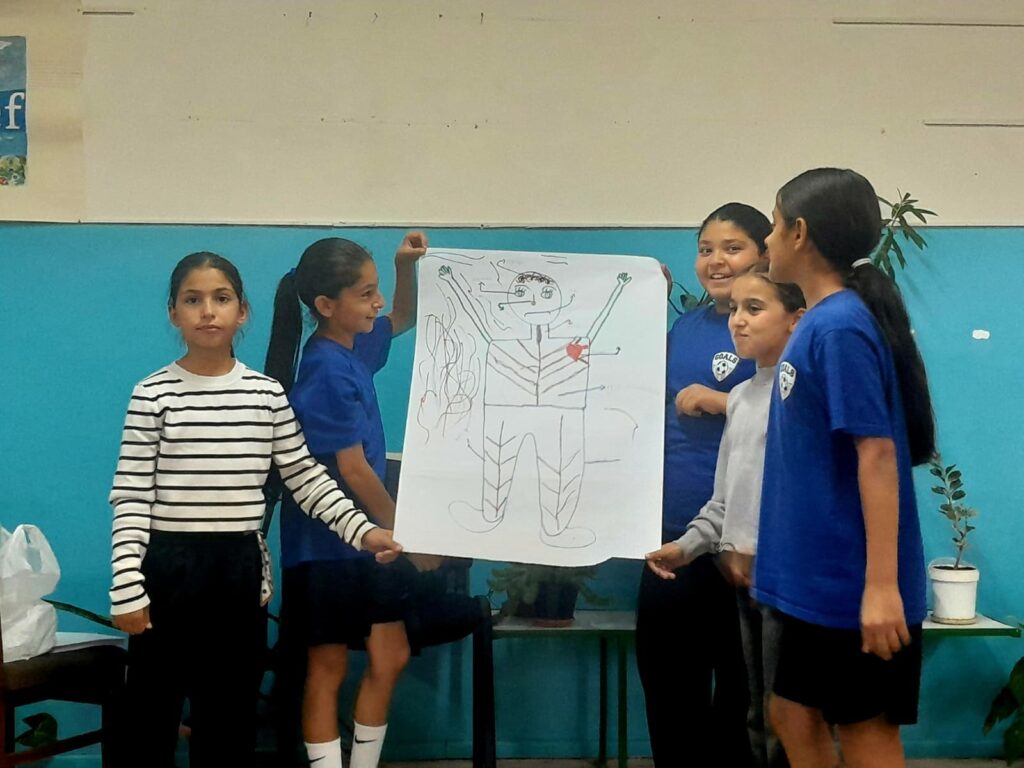
Girls from Surenavan reflect on their feelings during a GOALS workbook session (PHOTO: CivilNet/ Alik Garibian)
Responding to War and Displacement
Crises forced the program to adapt. Kornidzor in Syunik was one of the first villages to welcome a Goals team, but during the war it became a border area, raising safety concerns. At the same time, children displaced from Artsakh stayed in hostels and shelters across Yerevan. Goals ran activities for them three times a week, providing sports in safe spaces and a sense of normalcy.
“Imagine these kids carrying all their trauma in a backpack. Our goal was to create a space where, for an hour or so, they could put it down and just be children again,” Avakian explains.
After the war, Goals refocused on rural areas and teenage girls—often the most vulnerable in refugee situations—helping them integrate into new communities. “You’re a girl in a new community. What better way to belong than to join a local team and represent the village you now live in? There are cultural and language barriers, but sports is a universal language,” the CEO notes.
These efforts earned Goals significant recognition: the UEFA Grassroots Award for Best Amateur Club in 2024, for engagement with refugee communities and girls’ participation, and the UEFA Children’s Foundation Award in 2025, for educational programming. Having worked closely with the Armenian Football Federation since 2019 and gained a voice in UEFA decisions, the organization now aims to achieve a similar partnership with the Armenian Basketball Federation before exploring involvement in other team sports.


 Stories