 Civilnet
By Alik Garibian
Last weekend, Yerevan welcomed the fourth FEMINNO International Conference, gathering roughly a hundred participants from Armenia and abroad.
Under the theme “POWER NOW: Innovation. Impact. Her”, the conference highlighted women’s contributions to tech, innovation, and entrepreneurship. A central point of discussion was the “female innovation chain” — and, crucially, the break that disrupts it.
Women in Armenia account for nearly 40% of the tech workforce. Though this is above the global average, their numbers fall sharply in leadership. Only 33% of senior technical positions and just 18% of executive roles are taken by women. In other words, many women enter the tech sector, but fewer reach top positions or launch their own startups. Globally, the gap is even wider: only 25% of leadership roles in tech are held by women, 15% of startups have a female co-founder, and less than 2% of venture capital funding supports all-female teams.
Challenges along the way
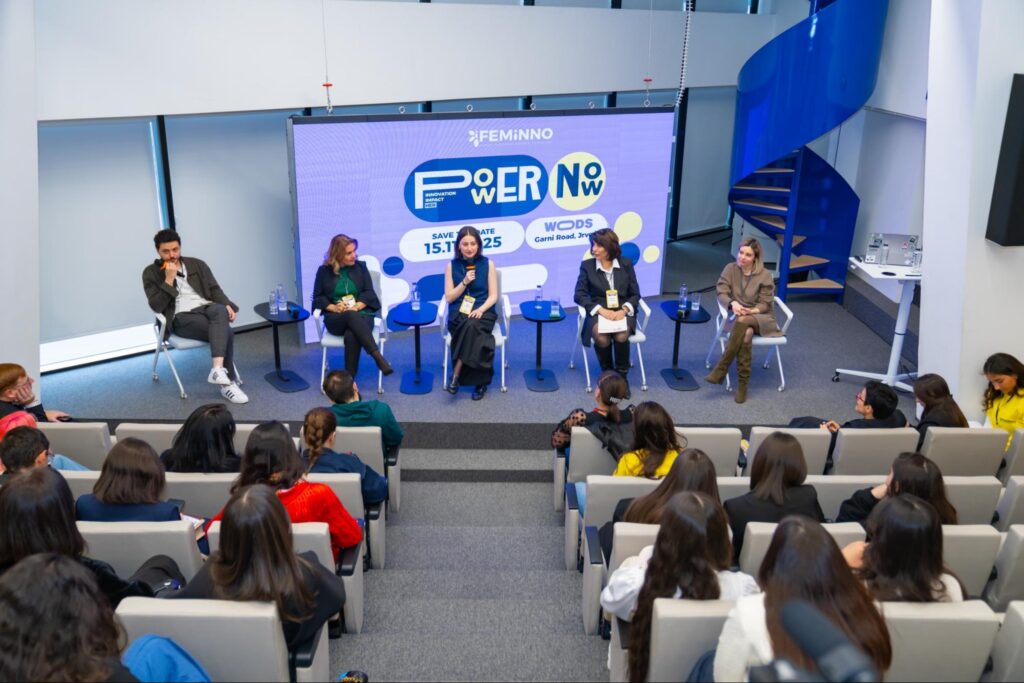
The panel discussion on this topic featured four influential women in Armenia’s tech scene: Irina Dumanyan (CEO of Siemens EDA Armenia), Bella Vasilyan (Head of Tumo Labs), Mariam Babayan (Advisor for Entrepreneurship, Innovation, and SME Development at GIZ), and Irina Ghazalian (CEO and Co-founder of Dr.Yan). Together, they highlighted several potential factors behind the gap in the female innovation chain.
First, women often face limited access to critical resources such as funding, networks, and opportunities, making the transition from education to career particularly challenging. In the startup environment, these support mechanisms are essential for growth.
“We have a problem when we are translating education into action,” explained Bella Vasilyan, head of TUMO Labs. “There are many programs available for women to start their enterprises, but I don't think there is enough opportunity for them to grow that enterprise.”
This reflects global trends which show that access to finance, mentorship, and professional networks remains a persistent obstacle for women entrepreneurs worldwide.
Second, societal expectations and family responsibilities often create tensions between career ambitions and personal life, especially for women.
“It's tough because you have to be ready to sacrifice certain aspects of your life if you go through the top career path,” stated Irina Dumanyan, CEO of Siemens EDA Armenia. “I don't want to talk about work-life balance because it doesn't exist.”
Finally, women in leadership are often seen as exceptional rather than standard, reinforcing stereotypes and making it difficult for them to normalize their presence in top roles. This perception gap contributes to the persistent disconnect between participation and leadership. Gender biases, both conscious and unconscious, continue to shape professional evaluations and opportunities for women globally, making it harder to achieve true equity in entrepreneurship and tech leadership.
Solutions and successful practices
Panelists emphasized that reducing the breakage in the female innovation chain requires interventions at multiple levels, from societal mindset to structural support.

One effective approach is comprehensive programs that support women from education to entrepreneurship. Bella Vasilyan, Head of Tumo Labs, highlighted the Goldman Sachs 10,000 Women initiative as an example.
“They take women from the stage of education, then they train them, introduce them to a network, and fund any initiatives they have.”
Vasilyan emphasized that this program succeeds because it addresses the entire entrepreneurial chain—education, training, funding, and networking—rather than focusing on just one aspect. Locally, Tumo Labs runs hackathons and incubators that select participants based on demonstrated leadership and skill rather than pre-existing networks, ensuring a level playing field.
Panelists also pointed out the need for developing female investors to close the funding gap. Mariam Babayan from GIZ described a training program for female angel investors that immerses participants in an international environment and enables them to invest in startups after completing the course. These initiatives create a pipeline of women who not only found startups but also have the power to support other women-led ventures. Babayan also stressed that government support, international visibility, and access to finance are essential to help Armenian startups scale globally.
Overall, these practices address multiple structural, social, and economic barriers. Enabling legal frameworks, government-backed initiatives, and multi-dimensional strategies are crucial for increasing women’s entrepreneurship and labor force participation. They suggest that Armenia’s tech ecosystem could benefit from a coordinated, long-term approach to empower women-led innovation.





 Stories