 Tigran Grigoryan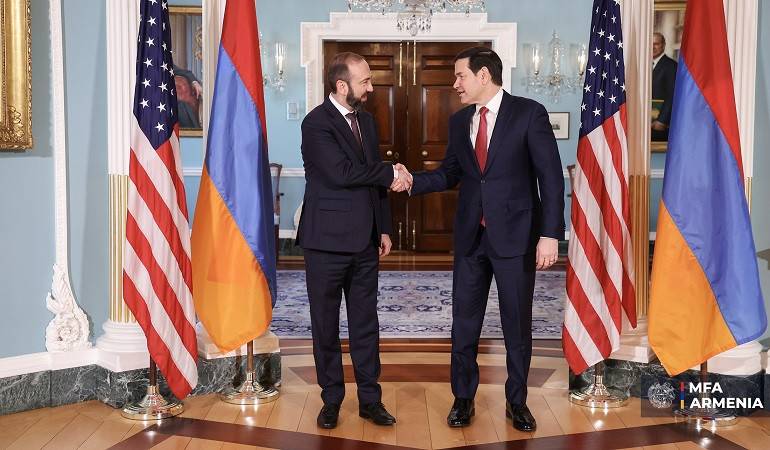
By Tigran Grigoryan
The Armenian Ministry of Foreign Affairs and the U.S. Department of State published a joint statement on Tuesday, revealing the implementation framework of the Trump Route for International Peace and Prosperity (TRIPP) project.
The statement envisaged the establishment of a TRIPP Development Company tasked with developing and operating multimodal transit infrastructure in Armenia, while fully preserving Armenia’s sovereignty and legal jurisdiction. The company would initially be 74% U.S.-owned and 26% Armenian-owned for the next 49 years, with the possibility of extending the arrangement and increasing Armenia’s stake to 49% after that. Any changes in ownership would require the approval of both governments.
Armenia would provide land-use and development rights, regulatory facilitation, and other non-monetary contributions, while retaining full authority over legislation, security, customs, border control, taxation, and law enforcement across the entire length of the communication route. The company would enjoy exclusive rights to plan, construct, operate, and generate revenue from the transit infrastructure, including through special-purpose vehicles.
Border and customs operations would be organized under a “front office–back office” model, whereby private operators would handle facilitation and customer-facing services, while all decision-making authority and control would remain with Armenian state bodies. These functions would be supported by digital systems, risk-based procedures, and targeted U.S.-assisted capacity-building.
Key clarifications and institutional safeguards
The document provided several important clarifications on issues that had caused widespread concern in recent months, most notably regarding Armenian control and access along the communication route. At this stage, it was essential to clearly and meticulously document key details related to the implementation of the project and secure a public reaffirmation from the U.S. side on issues of jurisdiction and control. It is also significant that the proposed implementation relies on mechanisms that are widely accepted in international practice.
Lack of reciprocity
The principal negative aspect of this arrangement, one that formalizes the asymmetric rights of the parties involved, is the absence of the principle of reciprocity. On the one hand, the application of the front office–back office mechanism is an interesting diplomatic solution that formally satisfies Azerbaijan’s demand that Azerbaijani citizens traveling to Nakhichevan should not come into direct contact with Armenian border guards, while simultaneously ensuring the presence, authority, and oversight of Armenian state bodies in the border and customs control process.
On the other hand, it is evident that Azerbaijan will never agree to similar arrangements on its own territory. This is not merely a symbolic concession on Armenia’s part; it could also generate practical problems. Given the decades-long history of the conflict and sensitivities associated with it, this reality will make transit through Azerbaijani territory far more difficult for Armenians than transit through Armenian territory will be for Azerbaijanis.
Areas of potential dispute
Despite the fact that Armenia and the United States have reached a mutual understanding on the project’s details, serious concerns remain that disagreements between Baku and Yerevan may still arise on a number of issues. For example, Azerbaijani authorities have consistently insisted that goods transiting from Azerbaijan to Nakhichevan should not be subject to Armenian customs duties, while Armenia would be entitled to collect customs fees on cargo originating from Central Asia and transiting onward beyond Azerbaijan.
The published statement contains no reference to any such exemptions in the area of customs control, but it is still premature to speak of a change in Baku’s position on this issue. It is also likely that disagreements may emerge between the parties regarding the scope of Armenian functions within the front office–back office model, as well as other components of border control.
Choosing between bad options
When evaluating the TRIPP project, it is important to avoid extremes. The authorities, experts, and civil society actors try to present the project as a major achievement and a breakthrough for Armenia that enhances the country’s subjectivity and agency. This narrative contains clear elements of propaganda.
It is evident that under normal circumstances Armenia would hardly agree to arrangements that involve a third party on its own territory and introducing special border and customs regimes. Claims by Armenian officials that the decision to introduce new border-control mechanisms reflects a broader desire to implement comprehensive reforms in this sphere are unconvincing. Comparisons between TRIPP and other infrastructure assets transferred to third parties through concession agreements are also inaccurate.
There is a clear difference between relinquishing control over an airport, a port, or even a railway, and relinquishing control over a stretch of territory extending for dozens of kilometers. According to the published statement, the TRIPP company would have exclusive rights to conduct commercial and economic activity there and would, in practice, exercise control over that area.
At the same time, while acknowledging all of the above, it is also necessary to consider the alternatives to this initiative. After the ethnic cleansing of Nagorno-Karabakh in 2023, the communication route passing through Meghri became the most likely source of escalation. Azerbaijan accelerated the construction of its segment of the communication route, while Turkey launched the construction of a railway linking Kars to Nakhichevan.
In this context, Armenia had very limited room to refuse concessions altogether, and in a worst-case scenario could have been forced to make such concessions under the pressure of yet another Azerbaijani military escalation.
The Russian proposals envisaged the involvement of Russian security agencies in controlling the route. That option might have been relevant when Nagorno-Karabakh was still populated by Armenians, as the expansion of Russia’s presence in southern Armenia would have been balanced by its presence in Nagorno-Karabakh. But today this balancing factor no longer exists, and an increased Russian security presence, and especially any form of partial control, over the Meghri route no longer has a rational justification.
In this context, the TRIPP project is not the worst possible option for addressing this issue. Presenting it as a major achievement for Armenia, as already noted, is largely driven by propaganda considerations. At the same time, given the regional balance of power, it is clear that Armenia’s choice was never between good options.



 Stories