 Civilnet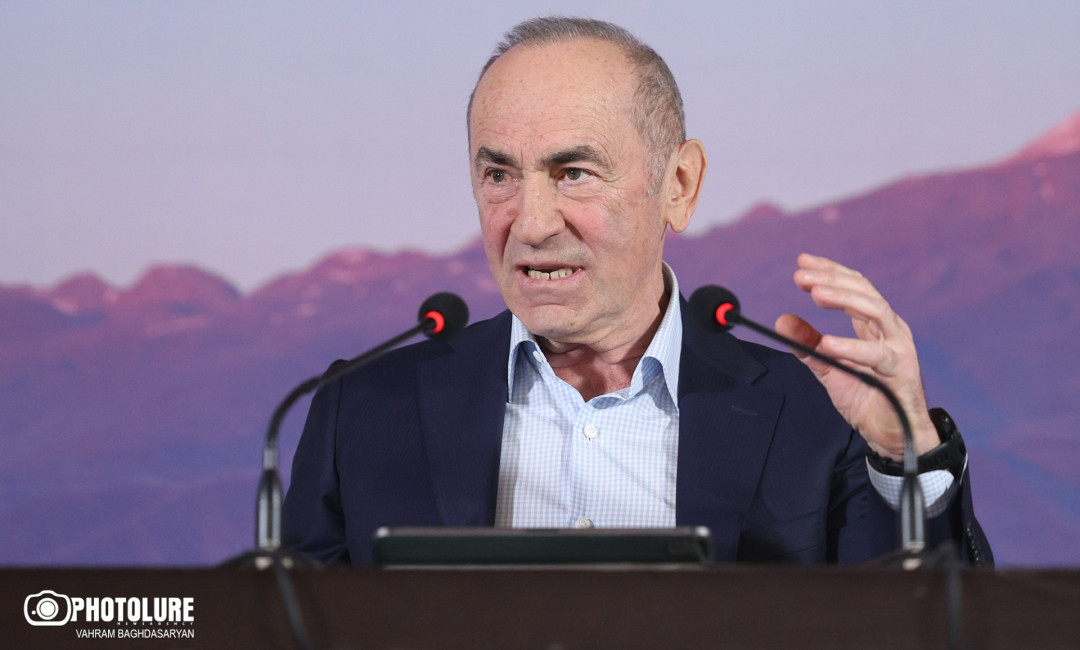
By Gevorg Tosunyan
Former Armenian president Robert Kocharyan said on Thursday that Armenia has once again found itself at the center of competing great power interests, warning that current geopolitical shifts could expose the country to new risks if not carefully managed.
Speaking to reporters in Yerevan, Kocharyan said U.S. engagement in the South Caucasus should not be interpreted primarily through an economic lens. Washington’s core objective, he argued, is strategic control over Iran’s border rather than regional development, a dynamic that also reflects Israel’s interests and broader U.S. policy calculations.
Kocharyan was sharply critical of the Trump Route for International Peace and Prosperity (TRIPP), a U.S.-backed framework promoted by the Armenian government as a major economic and security opportunity. He said the initiative largely serves the interests of Azerbaijan and Turkey, while Armenia’s national interests are insufficiently articulated within the project.
He dismissed claims that TRIPP would bring billions of dollars in investment, arguing that the Armenian segment under discussion amounts to roughly 42 kilometers of infrastructure and would cost only a few million dollars—well within Armenia’s own financial capacity. Talk of massive foreign investment, he said, was unrealistic and misleading.
The former president also questioned how external actors could exercise “control” over the region without deploying forces, suggesting that influence is often exerted through management rights and governance mechanisms rather than military presence. In that context, he warned that Armenia risks becoming entangled in a renewed struggle among major powers, similar to the period preceding the 2020 Nagorno-Karabakh war.
Kocharyan said the ongoing reconfiguration of the global order—marked by the emergence of a multipolar world, U.S. rivalry with China, and more pragmatic U.S.-Russia relations—could create both opportunities and dangers for Armenia. The country’s priority, he said, should be to avoid becoming a focal point of geopolitical confrontation.
Turning to domestic politics, Kocharyan said he has not yet decided in what format his political force would contest Armenia’s next parliamentary elections, slated in June 2026. He said his team plans to conduct a sociological survey in early February to determine who should lead the electoral list as the prime ministerial candidate. If the polling indicates he is the strongest option, he said, he would accept the role; if not, another figure would be nominated.



 Stories