By Lia Avagyan
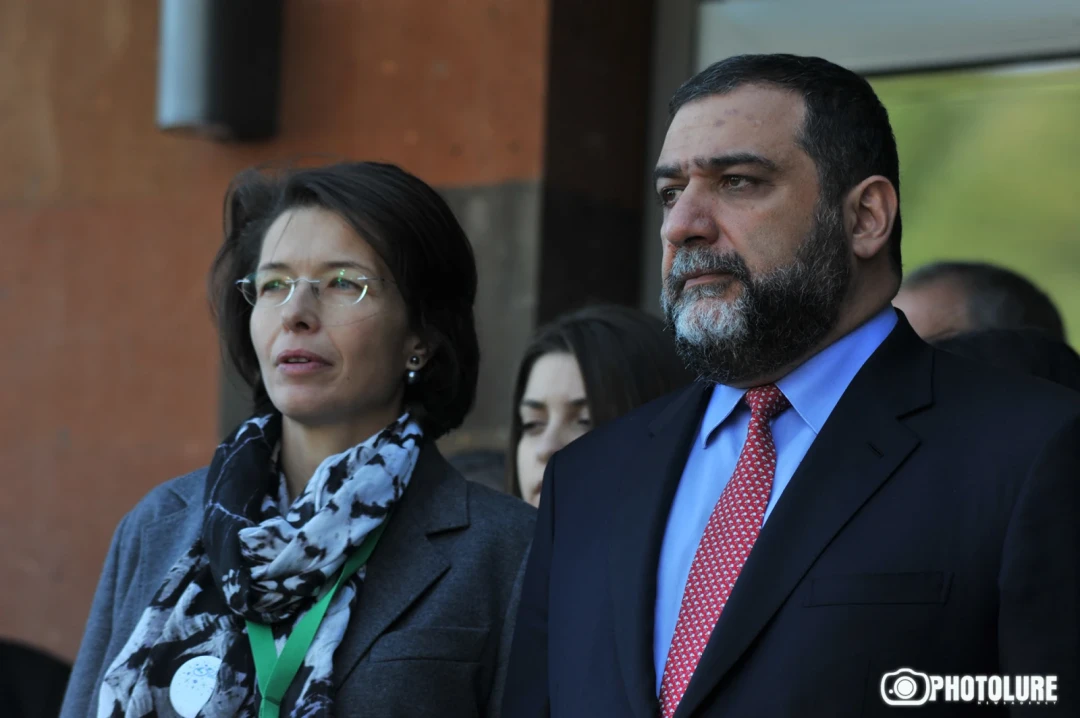
Veronica Zonabend, the wife of imprisoned businessman, philanthropist and former Nagorno-Karabakh state minister Ruben Vardanyan, has criticized what she described as an insufficient response by Armenian authorities to efforts to secure information about and access to detainees held in Baku.
In an interview with Armenian outlet Mediamax, Zonabend pointed to what she sees as a lack of tangible progress following appeals by families of Armenian detainees held in Baku and human rights defenders.
“So far, we have not received a response that would allow families to say that a real path has opened,” she said, referring to a request sent in early April to the Armenian and Swiss foreign ministries to activate the Protecting Power mechanism.
“But for us, it is important to continue. Behind every such letter is not a diplomatic formality, but a simple request: help us see our loved ones, help us understand what is happening to them.”
Zonabend said the mechanism could provide an independent humanitarian channel at a time when families rely on limited and often unverifiable information.
“The Protecting Power mechanism is important precisely because it can create an independent humanitarian channel,” she said. “Today, families are forced to rely on brief conversations and fragmented information. This is a very difficult state to live in.”
She said her family has yet to receive a substantive response to the appeal.
Zonabend also warned against what she described as a growing normalization of the issue.
“What worries me is not only the specific response. What worries me is that people can become accustomed to this issue — to the fact that fellow citizens remain effectively held hostage in detention,” she said. “Such normalization is very dangerous. It quietly changes society.”
Her remarks come as access to detainees has become more limited after Azerbaijani authorities requested the International Committee of the Red Cross to end its operations in the country in September 2025, removing one of the few independent channels for monitoring their conditions.
“I understand that any institution has its mandates, procedures, and limitations. But there are situations where a purely formal response is not enough,” Zonabend said.
“Families expect more than just legal wording. They expect a human approach — that someone will try to find a way, make an effort to help their fellow citizens.”
She added that political will could enable alternative mechanisms to protect detainees’ rights.
“I don’t want to measure a person’s worth only by their achievements. But it must not be forgotten: Ruben and many of those who are now detained in Baku have done a great deal for Armenia,” she said.
“It seems to me they have done enough for their homeland and that, today, the homeland should at least help their families see them.”
Zonabend said her appeal is not political. “I am not talking about politics. I am talking about a human attitude. Behind every name there is the life of a real person and their family.”
The comments come days before Armenia hosts major European gatherings in Yerevan, including the European Political Community summit on May 4 and the first EU–Armenia summit on May 5, expected to bring together around 40 heads of state and government. French President Emmanuel Macron is also due to visit.
Also read: European summits in Yerevan mark a unique opportunity to seek release of detainees in Baku
The meetings have been seen by some as a potential opportunity to raise the issue of Armenian detainees held in Azerbaijan.
However, Prime Minister Nikol Pashinyan said his government does not plan to address the issue with European partners and will continue to pursue it through direct talks with Baku.
Speaking after a government meeting on Thursday, Pashinyan said Armenia considers bilateral negotiations the most effective approach for now, arguing that previous discussions in other formats had produced limited results. He said “extensive work” is ongoing to secure the return of detainees, but did not rule out using international platforms in the future if they prove effective.
On the same day, a group of 22 Armenian non-governmental organizations urged European Union leaders to take steps toward securing the release of detainees.
Vardanyan had earlier appealed to Armenia’s human rights defender to take steps to clarify his conditions of detention and ensure access to his rights. The ombudsperson’s office said it had limited jurisdiction over individuals held outside Armenia and could only raise the issue through international counterparts, a response his family criticized as overly procedural and lacking practical effect. Zonabend suggested such approaches reflect a broader lack of initiative, arguing that even within existing constraints, authorities could pursue alternative mechanisms if there was sufficient political will.
Also read: Ruben Vardanyan urges Armenia to arrange family visits for Baku captives
At least 19 Armenian detainees are currently held in Baku. They include former political and military leaders of Nagorno-Karabakh captured during Azerbaijan’s September 2023 offensive that led to the displacement of the region’s Armenian population.
Vardanyan was sentenced in February to 20 years in prison by an Azerbaijani court on charges including financing terrorism and waging war against Azerbaijan. Prosecutors had sought a life sentence.
He dismissed the proceedings as a “farce” and instructed his lawyer not to present a defense. No independent observers or media were allowed to attend the trial. He was later transferred, along with other detainees, to the Umbaki prison complex in Baku’s Qaradagh district. Conditions at the facility remain unknown.

 Stories