 Tigran Yegavian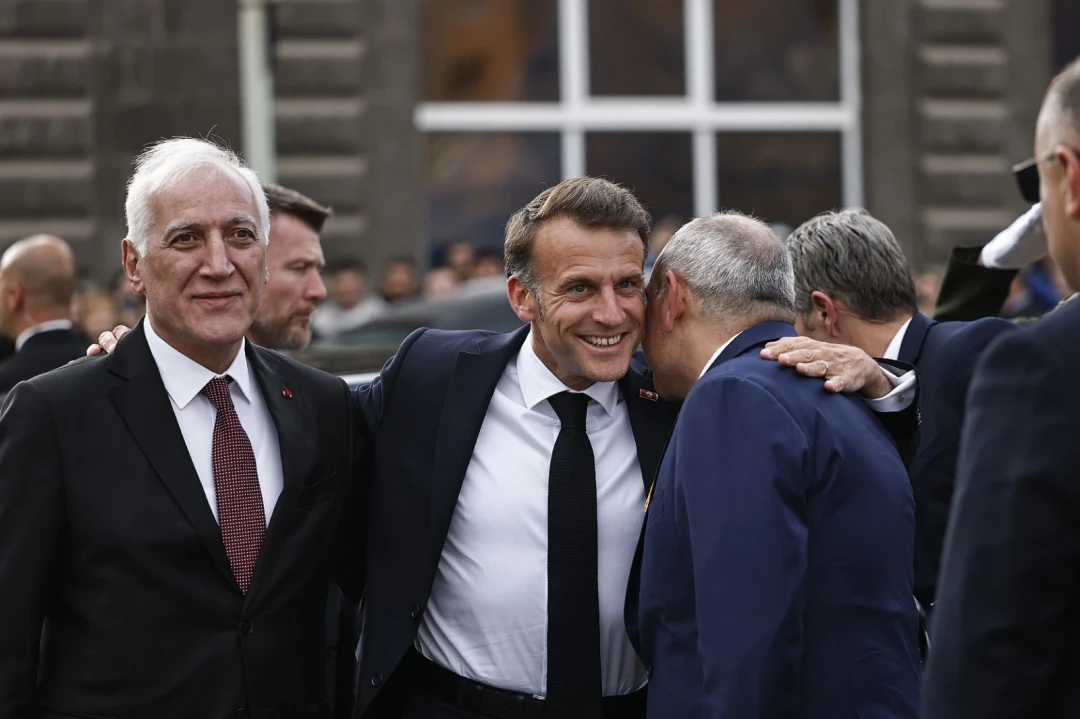
By Tigran Yegavian
French President Emmanuel Macron’s visit to Armenia from May 3 to 5 will be remembered for its imagery. A French leader facing record-low approval ratings at home was welcomed in Yerevan almost like a hero. Warm crowds, carefully curated emotional moments amplified across the Élysée’s social media channels, and even — in a rare scene — the French president singing classic French songs before an enthusiastic audience. The message was skillfully crafted: friendship, cooperation, and support for Armenia’s sovereignty and democracy. On the surface, everything was there.
The European Political Community summit held in Yerevan on May 4 was undeniably a major symbolic event. For Armenia, it represented another step out of diplomatic isolation, a chance to loosen Russia’s grip and open new strategic horizons. That, in itself, deserves recognition. But symbolism alone is not enough. Between political declarations and any real transformation of the regional balance of power lies a vast gap that speeches and carefully staged gestures cannot bridge.
Not a word was said about the 23 Armenian detainees still held in Baku. Nor was there any mention of the ongoing systematic destruction of Armenian cultural heritage in the territories lost after the war. These silences are not insignificant. They reveal the limits of a diplomacy that prefers carefully managed emotion over direct political confrontation with Azerbaijan — a European energy partner that has become strategically indispensable.
Interference reflected back
If Russian interference in Armenia is visible, acknowledged, and openly asserted, what should one make of European interference?
The clear effort to publicly align with Nikol Pashinyan in the middle of a pre-election period inevitably raises questions. The comparison with the overt European support shown to Moldovan President Maia Sandu during her campaign against pro-Russian forces is striking. Is this a double standard? Not really. It reflects the same geopolitical logic: Europe openly backs the allies it sees as strategically aligned, even at the risk of appearing partisan in domestic political struggles.
The issue is not whether such support is legitimate — from an Atlanticist perspective shaped by competition between spheres of influence, it probably is. The deeper question is whether Armenian society, fractured and exhausted, needs yet another external patron, or rather the political space to determine its own future on its own terms.
Economic challenges
Visa liberalization is all well and good. But in concrete terms, what are France and the Europeans actually offering to offset the economic losses that could come with a gradual rupture from Russia?
Easier travel for tourists will not be enough to sustain living standards if purchasing power collapses amid rising energy costs.
One basic fact should be remembered: Russia still sells gas to Armenia at a price roughly four times lower than prevailing European market rates — even if Gazprom Armenia profits handsomely in the process. So what is the alternative energy strategy? What concrete economic compensation is being proposed?
To be sure, the French companies Vinci and Razel-Bec have signed a memorandum of understanding to construct a strategic tunnel along the North–South highway corridor — an important infrastructure project aimed at reducing Armenia’s isolation. The Élysée has also mentioned “potential prospects for Airbus” in the transport sector.
However important these long-term projects may be, they do not address the immediate question: how will Armenians maintain their purchasing power during this transition?
Talk of resilience and diversification rings hollow without large-scale, sustainable financial mechanisms to support them.
A strategic partnership
At the heart of the strategic partnership lies the military dimension. The package announced by France is impressive.
Paris is supplying 36 CAESAR self-propelled howitzer artillery systems — ordered in June 2024 during the Eurosatory defense exhibition — enough to equip two artillery battalions. These modern systems, battle-tested in Ukraine, have a range of around 40 kilometers and can fire six rounds per minute. Each unit is estimated to cost between €3 million and €4 million. The contract also includes 155 mm ammunition.
Armenia’s air defense capabilities are also being strengthened with three Ground Master 200 radar systems produced by Thales, capable of detecting hostile aircraft — whether drones or fighter jets — at distances of up to 250 kilometers. These radars are accompanied by a letter of intent with MBDA for the acquisition of Mistral 3 missile systems. The stated objective, in the words of the French defense minister, is to provide Armenia with “the most effective air defense possible.”
Six Airbus H145 helicopters are also expected to be delivered to the Armenian military. These twin-engine, multi-purpose aircraft, equipped with five-blade rotors and fenestron tail systems, can transport up to ten troops. Their militarized variant, the H145M, can carry modular weapons systems. Yet nothing suggests Armenia will actually receive the armed version.
The agreement also includes a substantial training component. France already dispatched military instructors to train Armenian soldiers in infantry combat, mountain warfare, and precision shooting. Exchange programs between French and Armenian officers are planned, including visits to the military academies of École spéciale militaire de Saint-Cyr and Saint-Maixent. A French officer is seconded to Armenia’s Defense Ministry as a military adviser.
Additional equipment for Armenian special forces is also part of the package, along with multifunction optical systems from Safran designed to improve reconnaissance and intelligence capabilities.
Beyond defense, the agreement extends into innovation, cybersecurity, and artificial intelligence. A cultural partnership between the Matenadaran and the Bibliothèque nationale de France rounds out the broader framework of cooperation.
Toward a third path?
At the end of this sequence of events, one conclusion becomes unavoidable: Armenian society is in desperate need of calm and political breathing space.
Caught between the Russian trap and European promises, between yesterday’s manipulations and today’s competing forms of interference — from all sides — Armenia urgently needs to consider a third path. A path that is more pragmatic and less ideological, supported by people and institutions capable of confronting the immense challenges ahead.
Because the price of poorly managed dependency — whether eastern or western — could prove just as costly as the mistakes of the past.
Armenia deserves more than simply exchanging one form of tutelage for another. It deserves genuine sovereignty, built on its own capacities and its own decisions.

 Stories