 Alexander Pracht
Armenia and the European Union are stepping up efforts to mitigate the economic impact of Russia’s recent restrictions on Armenian imports, which many economists have already described as a trade war ahead of Sunday’s parliamentary elections.
Brussels announced on Thursday that it will provide an assistance package worth approximately $58 million.
“Today I spoke with Prime Minister Nikol Pashinyan about Russia's recent restrictions targeting Armenia. This is nothing short of economic coercion, and it is unacceptable. We are preparing an EU support package; it includes immediate financial assistance, worth over 50 million euro, and more will come,” European Commission President Ursula von der Leyen said in a statement on Thursday.
“[It focuses] on measures to ease the trade for some Armenian products, in particular agri-food, and on practical support for affected sectors, such as Armenian flowers, given that Russia has recently restricted Armenia's flower imports over questionable allegations. A shipment of 10,000 flowers is planned to arrive in Latvia tomorrow; others will follow,” von der Leyen added.
Also read: Armenia faces sweeping Russian import restrictions across industries
She also said that Armenia’s recent reopening of trade routes with Turkey, including the railway connection through Georgia, is an excellent step forward, and that Brussels is ready to support infrastructure and border crossing points, while also looking to connect European and Armenian businesses.
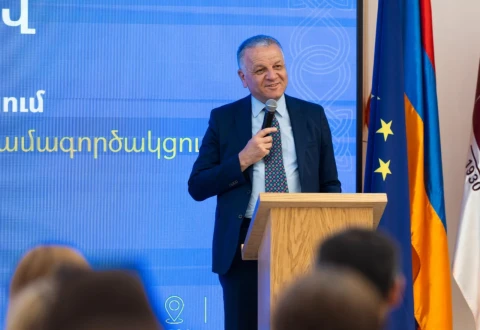
On Thursday, the EU delegation in Armenia held a meeting with Armenian businesspeople, primarily producers of agricultural products and beverages seeking to enter the European market or expand their presence. The event was also attended by CivilNet.
“This is not the first time in the European Union's history. We already have a number of tools, [...] and we will use them to accelerate the support that we've already provided, but it will be really important as well to see different reform measures from the government,” EU Ambassador to Armenia Vasilis Maragos said at the event in Yerevan.
Also on Thursday, Armenia’s government announced that exporters will receive subsidies for products shipped abroad this month per each kilogram of exported produce, with different rates applying to different types of commodities.
The measure is intended to help producers find new export destinations after Russia's ban on products from entire sectors, including most vegetables and fruit, mineral water, and flowers, as Armenia has traditionally been heavily reliant on selling those on the Russian market. The government has not yet amended the state budget to adjust for the subsidies. It estimates the total cost of the compensation program to be roughly $5 million this month.
Prime Minister Nikol Pashinyan earlier this week pledged state support for businesses affected by Russian trade restrictions. He also said the first shipments of roses and vegetables had already been redirected to other markets, although he did not specify the destinations.


 Stories