 Ani Grigoryan
 CivilNetCheck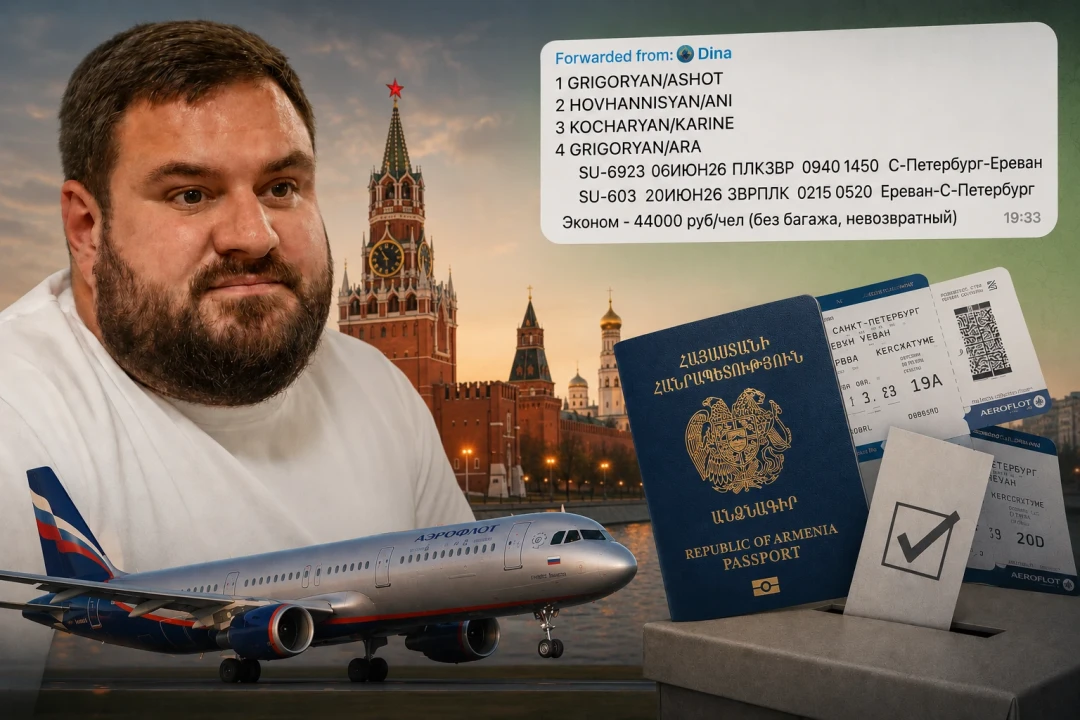
“There won’t be a list, nothing will happen.” Mika Badalyan, a board member of the Russian “Eurasia” organization, made this promise back in March in an appeal to Armenians living in Russia, offering to help them come to Armenia in order to vote in the parliamentary elections.
The statement came after Prime Minister Nikol Pashinyan’s claim that most Armenians in Russia would cast their votes for the incumbent authorities in the elections.
“I very much want to help Armenians go to Armenia for the parliamentary elections and make their choice—especially since Mr. Pashinyan is confident that Armenians in Russia will vote for him,” Badalyan said in a video message posted on Telegram on March 12.
In another video message published on May 3 made in front of the Armenian church in Moscow, he again referred to Pashinyan’s statement and urged those who need help purchasing tickets to take part in the elections to contact him, as well as those who are ready to support travel for other compatriots.
To find out what scheme was being used to organize support for voters traveling from Russia to Armenia, a #CivilNetCheck journalist contacted Badalyan on Telegram, introducing himself as an Armenian living in Russia.
The story of four travelers
We wrote to Badalyan saying we were a family of four living in Russia, asking whether it was possible to obtain airline tickets to travel to Armenia. He responded quickly, suggesting we send the passengers’ first and last names, city of residence, and contact details.
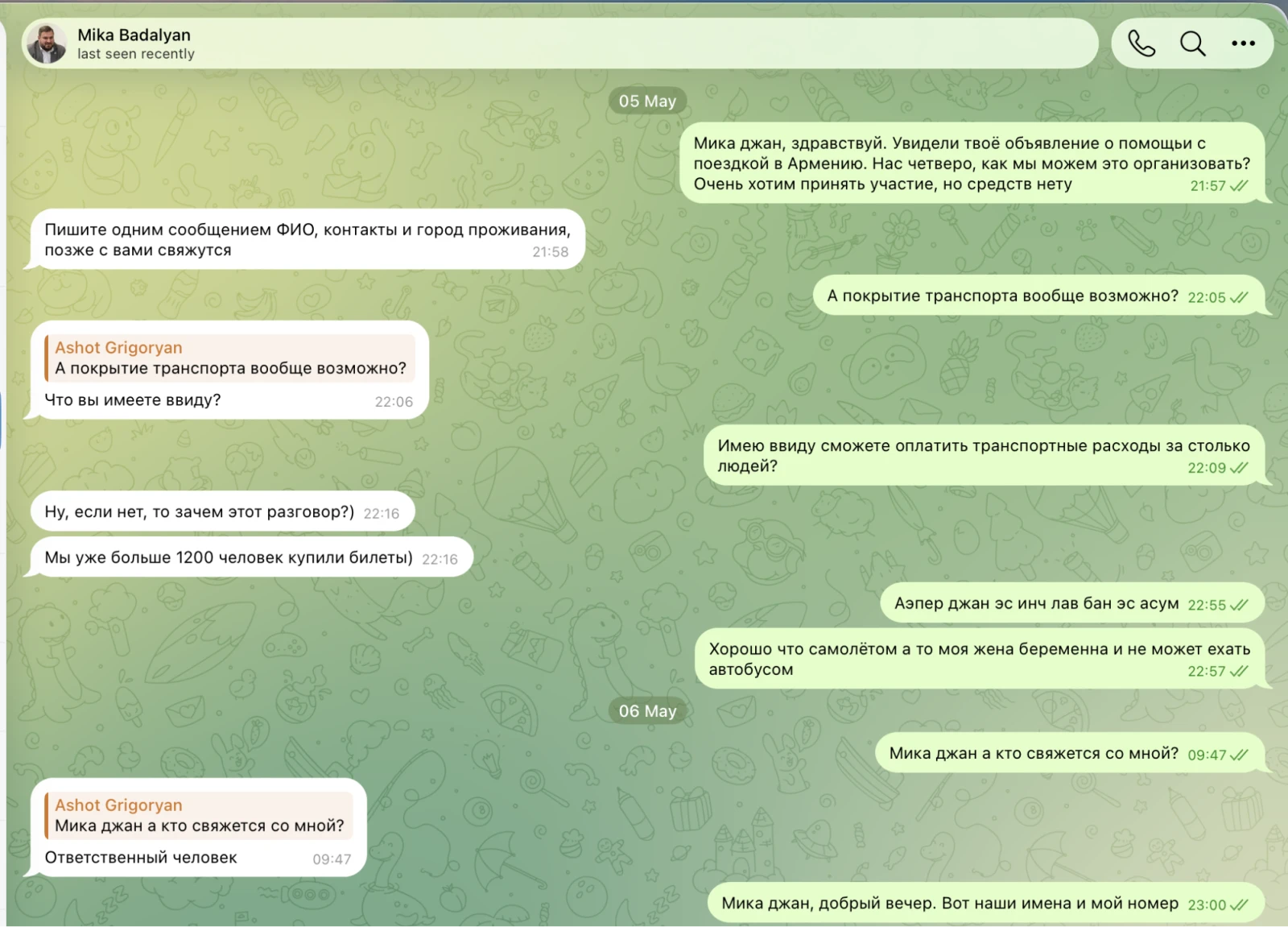
We asked Badalyan whether tickets could be purchased for all four of us. On May 5, he replied that tickets had already been bought for 1,200 people, implying it wouldn’t be a problem. Upon asking who would contact us, he said it would be a “responsible person.”
We then sent fictional names and contacts, noting that we live in St. Petersburg.
However, despite waiting for several days, no one contacted us. When we asked Badalyan again whether it was worth waiting, he answered yes, noting that “the queue is big.” He assured us they would definitely get in touch.
The “responsible person”
On May 15, we received a message on Telegram from a user with the Biblical username “Simon of Cyrene.” No identifying information related to the account was available: the phone number was hidden and there was no way to determine the person’s identity from the account.
The message read: “...I’m writing regarding the purchase of tickets. For processing, please provide passport details as well as the dates of departure and return that suit you. Indicate the departure and return airports. Preferably you should be there no later than the 6th, better a bit earlier. The return flight will be on the 8th or 9th, whichever is convenient.”
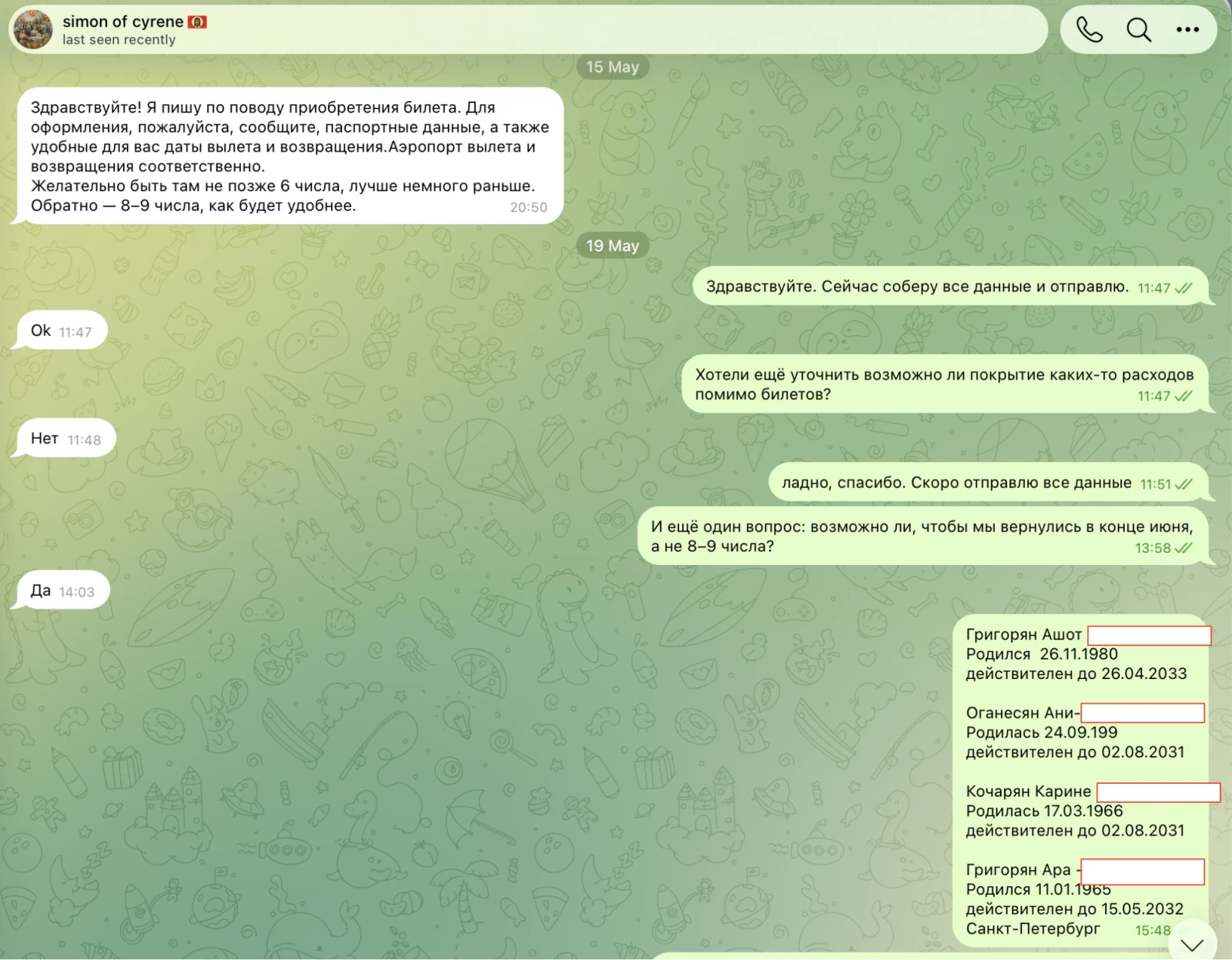
To develop the conversation, we asked whether it was possible to cover other expenses besides the tickets. The answer was no. Then we asked whether it would be possible to travel to Armenia on June 6 and, instead of returning on June 8 or 9, return at the end of the month. We were told yes.
We then sent fictional passport details.
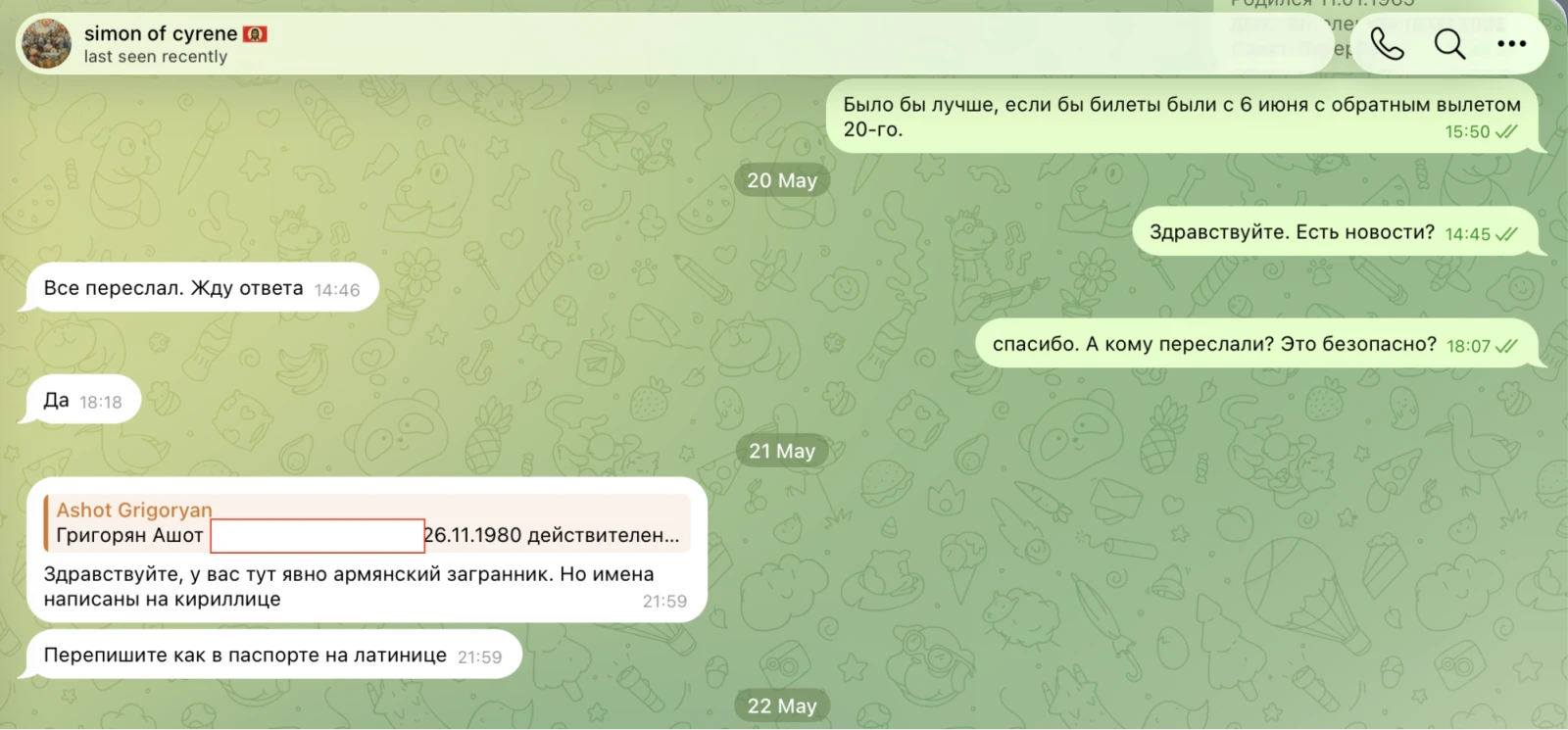
After receiving our fictional data, the interlocutor noted that we had provided details of an “Armenian foreign passport” (армянский загранпаспорт), but the names were written in Cyrillic.
This response is noteworthy because anyone even somewhat familiar with Armenia knows that the concept of a “foreign passport” or “zagranpassport” does not exist here. Therefore, the impression is that our interlocutor is not only unfamiliar with Armenia’s passport system, but is possibly not Armenian at all.
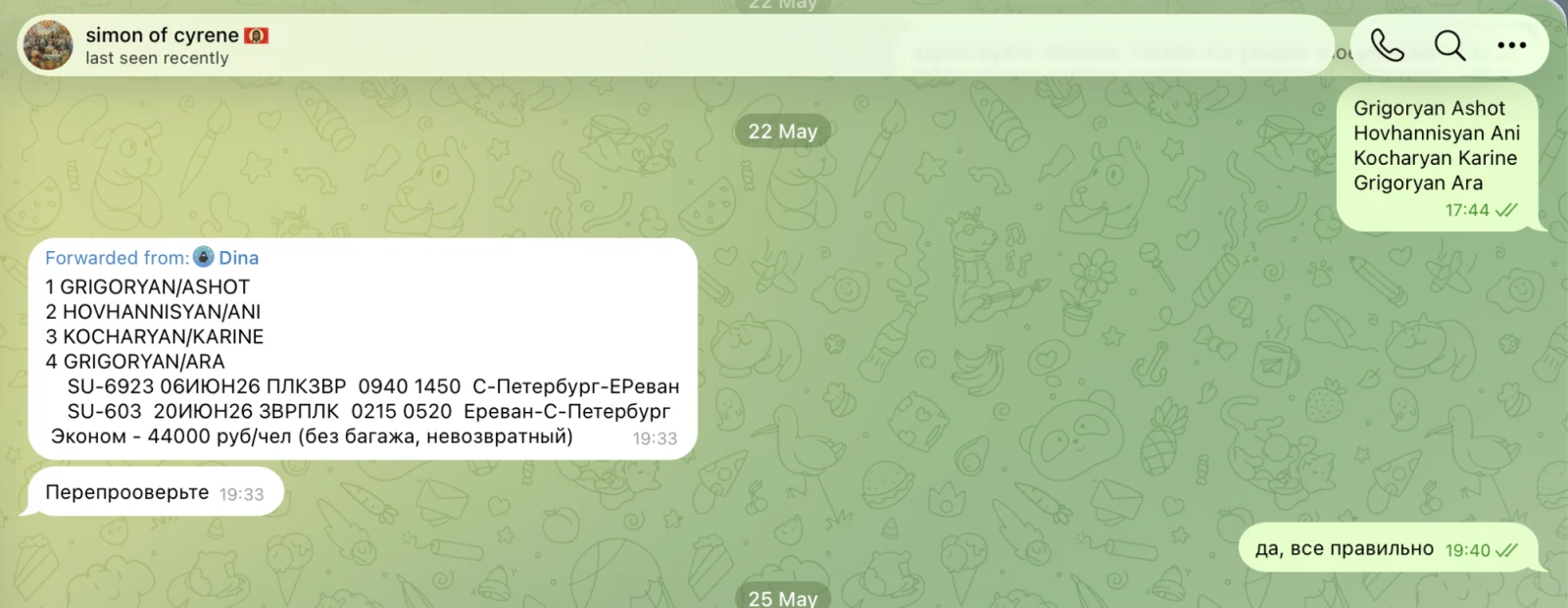
Flight details for four passengers
On May 22, “Simon” sent air-transport details under the names of our four passengers, which in outward appearance resemble itinerary data found on airline reservation systems. They listed the passengers’ names, flight numbers, dates, times, and the ticket price.
As we had requested, the flights were scheduled from St. Petersburg to Yerevan on June 6, and from Yerevan to St. Petersburg on June 20. The price was 44,000 rubles per person in economy class, without baggage, and with non-refundable tickets. That is, they were ready to pay approximately 230,000 drams ($625) per passenger at the current exchange rate, about 910,000 drams ($2,500) in total.
After confirming the itinerary details, we began “preparing” for the trip. Over the following days, we asked several times whether the tickets had been purchased. Each time, the interlocutor assured us the process was underway. On May 31, he replied that he believed we’d receive the final confirmation the following day.
That same day, Badalyan posted a new video message on Telegram, stating that an opportunity had arisen to provide tickets for a larger number of compatriots to travel to Armenia to participate in the elections. He also urged people to contact him quickly, noting that registration would close within the next two days.
The tickets never arrived
On June 1, the Telegram channel Ateo Breaking published screenshots of communication with Badalyan. As in our case, Badalyan promised tickets. The flight date was for June 4 from Moscow. The post spread widely, and Badalyan responded the same day. He stated that he has been speaking openly about such assistance since March 12, and insisted that “thousands of people” have already taken advantage of the opportunity. Badalyan also emphasized that when providing tickets, no political condition or campaign activity is involved, and again urged those who want to travel to Armenia to take part in the elections to contact him via Telegram.
On June 2, our anonymous interlocutor sent a new message, informing us that “unfortunately, there is an opportunity to purchase tickets only for June 4 and only from Moscow.” We replied that we were ready, if necessary, to travel to Moscow as well, if the flight was confirmed. The interlocutor said he would check and get back to us.
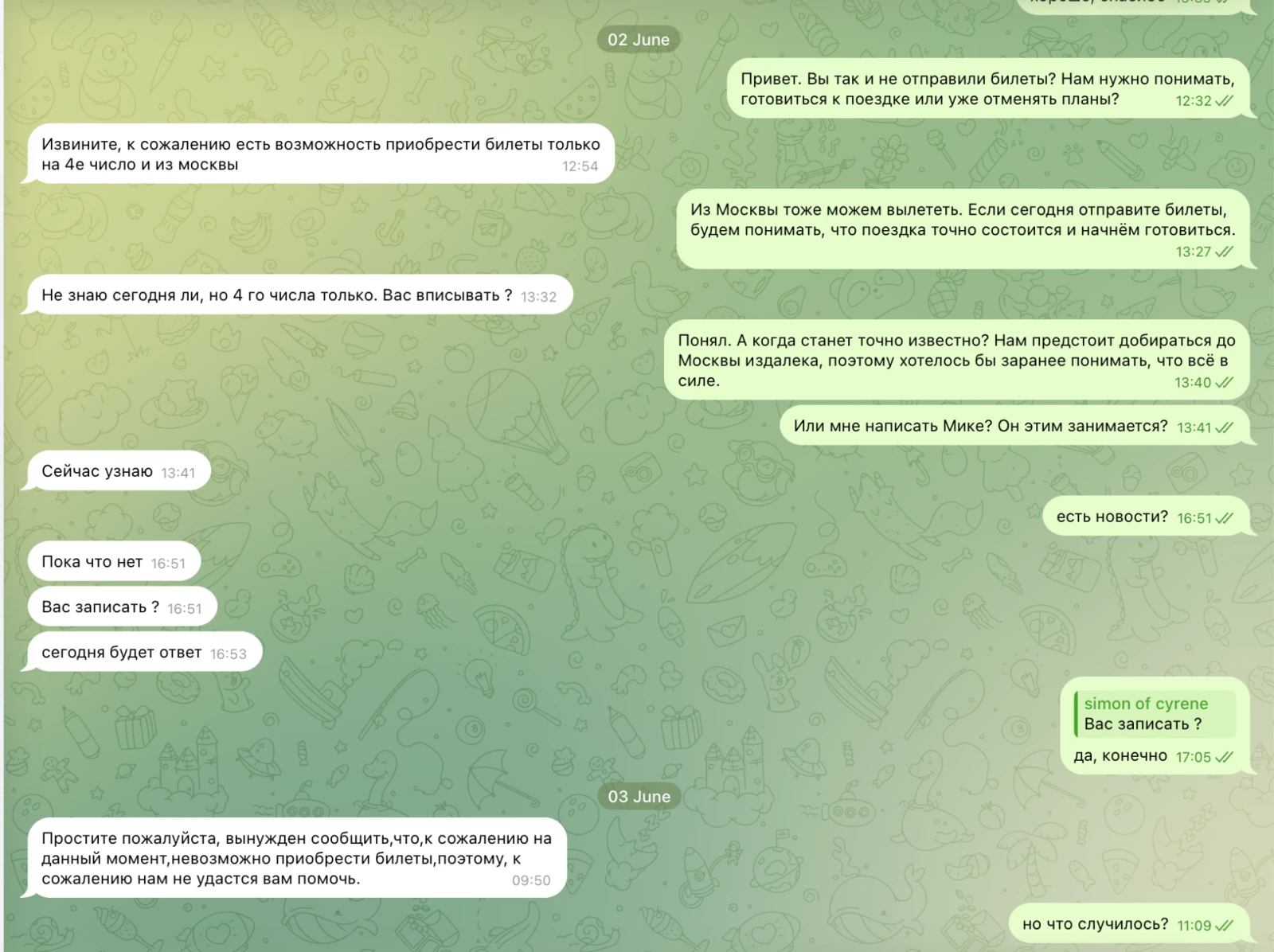
However, on June 3, we received a final answer: “I apologize, but I have to inform you that at this moment, unfortunately, it is not possible to obtain tickets, therefore, unfortunately, we will not be able to help you.” We asked what the reason was, but there was no response.
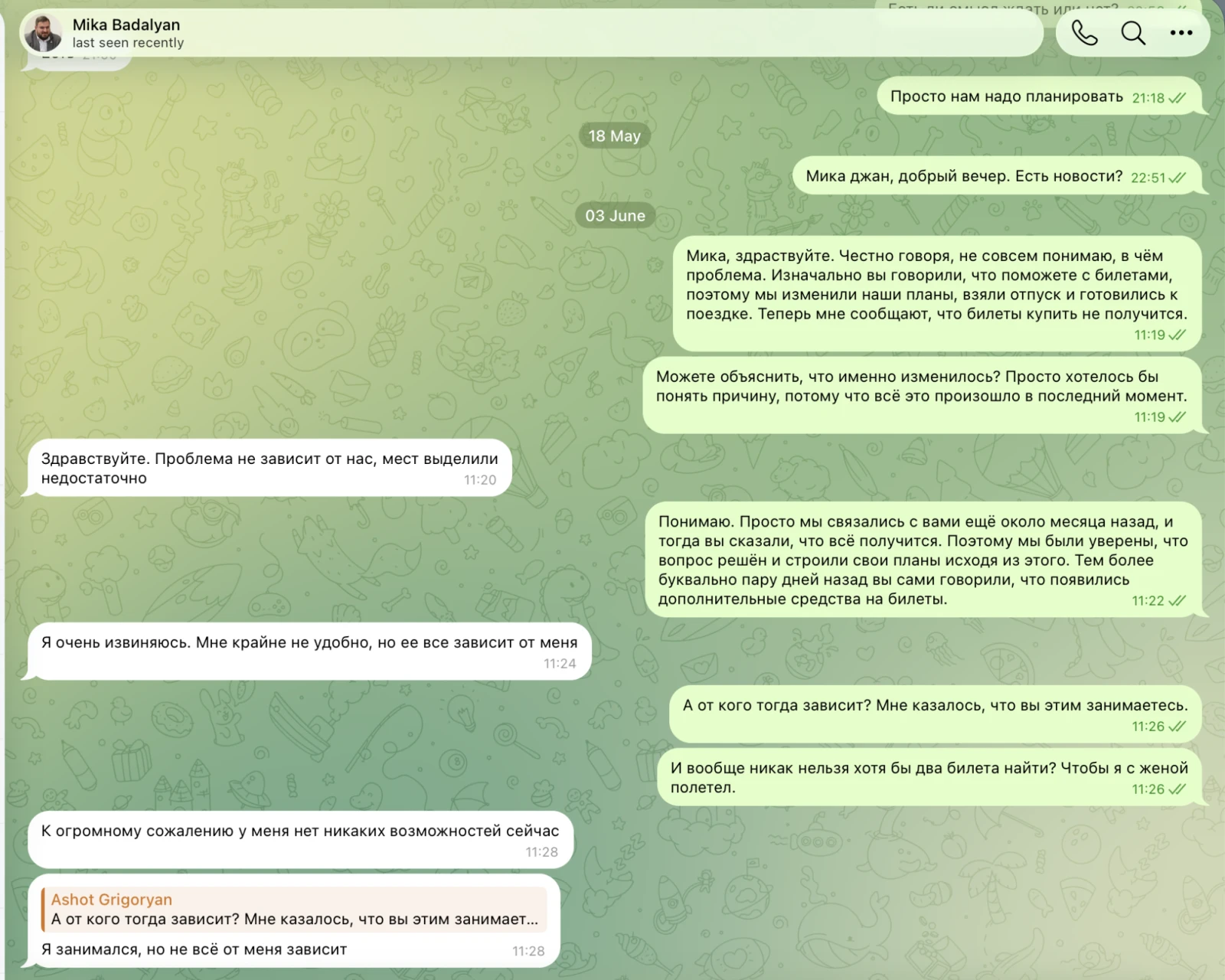
We wrote to Badalyan, expressing dissatisfaction that throughout the entire month they had assured us the issue was resolved, which is why we had already changed our plans, taken vacation time, and were preparing for the trip.
Badalyan replied that the problem did not depend on them and explained that “a sufficient number of seats were not allocated.” When asked who was in charge as he appeared to organize it, reminding him that just two days earlier he had publicly announced new opportunities for tickets. He again insisted that “not everything depends on him.” Asked who, then, the process depended on and whether he was not organizing it, Badalyan replied that yes, he had been organizing it, but again stressed that “not everything depends on him.” We suggested buying at least two tickets, but he replied: “unfortunately, at this moment I have no possibility whatsoever.”
The Anti-Corruption Committee opened a criminal case
Notably, we received the refusal on June 3, the same day the RA Anti-Corruption Committee announced that it had initiated criminal proceedings regarding alleged cases of vote-buying by Mika Badalyan.
According to the committee’s statement, sufficient factual data had been obtained that Badalyan promised services and other advantages to hundreds of RA citizens living in the Russian Federation on the condition that they participate in the parliamentary election. The statement noted that measures are being undertaken to identify citizens who allegedly had their vote bought.
Whether the initiation of criminal proceedings was the reason the tickets were never sent to us is hard to say. However, Badalyan’s explanation that “a sufficient number of seats were not allocated” does not align with his own statements in recent days that there were new opportunities to provide tickets to a larger number of people.
In effect, after weeks of promising us tickets, the process was halted on the very day the Anti-Corruption Committee announced criminal proceedings regarding Badalyan.
It should also be noted that throughout our entire communication, neither Badalyan nor the other user indicated who we must vote for. However, since the process stopped before the final issuance of the tickets, it cannot be ruled out that such a requirement could have been made after the tickets were received.
If tickets were indeed purchased for others, where did the necessary funds come from?
In a conversation with Factor TV, Badalyan claimed that the initiative is financed exclusively by “Armenian philanthropists” who want to help citizens participate in the elections. Asked who those philanthropists are, he replied that they do not want publicity.
However, this topic has also come under the spotlight of international media in recent months. According to a Reuters investigation, the Russian authorities discussed transporting Armenians living in Russia to Armenia in order to participate in the elections. Citing a number of sources, the investigation notes that the Russian side had estimated spending of about $50 million to transport 100,000 voters. Reuters also noted that it could not independently confirm whether the plan was actually being implemented, or how much it could affect the election result.
We cannot confirm whether our investigation into the distribution of tickets organized by Badalyan was related to the scheme described by Reuters.
However, given that Badalyan is involved in the activities of the Eurasia Foundation linked to the Russian authorities, and that the foundation has previously been at the center of accusations in Moldova regarding influence on electoral processes and vote-buying, it cannot be ruled out that his initiative could have been connected to the broader scheme described by Reuters.
This ticket story is only one part of the broader picture of Eurasia’s activities. More about how the organization built its influence in Armenia, the role Mika Badalyan and his associates played in those processes, and how those mechanisms became intertwined with political and public life will be revealed in an upcoming joint investigation by CivilNet and DFRLab.


 Stories