 Karen Harutyunyan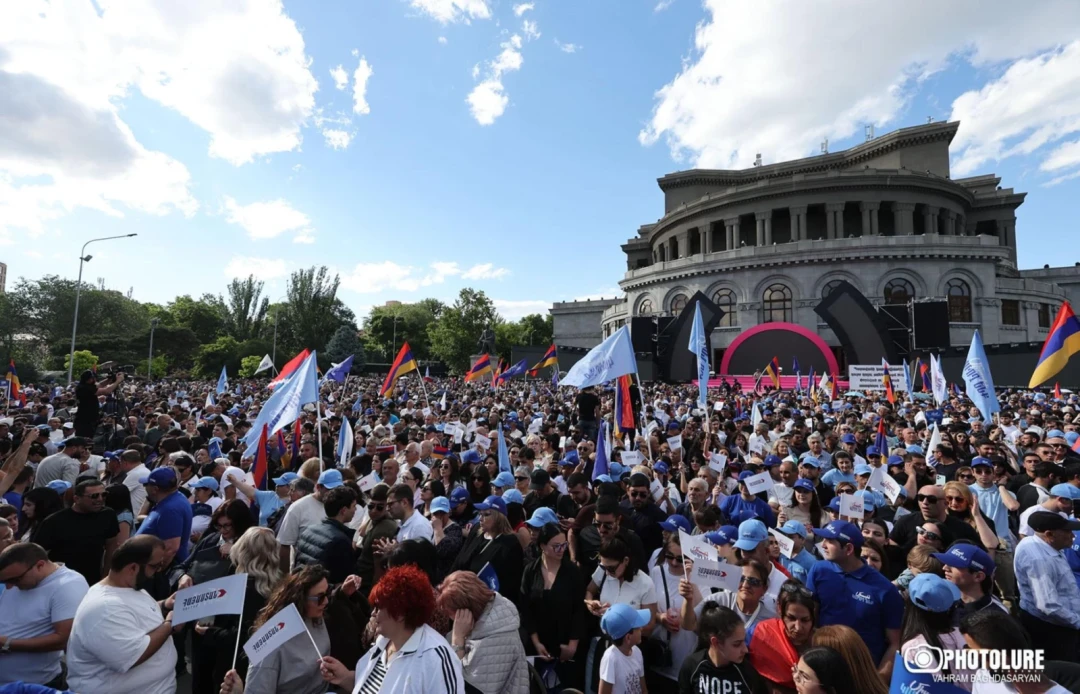
Armenia’s June 7 parliamentary elections resembled a battlefield of information warfare. Media outlets became political actors, while political actors became media outlets. This was compounded by unprecedented domestic and foreign stakes, accompanied by waves of information and disinformation. It felt less like an election in a small country and more like one in a major power.
This geopolitical short circuit between the West and Russia overshadowed the core issues of Armenia’s election campaign, the public’s real sentiments, and the nation’s collective trauma following the devastating defeat of 2020 and the catastrophic loss of Artsakh in 2023.
Everything became geopolitical. Political forces were conventionally divided into pro-Western and pro-Russian camps, even though all of them are essentially post-Soviet-style parties with almost no differences between them.
These alignments were mirrored in the media landscape. While in previous elections, political parties fought through media outlets, in this election, many media organizations became direct participants in the political struggle. Political polarization evolved into information polarization.
Four broad groups of media were active during the election.
Group 1 – Pro-government media
This group includes media outlets serving the government, including TVs, websites and social media pages. Their primary objective was to discredit political opponents.
In some cases, traces of senior government officials could be seen behind disinformation campaigns.
The country’s most widely consumed media outlet, Public Television, continued its biased coverage. “The public television complied with its legal obligation to provide each contestant with 90 minutes of free airtime, but it also displayed clear bias in favour of the ruling party, contrary to its legal obligations and public mandate,” noted the OSCE/ODIHR.
Group 1 also includes proxy media outlets, experts, and influencers who present themselves as independent but largely defend the ruling party. While occasionally criticizing the authorities, they keep opposition figures at the center of their criticism.
During the campaign, the ruling party and its affiliated media promoted a central narrative of peace versus the “three-headed war party.” Prime Minister Nikol Pashinyan used this label to describe the political forces led by Samvel Karapetyan, Robert Kocharyan, and Gagik Tsarukyan. Notably, none of the 18 parties participating in the election employed revanchist rhetoric. Yet that did not prevent some media outlets from spreading narratives unsupported by reality.
Group 2 – Opposition media
This group comprises the media ecosystem serving opposition parties, including television channels, websites, podcasters, and influencers. It is a diverse group representing different political forces. Their primary target was the government, using both information and disinformation.
For both Groups 1 and 2, funding sources remain opaque, except for Public Television. These media outlets and influencers are clearly financed by political figures and business interests. During election campaigns, those financial flows multiply.
Armenia presents an unusual situation. The opposition possesses at least as many — if not more — financial and media resources than the government. This places voters in a more difficult position, as the money invested tends to increase political targeting rather than the quality of content.
Many media outlets in both groups have not published their journalistic ethics principles. In many cases, even their editorial teams are not publicly known.
Group 3 – Russian media
This group includes Russian media operating in Armenia: television channels with terrestrial broadcasting rights, local branches of major Russian news agencies, various websites and social media pages, as well as Armenian media outlets financed by Russia.
The primary targets of both this group and the Russian authorities were Armenia’s government and the issue of European Union membership. Although Armenia passed a law in March of 2025 to launch a process toward EU accession — a law that, in reality, has little to do with an actual membership process — Russia revived the issue during the campaign, urging Armenia to decide whether it was heading toward Europe or remaining in the Eurasian Economic Union.
The Russian information offensive was accompanied by disinformation campaigns on social media and the circulation of fabricated investigations.
Economic pressure accompanied the information campaign. Russia restricted access for Armenian products to its market while simultaneously warning Armenia about the possibility of a Ukrainian-style scenario. It remains unclear whether Moscow’s actions helped its preferred political forces in Armenia or instead consolidated support among the ruling party’s electorate.
Group 4 – Independent media
This group is significantly smaller than the previous three. It can broadly be described as public-interest or independent media. However, it is also almost entirely dependent on grant funding.
A handful of outlets — primarily CivilNet, Azatutyun, Hetq, Factor, and Infocom — remained committed during the campaign to their mission of holding both political forces and the government accountable.
Fact-checkers played a particularly important role within this group, exposing false claims on a daily basis. AI-generated disinformation emerged as a new feature of the campaign. For the first time in Armenia’s political history, a politician's speech was broadcast using AI-generated content.
It should also be noted that several grant-funded platforms — along with think tanks, experts, and influencers — largely defended the government’s line and reinforced its key narratives. They were frequent guests on Public Television and other pro-government platforms.
In the shadow of geopolitics
This was arguably the most geopolitically charged election in Armenia’s history, with both domestic and international actors openly signaling their preferences.
While Russia acted bluntly through information campaigns and economic pressure, the West operated through political and diplomatic channels. The visit of U.S. Vice President JD Vance, Secretary of State Marco Rubio’s stop in Armenia, two European summits held in Yerevan in early May, and the French president’s state visit all demonstrated favorable attitudes toward Armenia’s authorities. The process culminated with U.S. President Donald Trump declaring that he had supported Pashinyan’s reelection. Notably, Azerbaijan and Turkey also made little effort to conceal their preferences regarding Armenia’s election.
Western mainstream media largely covered developments in Armenia through the prism of West-Russia competition, showing little interest in the country’s domestic realities. The impression was that Armenian citizens were choosing not between their own political leaders, but between Putin and the West.
Conventional wisdom assumes that Armenia’s pro-Western orientation is automatically synonymous with democratization. This simplistic approach obscured many of the deeper realities on the ground. Tailoring the truth to audience expectations remains one of the media’s greatest temptations — even for quality media outlets.


 Stories