By Siranush Adamyan
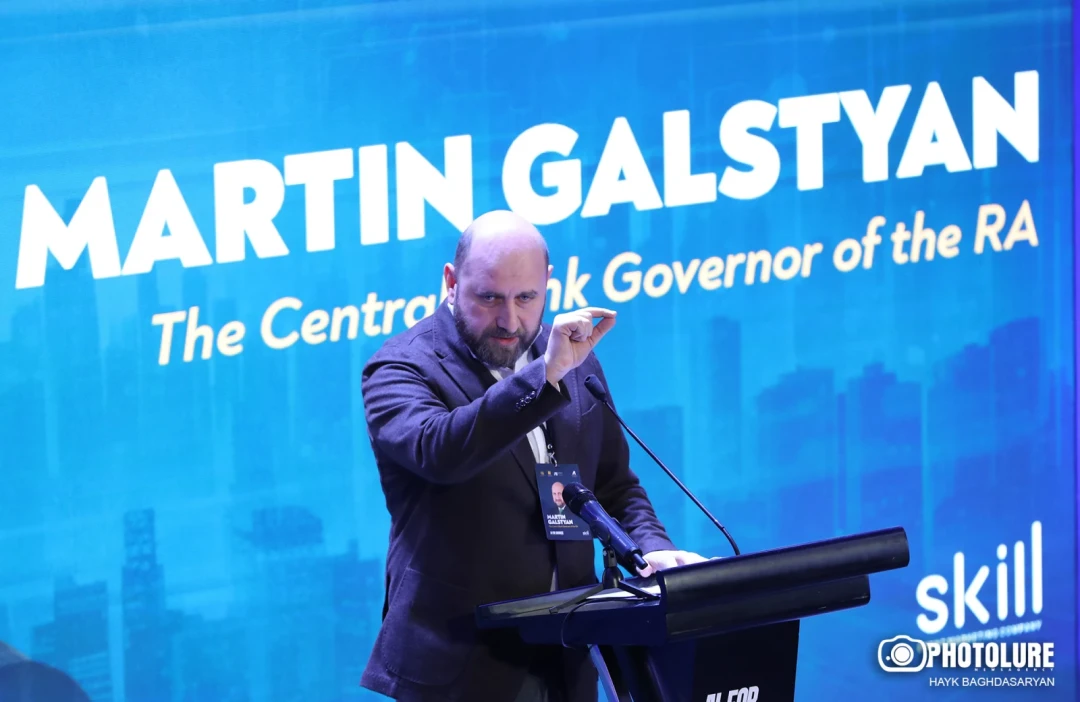
Armenia’s Central Bank Governor Martin Galstyan warned on Tuesday that Russia’s growing restrictions on Armenian imports could have a measurable impact on the country’s economy, potentially affecting output, inflation, exchange rates, and employment.
Speaking at a press conference in Yerevan, Galstyan said the Central Bank had modeled several scenarios following Moscow’s recent moves to restrict imports of Armenian agricultural and food products. He said the restrictions pose primarily deflationary rather than inflationary risks for Armenia.
Russia has imposed a series of restrictions on Armenian exports in recent weeks, including flowers, fish, mineral water, alcoholic beverages and a wide range of fruits and vegetables. Starting June 12, Russia imposed a ban on imports of all quarantine-regulated products from Armenia, citing phytosanitary concerns.
Galstyan said products most exposed to the Russian market include flowers, vegetables, mineral water, alcoholic beverages, and stone fruits. If exporters are unable to find alternative markets and goods remain in Armenia, excess supply could emerge in the domestic market, putting downward pressure on prices.
"Our assessment is that the impact on inflation could reach as much as minus 0.6 percentage points," Galstyan said, adding that the overall economic effect could amount to as much as 2% of gross domestic product under the most adverse scenario.
He stressed that the estimate does not mean Armenia’s GDP would automatically contract by 2%. Rather, it reflects the share of economic activity linked to exports currently affected by Russian restrictions, mainly in agriculture and food processing.
Also read: Russian market closure is catastrophic for Armenian farmers, grower warns
The Central Bank governor acknowledged that reduced exports could also lower foreign currency inflows, potentially putting pressure on the Armenian dram if losses are not offset by other sources of income. He said the bank is also monitoring risks to employment, incomes and loan repayments among farmers and exporters.
Asked whether the government and Central Bank were considering support measures for affected businesses, Galstyan said discussions were underway. He noted that Armenia had previously introduced similar assistance programs during the COVID-19 pandemic and the 2020 war, suggesting existing tools could be reactivated if necessary.
Despite the risks, Galstyan said the outcome would depend largely on whether Armenian producers can redirect exports to new markets.
"If there is an opportunity to change markets and exports do not suffer, the effect will be much milder," he said.
The restrictions come amid deteriorating relations between Yerevan and Moscow. Russia remains Armenia’s largest trading partner, accounting for roughly 37% of the country’s foreign trade, making Armenian producers particularly vulnerable to disruptions in the Russian market.
Also read: Armenia faces sweeping Russian import restrictions across industries




 Stories