By Nicholas Castillo
Armenia now finds its history at the center of politically charged debates removed from any organic effort aimed at genocide recognition. In late June, Israel moved to recognize the Armenian Genocide. With Ankara having leveled charges of genocide in response to Israel’s war in Gaza, the new initiative was broadly read as one more connected to political rather than historical reasoning.
Commenting on the apparent instrumentalization of history by Israel, Armenian Prime Minister Nikol Pashinyan remarked “We see no need to respond because we believe that refraining from entering into the issue of the weaponization of the Armenian Genocide is in the interests of the Republic of Armenia.”
Such a reaction is a far cry from the Prime Minister's response to the U.S. recognition of the genocide in 2021, which he described as “a powerful step on the way to acknowledging the truth, historical justice, and an invaluable [show] of support for the descendants of the victims of the Armenian Genocide.”
For another party, the recent developments in Israel came as yet another diplomatic conflict between two friendly states. Azerbaijan has long counted Turkey and Israel as two of the country’s closest partners, both of which provided substantial military and political support to Baku over the course of Azerbaijan’s assaults on Nagorno-Karabakh in 2020 and 2023.
In the aftermath of Israel’s move to recognize the Armenian Genocide, the Azerbaijani foreign ministry released a statement arguing the development was a “distortion of the historical facts surrounding the events of 1915, and the reduction of a complex historical issue to a political decision.” The statement asked the Israeli government to “reconsider.”
The diplomatic tone of the Azerbaijani press release stands in stark contrast to Turkey’s remarks on the issue. In their response to Israel’s genocide recognition, the Turkish Ministry of Foreign Affairs decried the move as a “malicious attempt” designed to cover up Israel’s own “systematic persecution against the Palestinian people… currently before the International Court of Justice in the case concerning the commission of the crime of genocide against Gazans.”
The latest in Israeli-Turkish confrontations
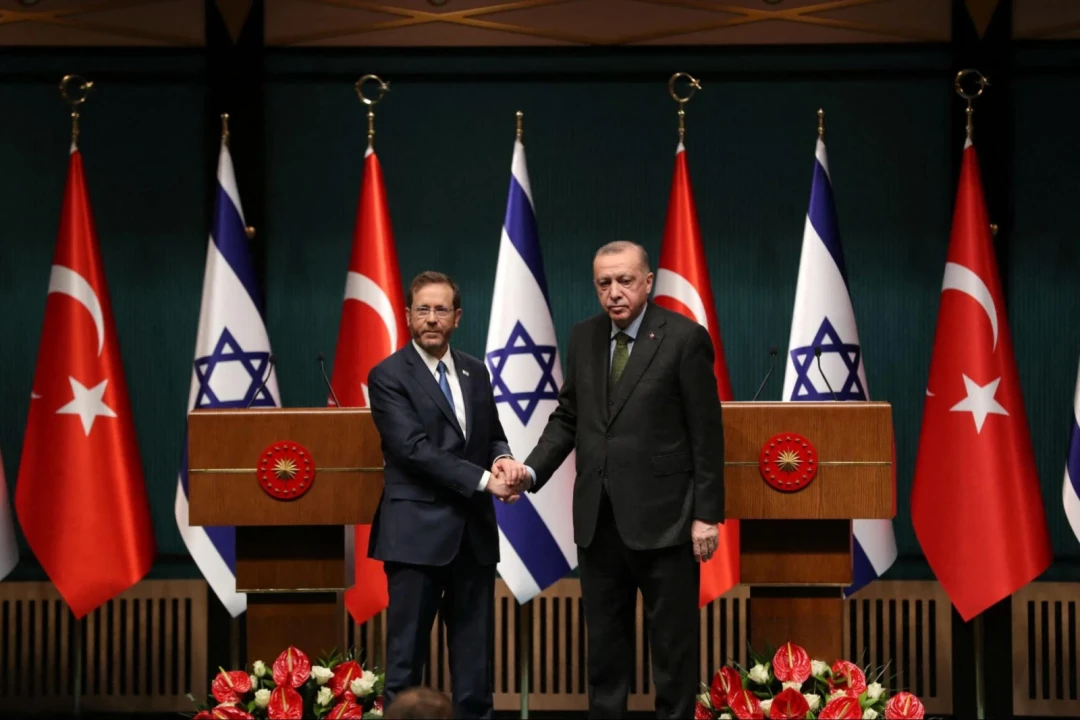
The political use of the Armenian Genocide is only the latest in a series of conflicts between Turkey and Israel. Recent years have seen Turkey sever diplomatic relations and restrict trade with Israel.
As war has enveloped much of the Middle East in recent years, Turkish President Recep-Tayyip Erdogan has sought to firmly depict Turkey as a regional leader, tapping into longstanding appeals to pan-Islamic solidarity. In a speech given as Israel moved to recognize the 1915 genocide, Erdogan addressed his party saying “Be assured; you are the sole hope of Gaza. You are the hope of Damascus rising up, of Aleppo rising from the ashes, of Mogadishu, Khartoum, Beirut, Tripoli, and Tripolitania.”
Forgoing the accusatory language of Ankara, Azerbaijani political elites have labeled the war in Gaza simply a "tragedy" and reiterated calls for a ceasefire and two-state formula.
For their part, Israeli political elites now routinely frame Turkey as a threat. Former Prime Minister Neftali Bennet, a likely challenger to current Prime Minister Benjamin Netanyahu in Israel’s next round of elections, has publicly described Turkey as part of a threatening axis of Muslim countries. He cautioned Israel not to “turn a blind eye” to Ankara.
Netanyahu has echoed similar sentiments, saying in 2024 that Israel "will not accept moral preaching from Erdogan, who supports murderers and rapists of the terrorist organization Hamas, denies the Armenian Holocaust, massacres Kurds in his own country."
“In Israel, there is a growing understanding that after Iran, Turkey may become one of the main long-term security challenges,” Sergei Melkonian, a Research Fellow at Armenia’s Applied Policy Research Institute (APRI) told CivilNet.
This is especially true in Syria, where “the problem for Israel is not only Turkish rhetoric, but also the possibility that Ankara will consolidate military-political influence.”
Azerbaijan’s cautious balancing act
Asked about the tensions between Turkey and Israel in April 2025, President Ilham Aliyev responded: “[B]oth countries are close friends of Azerbaijan… These tensions between the two countries are very disturbing for us.”
“The first successful reconciliation between Turkey and Israel was to a certain degree facilitated by Azerbaijan,” Aliyev went on to say, “We just wanted to help our ally and brother Turkey and our friend Israel to rebuild their relationship.”
Indeed, in April 2025, Israeli officials confirmed that Baku had hosted closed-door diplomatic meetings between Turkish and Israeli officials on deconflicting their positions in Syria, although reporting indicates no agreement was reached.
Yet, Azerbaijan’s close ties to Israel have not been without controversy in Turkey. In 2025, a Turkish member of parliament from the Kurdish Peoples' Equality and Democracy Party attacked Azerbaijan’s defense minister for his visit to Israel, calling it “shameful” and saying “In Gaza, [Azerbaijan] are cooperating on natural gas exploration while genocide continues.”

In response to pressure from Ankara in 2025 Baku removed Israel from its list of official recipients of oil. However, sources report that SOCAR has started using intermediaries to ensure Azerbaijani oil reaches Israeli consumers.
Erdogan and members of his ruling party have been notably silent on Azerbaijani-Israeli ties.
Overall, it would seem Baku has proven itself capable of managing these tensions so far. It has all at once deepened ties with Turkey and Israel since October 2023, for instance expanding its role in the energy sector of each. The past year has seen efforts by Azerbaijan and Israel to formulate a trilateral partnership between Baku, Washington, and Tel Aviv. Even as Azerbaijan publicly expressed opposition to Israel and the United States’ war in Iran, recent reporting indicates Baku allowed Israeli forces to operate from within the country during the confrontation.
“Azerbaijan does not want to choose between Ankara and Tel Aviv,” Melkonian said, “Both are important for its security: Turkey as Azerbaijan’s main political and military ally, and Israel as a key partner in military-technical cooperation, intelligence, energy, and the Iranian dimension. For Baku, weakening one of these relationships would increase dependence on the other.”
As Azerbaijan’s efforts to host diplomatic back-channels demonstrate, the split between two Middle Eastern regional powers has even granted Baku greater political importance.
Is Armenia stuck as an onlooker?
For Armenia meanwhile, this latest clash of histories between Ankara and Tel Aviv would seem to create few if any diplomatic openings. Recently, Yerevan has voiced interest in better relations with Israel, a task made difficult and controversial due to Israel’s ties to Azerbaijan and role in providing weapons to Baku.
There have been policy discussions around Armenia and Azerbaijan both joining the Abraham Accords diplomatic platform. Initially organized around Arab states offering Israel diplomatic recognition, the initiative has transformed into a more vaguely defined U.S.-led diplomatic grouping. Kazakhstan, despite recognizing Israel since independence, joined the group last November.
However, the increasing tenor of the Israel-Turkey confrontation may provide additional costs to either Baku or Yerevan increasing ties to Tel Aviv. Especially for Armenia, still pushing forward a politically delicate process to normalize relations with Turkey, it is logical that policymakers would seek to minimize such risks. This is likewise true with Iran, an important partner for Armenia.
Therefore, the reemergence of the issue of genocide recognition seems likely to only create additional controversies of the kind Pashinyan has worked to avoid. Sponsored by Israel as part of its broader feud with Turkey, the sort of diplomatic opening genocide recognition may have fostered in a different context is largely lost.
The extent to which Israel even desires closer ties with Armenia remains unclear. While Armenia has maintained an embassy in Israel since 2020, Israel has yet to reciprocate.
“Israel is unlikely to risk its existing alliance with Azerbaijan for the sake of improving relations with Armenia,” Melkonian told CivilNet.
“For Israel, Azerbaijan has already become an established strategic partner, while Armenia cannot offer an equivalent replacement.”
In this context, Tel Aviv’s move to politicize Armenian history would appear to generate few opportunities for Yerevan.

 Stories