By Hrair Balian
Defeated in the 2020 and 2023 wars, without a military deterrent or a defense treaty ally, Armenia’s only realistic alternative to renewed war is a negotiated de-escalation with Azerbaijan. But the weakness that makes negotiation necessary also makes it perilous. Without firm red lines on issues not formally on the table, further concessions risk reducing Armenia to a client state and confirming to Baku that demands can be escalated indefinitely at little cost, without necessarily preventing another attack.
The process has produced interim de-escalation, not a ratified treaty, and the asymmetry behind it remains unaddressed. Comparative cases and the literature on asymmetric negotiation agree: settlements that leave the founding power imbalance intact, resting on a single patron’s goodwill rather than binding multilateral enforcement, are the most fragile. Judged against that record, the Armenia–Azerbaijan process sits closer to Ethiopia–Eritrea’s ill-fated Algiers Agreement than to Bosnia’s Dayton or Northern Ireland’s Good Friday Agreement.
Initialed, not signed
On 8 August 2025 in Washington, the Armenian and Azerbaijani foreign ministers initialed — but did not sign — a peace agreement. A year later, a joint US–Armenia–Azerbaijan statement reaffirmed commitment to implementation “in letter and spirit,” leaving Azerbaijan’s precondition for signing in place. As a RAND commentary put it, “at present the peace agreement exists in diplomatic limbo: agreed but not signed, a roadmap for the future but also a bone of contention in the present.”
Azerbaijan’s precondition is an amendment to Armenia’s constitutional preamble, which references the 1990 Declaration of Independence and, by extension, the 1989 Armenia–Nagorno-Karabakh unification act. Aliyev says the treaty could be signed “the next day” once the constitution is changed; his aide Hikmet Hajiyev reiterated the precondition in August 2026. The only route is a new constitution ratified by referendum, which first requires a two-thirds parliamentary vote. Pashinyan’s Civil Contract won the 7 June 2026 election with 49.81% and 64 seats, against Strong Armenia’s 29 and Armenia Alliance’s 12. That three-fifths majority suffices for ordinary constitutional laws but leaves the ruling party six votes short of the 70 needed to send a new constitution to voters without opposition support. Even if that bar were cleared, the amendment is widely understood in Armenia as the price of peace dictated by Azerbaijan rather than a reform Armenians chose — a harder sell than the arithmetic suggests. Yerevan points toward 2027 without a firm date.
The unsigned treaty also keeps the Armenia–Türkiye border, closed since 1993, hostage to Azerbaijani objection, despite Ankara’s 2022 agreement to open it as a first step. On the positive side, by Aliyev’s own account there has been no shooting on the border since the Washington summit; the functional cease-fire holds independent of the treaty’s legal status. But a Russia–Azerbaijan rapprochement since October 2025, alongside renewed Russian interference in Armenia, complicates the US-versus-Russia framing the summit implied, and Iran’s opposition to a US-anchored corridor on its border entangles the process in a wider contest neither Yerevan nor Washington controls.
The data hint at further risk. The 2026 Global Peace Index ranks Armenia 51st of 163 countries (“high” peacefulness, up 21 places) and Azerbaijan 121st (“medium,” down eight). Baku’s slide is not dispositive, but it plausibly signals domestic pressures that could unravel the current “negative” peace — the mere absence of war — rather than build a “positive” peace that removes the conflict’s root causes.
What the treaty leaves out
Three issues outside the treaty text bear on whether a signature would settle the conflict or merely formalize a cold peace between elites — and whether Armenians experience the outcome as negotiated peace or capitulation.
Hostages. Nineteen Armenians captured during and after the wars — including three former Nagorno-Karabakh presidents and former state minister Ruben Vardanyan — have been sentenced by Azerbaijani military courts in closed proceedings, five to life and the rest to 15 to 20 years, on charges Amnesty International and their lawyers call procedurally void or fabricated. Lawyers of their choice were denied and international monitors barred. The peace process offers no mechanism for their release or independent review. Indeed, “For many Armenians, the prisoners ... remain the clearest sign that the war has not fully ended.”
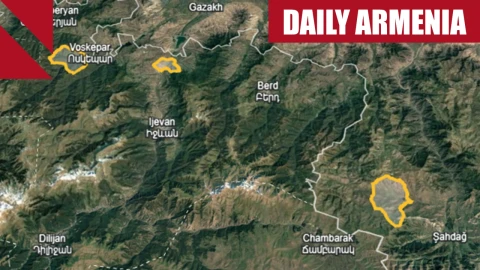
Territory. An estimated 240 square kilometers of internationally recognized Armenian territory, seized in 2021–2022, remains under Azerbaijani control, and only about 12 kilometers of the 996-kilometer border — a single Tavush segment settled in 2024 — has been delimited and demarcated. Piecemeal delimitation forecloses the territorial swaps that could resolve the Soviet-era enclaves stranded on both sides.
“Western Azerbaijan.” Through 2026, Azerbaijani state and quasi-state bodies intensified a campaign asserting a right of return for 300,000 Azerbaijanis to a fabricated “Western Azerbaijan” in present-day Armenia — a claim with no basis in the treaty or in history, which Pashinyan has had to deny repeatedly and which feeds the perception of a process that generates new demands rather than closing old ones.
A corridor that must pay both ways
TRIPP, the Trump Route for International Peace and Prosperity, is the process’s most concrete deliverable. A company 74% US-owned and 26% Armenian holds 49-year rights to a 42-kilometer route across Syunik linking mainland Azerbaijan to Nakhichevan, with onward extension toward Türkiye as part of the Middle Corridor from Central Asia to Europe, on a rail alignment still under a Russian Railways concession that Yerevan has begun to contest. Construction is expected to begin in late 2026, and Yerevan presents the corridor as Armenian sovereign territory under lease.
The question that matters is what Armenia receives in return. It provides the territory and absorbs the sovereignty risk, while its own gains depend on processes it does not control. Reciprocity is what would turn hosting into partnership, and it is precisely what remains unresolved. The framework references Armenian transit rights across mainland Azerbaijan and Nakhichevan but does not define or operationalize them — rights that would give Armenian goods and travelers routes east and south that the closed borders have denied them for three decades. Whether the route continues through Yerevan and Gyumri before entering Türkiye — making Armenia a transit economy rather than a mere passage — is undecided. And Ankara still conditions the border opening that would give the corridor its value to Armenia on a signed treaty with Azerbaijan. With the EU excluded from TRIPP’s governance despite its Resilient Syunik and Global Gateway investments, no second guarantor stands behind Armenian reciprocity. These benefits must be written into the contract before construction begins, not settled as an afterthought.
Leverage and its limits
Azerbaijan’s military dominance removes any need to use force to extract concessions. The constitutional precondition is a high-value lever: Yerevan absorbs all the domestic risk of a referendum while Baku claims “peace already exists in practice,” and Turkish alignment plus its own rail construction give Baku a second track toward Nakhichevan connectivity that does not strictly require a treaty. Its vulnerabilities are reputational: the Moscow rapprochement irritates Washington, indefinite deferral will eventually read as bad faith, and the detention of Nagorno-Karabakh leaders in Baku and continued occupation sit awkwardly beside the “peace achieved” narrative.
Armenia’s strengths are modest: a renewed, if flawed, electoral mandate; diversification toward the EU and US that reduces its historic dependence on Russia; and a quiet border that slowly normalizes “peace without signature,” raising the reputational cost of renewed coercion. Its core vulnerability is structural. The loss of Nagorno-Karabakh eliminated the territorial buffer and irregular-force reserve that had underpinned its security for three decades, while underinvestment in drones, air defense and modern command left its military unable to deter a renewed offensive. Its CSTO membership proved worthless; its Western partnerships carry no security guarantee. Yerevan has therefore conceded to nearly every sequential demand — territorial withdrawal, the dissolution of Nagorno-Karabakh’s institutions, and now the constitutional precondition — not because each was acceptable but because the assessed alternative was defeat. Each concession removes a card Armenia might have played against the next demand while showing Baku that pressure pays. The 2027 referendum could fail procedurally and substantively, since many voters object on principle to amending the constitution at Azerbaijan’s insistence; and Russia, after its June 2026 interference, would find a referendum campaign a richer target.
Lessons from elsewhere
Dayton (1995) and the Good Friday Agreement (1998) bound guarantors — NATO in Bosnia, the British and Irish governments in Northern Ireland — to enforce specific terms, putting their own credibility at stake. At Algiers (2000), Ethiopia ignored a “final and binding” boundary ruling for over a decade while compliant Eritrea bore sanctions; the UN and AU never used their leverage. Legal form does not predict durability; guarantor commitment does. TRIPP’s US equity stake nods toward the Dayton logic, but its bilateral structure and the EU’s exclusion leave it thinner than either durable comparator. Meanwhile the weaker party carries the settlement’s domestic political risk while the stronger party’s obligations rest, as at Algiers, on goodwill.
The literature agrees. The stronger party tends to dominate asymmetric negotiations, whether its power is real or self-perceived; settlements that embed the asymmetry are the least durable; and soft-power assets such as Armenia’s diaspora and Western ties rarely offset a hard-power gap without a guarantor willing to enforce. As four Canadian peacebuilders warn, “while strength through force may feel comforting, it is a short-sighted strategy,” producing “transactional ... diplomacy in the shadow of force.”
Holding red lines
Armenia cannot enforce red lines militarily. It must instead use sequencing, declining to advance on Azerbaijani preconditions until parallel Armenian conditions are met; internationalization, making violations visible and costly with Western and multilateral audiences; and domestic legitimacy, refusing to let a bare or fabricated majority commit the country to irreversible concessions. This does not eliminate the risk of renewed aggression, but pre-emptive capitulation forfeits even the leverage Armenia has. Concretely, Yerevan should:
● treat territorial integrity beyond a signed delimitation agreement as non-negotiable, and negotiate the border as a package, including an exchange of enclaves;
● make TRIPP’s reciprocal benefits — defined transit rights and Yerevan–Gyumri routing — contractual preconditions, not details to settle after construction begins;
● hold the referendum only on genuine cross-party consensus;
● refuse to sign without a binding mechanism for the release of the nineteen detainees/hostages;
● deepen security ties with France, India and other partners rather than return to dependence solely on Moscow.
If Baku wants genuine peace, it should retire the “Western Azerbaijan” campaign and stop using its de facto veto over Turkish normalization with Armenia. Ankara has its own reasons to implement the 2022 agreement now: an open border would unlock the Kars–Gyumri railway, revive isolated eastern provinces, and strengthen its role as an East–West transit hub and its standing in the West. The realistic task is to raise the cost of its deference to Baku. The international community, for its part, should build incremental stakes — sustained US investment, an EU seat in TRIPP’s governance, OSCE or Council of Europe border monitoring, a mechanism on the detainees — that raise the cost of unraveling the cold peace.
None of this is a case against the peace process; an unsigned status quo is preferable to war. It is a case against mistaking the absence of shooting for the resolution of the asymmetry that produced the war — and against letting the parties or their guarantors treat that asymmetry as settled simply because it is no longer actively contested.
Hrair Balian has served in leadership positions with the UN, the OSCE/ODIHR, and NGOs, including the Carter Center and the International Crisis Group. During a 35-year career in public service, he has worked on conflict resolution, elections and human rights in the Balkans, Eastern Europe, Caucasus, Central Asia, Middle East and Africa. Balian has taught conflict resolution, negotiations, and mediation at the Emory University School of Law (2008-2018). Book publication – Anatomy of Peacemaking: Nagorno-Karabakh Conflict & Missed Opportunities (Springer Nature / Palgrave Macmillan, February 2026); Armenian translation (Newmag, April 2026).


 Stories