By Siranush Adamyan
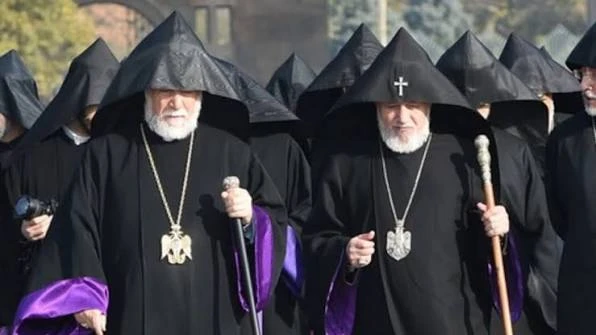
Catholicos Aram I of the Great House of Cilicia, the Eastern Diocese of the Armenian Church of America, the Primate and Diocesan Council of the Armenian Diocese of Canada, and several bishops from Europe and the Middle East have issued separate statements criticizing the criminal case against Catholicos of All Armenians Karekin II and six members of the Supreme Spiritual Council ahead of their first court hearing on Aug. 7.
The case, which will be heard at the Vagharshapat Court of First Instance, accuses Karekin II and the six bishops of failing to execute a judicial act by refusing to comply with a court order requiring the temporary reinstatement of Bishop Gevorg Saroyan. The Armenian Apostolic Church argues that the appointment and dismissal of bishops are matters governed exclusively by canon law and fall outside the jurisdiction of state authorities.
Aram I described the trial as "unacceptable and condemnable," saying he had remained in close contact with Karekin II throughout the proceedings.
"We expressed our deep indignation to His Holiness Karekin II and even suggested that he not appear before the court but instead send a representative," Aram I said. He also called on Armenia's state authorities to show "respect toward our Church and His Holiness" and to resolve disputes "within the bounds of mutual understanding and propriety, while respecting both the laws of the state and the internal order and canons of the Church."
The Primate and Diocesan Council of the Eastern Diocese of the Armenian Church of America likewise voiced "profound concern" over the Armenian government's decision to prosecute Karekin II.
"The Constitution of the Republic of Armenia recognizes the Armenian Apostolic Church as the National Church and affirms its right to self-governance," the statement said. "Questions concerning the governance, discipline, and leadership of the Church properly belong within the orbit of the Church's own canonical order. We believe that bringing matters of ecclesiastical governance before the civil courts is inconsistent with centuries of precedence and the constitutional recognition of the Armenian Church's right to self-governance."
The statement urged all sides to exercise "wisdom, restraint, and a renewed commitment to dialogue," expressing hope that the dispute would be resolved in a way that respects Armenia's Constitution, the Church's canonical traditions and the unity of Armenians in both Armenia and the Diaspora.
The Primate and Diocesan Council of the Armenian Diocese of Canada also criticized the criminal proceedings, warning that prosecuting the spiritual leader of the Armenian Apostolic Church over matters of internal governance could set "a dangerous precedent" for the protection of religious freedom and the autonomy of religious institutions.
Bishop Tatev Hakobyan, Primate of the Armenian Diocese of Romania, described the proceedings as "the most shameful trial in 21st-century Armenian reality." He argued that, instead of acknowledging mistakes made after the loss of Nagorno-Karabakh and fostering national unity, the authorities were targeting "the institution that has for centuries been the Armenian nation's last and most reliable refuge." He also warned that history showed attempts to silence the Church only deepen moral crises and ultimately harm society.
In a joint statement, Bishop Armash Nalbandian of Syria, Bishop Serovbe Isakhanyan of Germany and Bishop Oshagan Gulgulian of Iraq said the case raised "pain and concern" and could call into question Armenia's commitment to freedom of religion, the rule of law and the autonomy of the Armenian Apostolic Church. They urged the authorities to avoid actions that deepen public divisions and instead return to constructive dialogue.
Earlier this week, the Armenian General Benevolent Union (AGBU), one of the world's largest Armenian diaspora organizations, also called on the Armenian authorities to withdraw the indictment against Karekin II and the six bishops. AGBU said the case concerned "an internal ecclesiastical matter" that should be resolved through the Church's canonical procedures rather than the criminal justice system, warning that the prosecution raised serious concerns about religious freedom, church autonomy and the rule of law.
The statements add to growing international criticism of the case. Earlier, Norway-based religious freedom watchdog Forum 18 argued that the prosecution violated the Armenian Apostolic Church's constitutionally protected autonomy, while six United Nations human rights experts separately questioned Armenia's use of terrorism charges in another case involving senior clergy, raising broader concerns about religious freedom and the application of international human rights standards.




 Stories