By Lia Avagyan
Former Nagorno-Karabakh officials, Armenian scholars and civil society figures have criticized a recent Azerbaijani-organized visit to Nagorno-Karabakh by foreign diplomats, accusing Baku of using the tour to promote its account of the region’s Armenian cultural heritage.
The criticism has drawn no public response from Armenia’s government or major state academic institutions. As of Sunday, neither the Foreign Ministry nor the Culture Ministry, nor leading state-funded academic bodies and their heads, had issued a statement or social media posts about the visit and Azerbaijan’s presentation of Armenian monasteries as Caucasian Albanian.
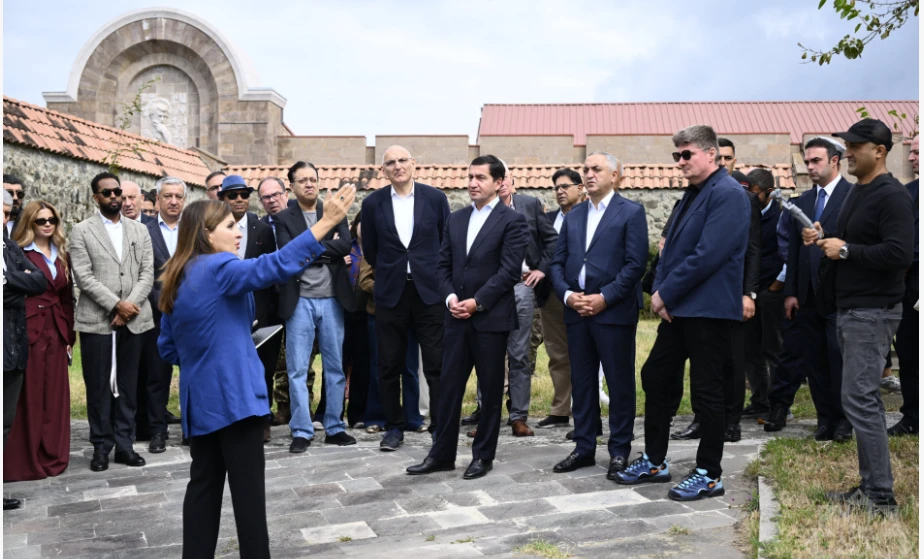
The Sept. 11-12 tour brought together representatives from 58 countries and nine international organizations, Azerbaijan’s state news agency AZERTAC said. The group visited Stepanakert, Shushi, Gandzasar Monastery and Dadivank Monastery with Hikmet Hajiyev, foreign policy adviser to Azerbaijani President Ilham Aliyev.
The delegation included European Union Special Representative for the South Caucasus Magdalena Grono and France’s ambassador to Azerbaijan, Sophie Lagoutte, according to Azerbaijani and Armenian reports. Baku did not publish a full list of participants.
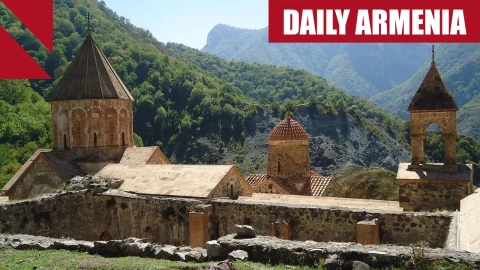
Hajiyev said Gandzasar and Dadivank were part of Caucasian Albanian Christian heritage, and accused Armenians of altering the monuments during the three decades when the region was under Armenian control. Azerbaijan says it is committed to protecting and restoring all religious and historical sites under its control.
Also read: Azerbaijan presents Armenian monasteries as Caucasian Albanian during diplomats’ Karabakh tour
Sergey Shahverdyan, Nagorno-Karabakh’s former culture and tourism minister, wrote an open letter to diplomatic missions in Armenia after the visit.
“If you visit Stepanakert, you must ask where its former residents are,” he wrote. “If you visit an Armenian monastery, you must ask why its Armenian identity is being altered.”
Shahverdyan, who said his own home had stood in what is now Stepanakert’s Victory Park, said diplomats should not become part of a narrative that presents the displacement of the Armenian population as “victory” and “liberation.”
“You must not allow ethnic cleansing to be turned into a tourist itinerary,” he wrote.
Hayk Khanumyan, the former minister of territorial administration of Nagorno-Karabakh, said in a Facebook post that European diplomats were becoming “playthings for the whims of authoritarian leaders in Azerbaijan,” before returning to Yerevan to speak about values.
Former Nagorno-Karabakh State Minister Artak Beglaryan said the tour had raised questions about the diplomats’ conduct. “At the very least, they should make public statements on the ethnic cleansing of the Artsakh true owners,” he wrote in an X post.
Historian Karpis Pashoyan said the Azerbaijani presentation at Gandzasar ignored the Armenian-language inscriptions, khachkars and written historical sources at the complex. He said the diplomats who participated, including Grono, “effectively legitimize the destruction of Armenian cultural heritage and the ethnic cleansing of Armenians through their silence,” according to his Facebook post.
Pashoyan also challenged a video circulated by Hajiyev that showed books with blank pages at Gandzasar. Hajiyev presented them as evidence that Armenians had fabricated the monastery’s history.
Laura Baghdasaryan, director of the Region Research Center, also questioned why none of the diplomats featured in the video appeared to ask why supposedly fabricated books would have been left behind for Azerbaijan’s officials to find. She said the more striking part of the video was the audible surprise and laughter of some visitors.
Gayane Abrahamyan, head of the For Equal Rights NGO, said basic questions should have arisen about the books. Manuscripts and artworks of historical value are generally not kept in a conflict zone, she wrote in a Facebook post.
She added a note of caution: “We have information disseminated by only one side,” referring to the Azerbaijani video.
Ethnographer Arsen Hakobyan recalled a separate episode from 2004, when he said Armenian inscriptions were removed during the Norwegian-funded restoration of St. Yeghishe Church in the Udi village of Nij, Azerbaijan. He said Norway’s ambassador to Azerbaijan had declined to attend the reopening and compared the destruction to the Taliban’s demolition of the Bamiyan Buddhas.
The response has also touched on the wider peace process. Gemafin Gasparyan, founder of BOON TV, said in a Facebook post that the visit undermined the fragile trust needed for peace. He suggested that the Matenadaran manuscript museum organize an exhibition of original manuscripts for diplomats accredited in Armenia.
Publicist Gor Madoyan mocked what he called the “era of peace” between Armenia and Azerbaijan, saying Hajiyev’s description of Gandzasar and the Hasan-Jalalyans as Caucasian Albanian sat uneasily with official rhetoric about reconciliation.
. . .
The tour took place nearly three years after Azerbaijan’s September 2023 military offensive in Nagorno-Karabakh, which prompted more than 100,000 ethnic Armenians to flee to Armenia within days. The region has remained inaccessible to displaced Armenian residents and independent international heritage specialists.
Caucasus Heritage Watch, a research initiative based at Cornell and Purdue universities, monitors cultural sites in Nagorno-Karabakh through satellite imagery. Its June 2024 report found a 75 percent increase in destroyed Armenian heritage sites between fall 2023 and spring 2024, alongside a 29 percent rise in sites classified as threatened.
The group confirmed in April that the Holy Mother of God Cathedral in Stepanakert, consecrated in 2019, had been demolished between March 3 and April 2. It says satellite imagery cannot reveal all forms of cultural erasure, including the removal of inscriptions or the recasting of Armenian monuments as Caucasian Albanian.

 Stories