 Alexander Pracht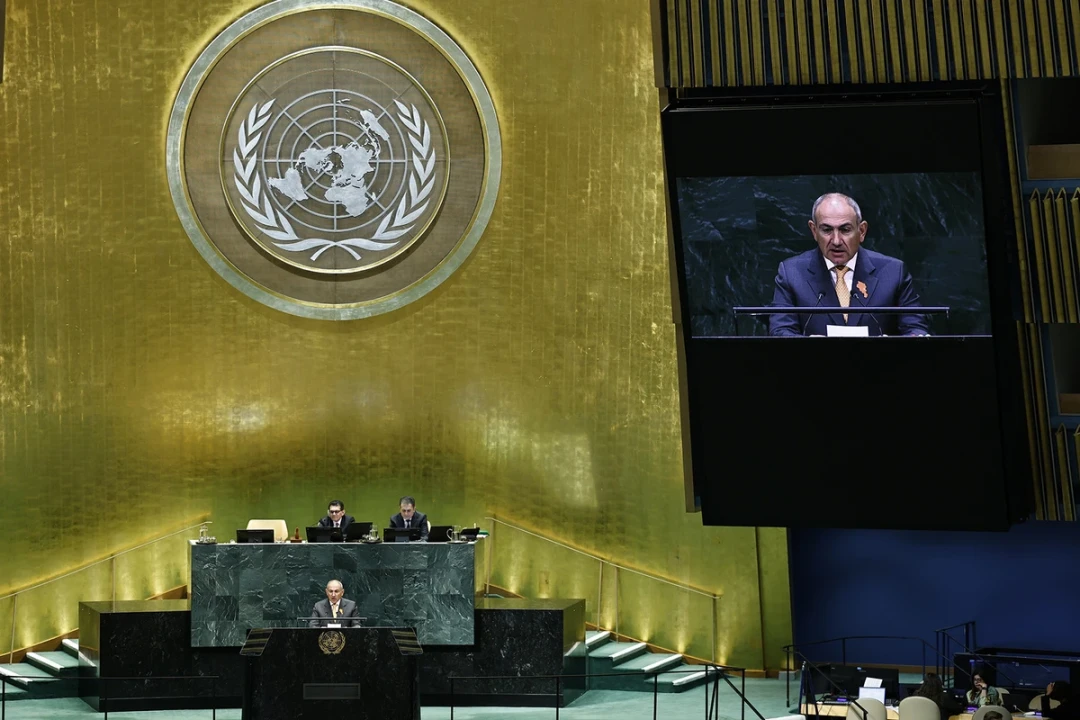
Armenia’s Prime Minister Nikol Pashinyan addressed the recent diplomatic scandal involving Azerbaijani officials and Armenian cultural heritage in Nagorno-Karabakh as he spoke at the United Nations General Assembly on Thursday.
“[Something] that fuels pessimistic sentiments is the occasional use of confrontational rhetoric in certain circles of Armenia and Azerbaijan, sometimes at the official level. I think that we, I mean Armenia and Azerbaijan, have achieved more than sufficient results, which should be more valuable for us than the use of confrontational rhetoric, whether it is about history or cultural monuments or anything else,” the prime minister said.
This remark is a reference to an incident earlier this month that involved Azerbaijani presidential aide Hikmet Hajiyev and foreign diplomats based in Azerbaijan. Hajiyev led a tour to Nagorno-Karabakh for the diplomats, during which the group visited medieval Armenian monasteries Dadivank and Gandzasar. During the tour, Hajiyev presented the monasteries as Caucasian Albanian heritage rather than Armenian, while also calling them by their Azerbaijani names rather than their original Armenian ones.
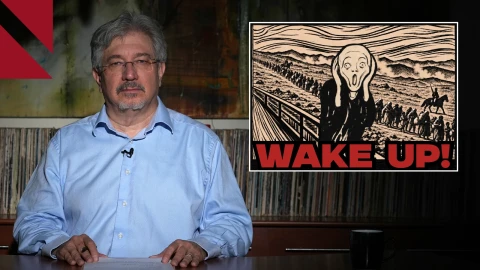
Also watch: Diplomatic tour to Karabakh stirs uproar over historical revisionism
This rhetoric is part of a broader strategy prevalent in Azerbaijan in recent decades aimed at negating and erasing Armenian cultural heritage and presence in the South Caucasus. According to Baku’s pseudohistorical concept, rejected by reputable scholars outside the country, the Christian heritage in the region is attributed to a genuine early medieval kingdom of Caucasian Albania rather than Armenia. Baku portrays Azerbaijanis as direct descendants of Caucasian Albanians and Armenian heritage as their own, while also describing modern Armenians as descendants of newcomers who arrived in the region in the 19th century.
These claims are widely regarded as anachronistic: for example, both the Dadivank and Gandzasar monasteries in Karabakh were built as Armenian churches centuries after Caucasian Albania had ceased to exist.
Hajiyev’s remarks prompted responses from Armenian officials, including Pashinyan and parliamentary speaker Ruben Rubinyan, who described the statements as false, unacceptable and obstructive to peace efforts.
In his speech at the United Nations, Pashinyan also addressed the issue of Armenian detainees held in Azerbaijan.
“In the relations between Armenia and Azerbaijan, the clarification of the fate of several thousand missing persons is a matter that needs to be addressed, on which we have reached an agreement to cooperate with Azerbaijan. Armenia is ready to continue and deepen cooperation with Azerbaijan on the issue of demining. And of course, people in Armenia are waiting for the return of Armenians who were detained in Azerbaijan as a consequence of the conflict,” the prime minister said.
Pashinyan also addressed the broader peace agenda, saying Armenia is committed to normalization efforts both with Baku and Ankara.
“We are waiting for the opening of the Armenia-Turkey railway,” Pashinyan said.
He also touched upon the parliamentary elections held in Armenia in June that saw his Civil Contract party retain its majority in parliament and him re-elected as prime minister.
“The overwhelming majority of voters voted in favor of the slogan ‘Stand up for peace.’ [...] The election took place under aberrant circumstances involving external information manipulation, and a number of external and internal forces were developing and implementing a plan to seize the state, using mass disinformation, hybrid and other tools, as well as the widespread distribution of voter bribes,” Pashinyan said.
The prime minister also addressed the ongoing strain in relations with Russia.
“Our relations with Russia are in a transformation phase, and this is a natural process, because previously the main factor influencing our relations was the Armenia-Azerbaijan conflict. Now that we have established peace with Azerbaijan, Armenia’s relations with Russia will naturally change, and it is our desire that these relations develop on the basis of friendship and mutual respect,” Pashinyan said.


 Stories