By Anton Ronis
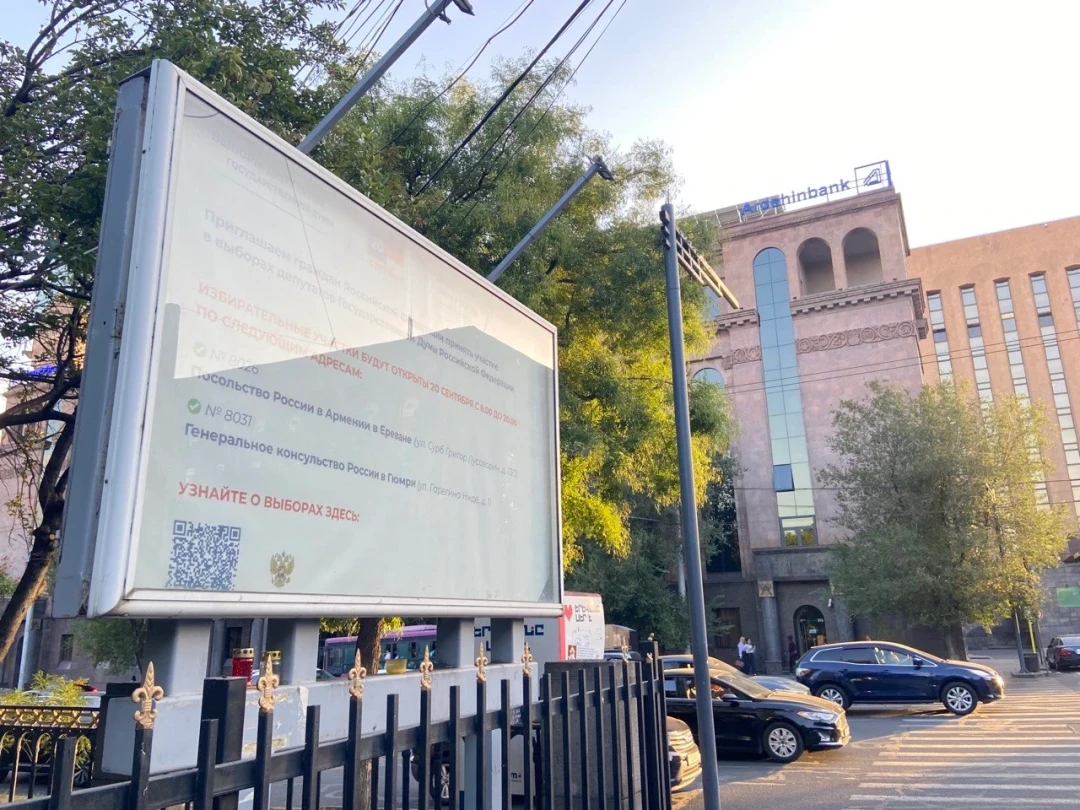
Russian citizens in Armenia can vote from Sept. 18 to 20 in elections to the State Duma, Russia’s lower house of parliament. But for several people interviewed by CivilNet in Yerevan, the choice is not simply which party to support. It is whether voting can have any meaning in a political system they do not trust.
Russia will elect 450 lawmakers to the ninth State Duma from Sept. 18-20. The 450 seats are split between party lists and single-member constituencies. Russian voters abroad, however, will receive only the party-list ballot.
The contest is the first parliamentary election since Russia’s full-scale invasion of Ukraine in 2022. United Russia (Yedinaya Rossiya), the party that supports President Vladimir Putin, is expected to retain its dominant position in the Duma, while the political space for opponents of the Kremlin has narrowed.
The Supreme Court removed the liberal Yabloko party from the ballot on Aug. 10. Yabloko was the only registered party openly opposing the war in Ukraine. Its exclusion means that voters dissatisfied with the war have no comparable option on the federal ballot.
For David, a digital-content manager who moved from Russia to Armenia in 2022, that does not mean staying home.
“I will have the feeling that I am doing something, changing something,” he said.
David said he does not rule out vote manipulation, but believes participation can make manipulation harder. With no party reflecting his views, he plans to vote for the one that provokes the least negative reaction.
Sergey, a student at a Yerevan university, also plans to vote, despite having no enthusiasm for the parties competing.
“Choosing the least bad of the bad options, I have picked one party,” he said. “I base that choice on the belief that most people may vote for it too.”
He said this would be the first election he has voted in, but added that he felt little optimism about the result.
Others see no point in participating. Pyotr, a machine-learning specialist, said he would not vote because the election was “meaningless” and because he did not want to visit the Russian Embassy in Yerevan.
Yabloko’s presence on the ballot could have changed his decision, he said. But he was not prepared to vote for a party that operates within Russia’s political establishment simply because it seemed less objectionable than United Russia.
Eva, an engineer at a Western technology company who arrived in Armenia in mid-2022, said she could not vote because she had not renewed her Russian documents in time. She said she would otherwise have gone to the polling station.
For her, voting would be “a way to feel closer to home.” She said she had no illusions about the result, but believed that broad participation by Russians could still be meaningful.
Armenia became one of the main destinations for people leaving Russia after the invasion of Ukraine. Tens of thousands arrived in Armenia in 2022, including people seeking to avoid military mobilization.
That group is distinct from another part of Armenia’s Russian electorate: ethnic Armenians with Russian citizenship, including those who returned to Armenia before the war or have long lived here. They have the same right to vote, but often a more distant relationship with Russian political life.
Gor, a student of Armenian origin with Russian citizenship, said he did not feel involved in Russian politics while living outside Russia. He said he saw no party on the ballot that he was ready to vote for.
Karen, a music producer who returned to Armenia in 2018, was more categorical.
“I do not think my vote will mean anything, or that elections mean anything in that country,” he said.
Several recent arrivals from Russia declined to speak with CivilNet, citing concerns for their own safety and for relatives who remain in Russia. The names of those quoted in this article have been changed at their request.
Two polling stations are due to operate in Armenia: at the Russian Embassy in Yerevan and the Consulate General in Gyumri.
Anton Ronis is a journalism student at the American University of Armenia and an intern at CivilNet.

 Stories