By Siranush Adamyan
Armenia’s public broadcaster aired no dedicated coverage of the third anniversary of the Nagorno-Karabakh offensive and mass displacement on September 19, focusing instead on official engagements, economic indicators and Independence Day celebrations, according to a review by Media.am.
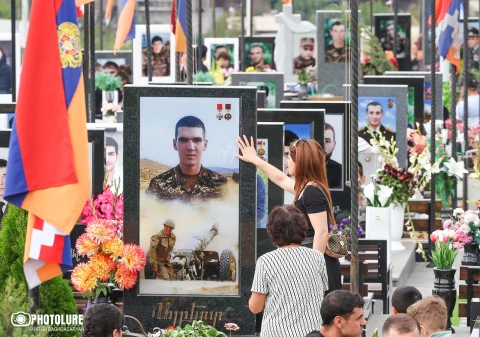
The omission came as families commemorated those killed and festivals and concerts took place across Armenia. It also reflected a widening divide over how the country remembers the loss of Karabakh, with senior government figures portraying the conflict as an obstacle to Armenian sovereignty.
Azerbaijan launched its final offensive against Nagorno-Karabakh, known to Armenians as Artsakh, on September 19, 2023, following a nine-month blockade. The attack killed 223 people, including civilians and children. More than 100,000 ethnic Armenians fled their homes in the following days.
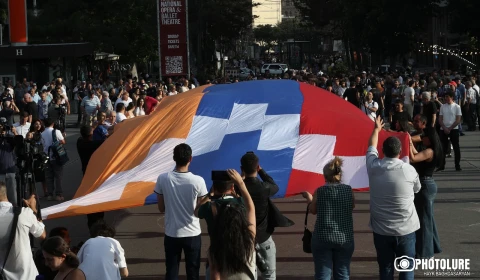
Media.am’s review, published September 20 by journalist Lusine Voskanyan, found that Public Television’s news service carried neither retrospective reports nor coverage of anniversary events, including a march to Yerevan’s Yerablur military cemetery and statements by Karabakh Armenian figures.
Other Armenian broadcasters and online outlets covered the anniversary, the review said.
There was one passing reference to the displacement in Public Television’s 1 p.m. news bulletin. It appeared in a report about Prime Minister Nikol Pashinyan receiving the Hessian Peace Prize, through remarks by German Minister of State at the Federal Foreign Office Serap Güler.
Güler recalled the departure of more than 100,000 Armenians, who left behind their communities, churches and relatives’ graves. She described the displacement as another trauma for Armenian society while praising Pashinyan for choosing political responsibility over exploiting that pain.
The reference did not lead into a separate report on the anniversary or the displaced population.
The broadcaster’s subsequent bulletins covered rising bank deposits, Armenia-U.S. defense consultations, government funding for local projects and President Donald Trump’s list of achievements, Media.am reported.
The flagship 9 p.m. bulletin focused on preparations for Armenia’s 35th independence anniversary. It covered a concert already held in Vanadzor and upcoming celebrations in Gyumri and Yerevan, ending with Pashinyan’s attendance at the opening of FC Noah’s youth soccer center.
Media.am’s article did not include an explanation from the broadcaster for its editorial choices.
The contrast extended beyond television. In a CivilNet opinion article, journalist Anush Petrosyan described commemorations taking place alongside festivals and entertainment events across the country.
Also read: Festivals across Armenia on a day of national tragedy
Khachik village in Vayots Dzor hosted the Gata Festival, while Dzoraghbyur hosted a harvest festival. A festival devoted to Armenian wedding traditions was scheduled in Zar, in Kotayk province.
Concerts were also scheduled in Yerevan and Kapan, where the advertised lineup included Nemra, Reincarnation and Dophamine.
Petrosyan, whose family was displaced from Karabakh, questioned the absence of an official commemoration and the scheduling of celebrations on September 19, two days before Armenia’s Independence Day.
“Making space for remembrance on certain dates does not require banning cultural life,” she wrote. “It is a matter of respect, timing and collective memory.”
The debate comes against a backdrop of government rhetoric recasting the Karabakh issue as a constraint from which Armenia needed to free itself.
Days after the mass displacement of Armenians from Nagorno-Karabakh, Gevorg Papoyan, then a senior lawmaker and deputy chairman of Pashinyan’s Civil Contract party, described September 19 as Armenia’s real independence day, rather than September 21.
Pashinyan later used a similar image to describe the conflict’s effect on Armenia’s freedom of action. On October 2, 2024, he said other countries had used the Karabakh issue as a rope around Armenia’s neck.
His argument concerned foreign leverage over Armenia through the unresolved conflict. But the portrayal of Karabakh as a burden sits uneasily alongside displaced families’ demands for recognition of their losses.
The dispute over remembrance also follows criticism of rhetoric directed at refugees themselves. In a March analysis for CivilNet, political analyst Tigran Grigoryan argued that Pashinyan’s remarks during an encounter with a displaced woman reinforced stereotypes portraying Karabakh Armenians as deserters and ungrateful beneficiaries of Armenian support. Pashinyan later apologized to the woman.
Also read: Pashinyan and the instrumentalization of hate speech against Karabakh refugees

 Stories