 Civilnet
 By Liz Fuller, CivilNet Special Correspondent
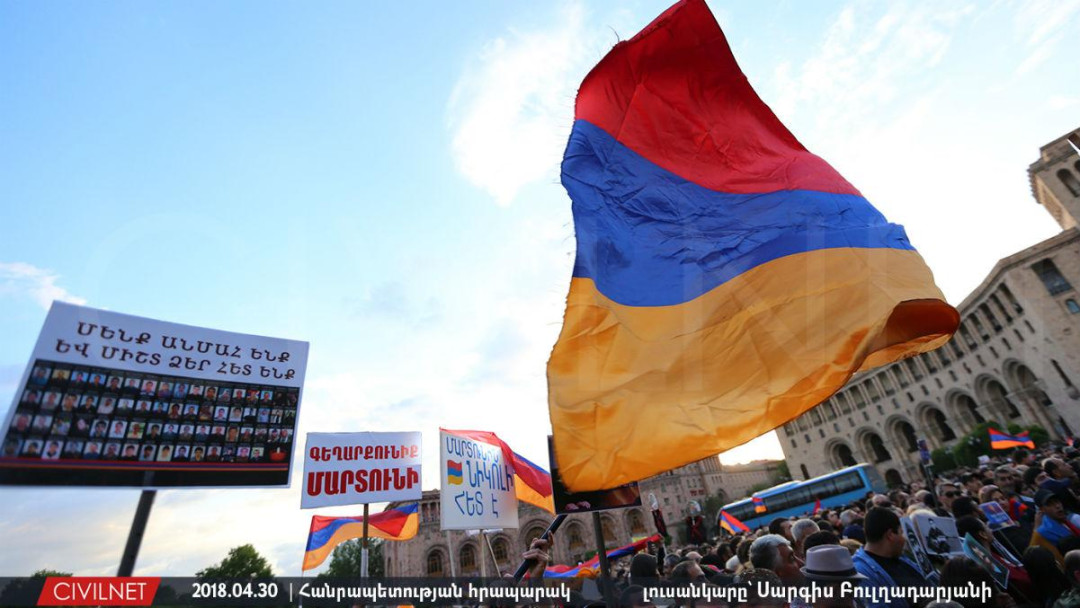
May 7. Given the dominant position Russia occupies in Armenia’s foreign and security policy, there has, predictably, been much speculation over the past three weeks both in Armenia and abroad about the role Russia may be playing in the ongoing stand-off between the embattled ruling Republican Party of Armenia and opposition leader Nikol Pashinian.
That speculation focuses primarily on two inter-connected premises, both of which are arguably specious. The first is that both former President Serzh Sargsyan and current acting Prime Minister Karen Karapetian are “Moscow’s men,” and therefore the Kremlin had a vested interest in intervening to shore them up in order to prevent a politician not aligned with the HHK from assuming the all-important post of prime minister. The second is that the Russian leadership is seriously concerned that the overwhelming popular support Armenians have demonstrated for Pashinian and his Velvet Revolution would serve to galvanize and reinvigorate Russia’s marginalized opposition to launch new protests to demand Vladimir Putin’s departure from the political stage on the eve of his planned inauguration for a fourth presidential term.
Both those premises may have seemed well-founded at the time of Sargsyan’s resignation two weeks ago, especially in light of Putin’s April 26 statement that “the resolution of the crisis situation in Armenia must take place exclusively within the parameters of the current constitution and on the basis of the results of the legitimate parliamentary elections held in April 2017.” And Sargsyan’s subsequent meetings with senior HHK members on the eve of the May 1 parliament session, and then prior to the announcement that in the interests of preserving political stability, on May 8 the HHK will back a candidate for prime minister who has the support of one third of all law-makers, have been construed as corroboration that he continues to dictate party policy. That is not to say, however, that he is doing so on orders from Moscow.
Meanwhile, as the probable future course of developments and Pashinian’s foreign policy priorities become clearer, the hypothesis that Russia’s options are contingent on either Sargsyan or Karapetian becomes increasingly less tenable, especially given that the Kremlin tends not to rely on individual political figures in pursuit of its long-term geo-political interests.
Indeed, the rhetoric now emanating from Moscow suggests acceptance of the likelihood that either Armenia’s National Assembly will elect Pashinian prime minister on May 8 at the second attempt, in which case the HHK will effectively be in opposition to a minority government; or that the parliament will approve Pashinian as premier but then vote down his government program.
The latter course of action would inevitably necessitate a pre-term parliamentary election under the current election law, and thus furnish the HHK with a breathing space to regroup and formulate a strategy for survival as a political player. Although Karapetian may end up discredited and marginalized, the party still stands to benefit in the medium term if Pashinian’s government proves incapable of delivering the genuine economic upswing Armenians have long been desperately hoping for.
At the same time, Armenia will remain heavily dependent on Russia both militarily and economically. And as Democratic Party of Armenia Chairman Aram Sargsyan observed on May 7, Pashinian does not have at his disposal a team of professional economists and defence and security experts, and may thus be constrained to co-opt some members of the outgoing government.
The Velvet Revolution does not pose a danger either to Russia’s strategic interests or to domestic political stability in the way that the single-minded pursuit of an unequivocally pro-Western foreign policy by the leaders of Ukraine and Georgia did.
By the same token, fears that Moscow might perceive a successful transition of power in Armenia as a threat, and thus intervene to avert it, seem misplaced, for a number of reasons. The Velvet Revolution does not pose a danger either to Russia’s strategic interests or to domestic political stability in the way that the single-minded pursuit of an unequivocally pro-Western foreign policy by the leaders of Ukraine and Georgia did. On the contrary, over the past two weeks, Pashinian has repeatedly stressed that “Armenia and Russia are and will remain strategic partners and allies. Armenia will remain in the Eurasian Economic Union … and the CIS Collective Security Treaty. Russian border troops will continue to protect the Armenian-Turkish border. All this is guaranteed, there is no need for further discussion.”
In addition, in light of Russia’s interventions in Georgia in 2008 and Ukraine in 2014, and its continued military involvement in Syria, the very fact that the Kremlin is demonstrating restraint vis-à-vis a genuine people’s revolution in Armenia could be construed as a point in Putin’s favour.
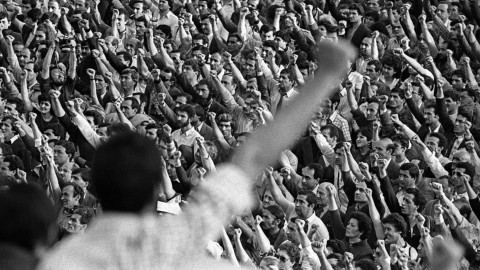
As for the argument that events in Armenia could inspire a similar upsurge of popular protest against Russia’s leadership, it overlooks the crucial fact that Armenia is a very small country with a population of less than 3 million, the overwhelming majority of whom – from school children to pensioners – exultantly took to the streets of the capital to demonstrate their support for the man who symbolized their aspirations for a better life in a country not held hostage to cronyism and corruption. Notwithstanding the effectiveness of social media as a tool for sharing information and coordinating tactics, Armenia’s Velvet Revolution is simply not replicable in a country the size of the Russian Federation.
Liz Fuller worked from 1980 until April 2018 as Caucasus analyst for Radio Free Europe/Radio Liberty, and from 1997-2008 as editor of “RFE/RL Newsline.”

 Stories