 Civilnet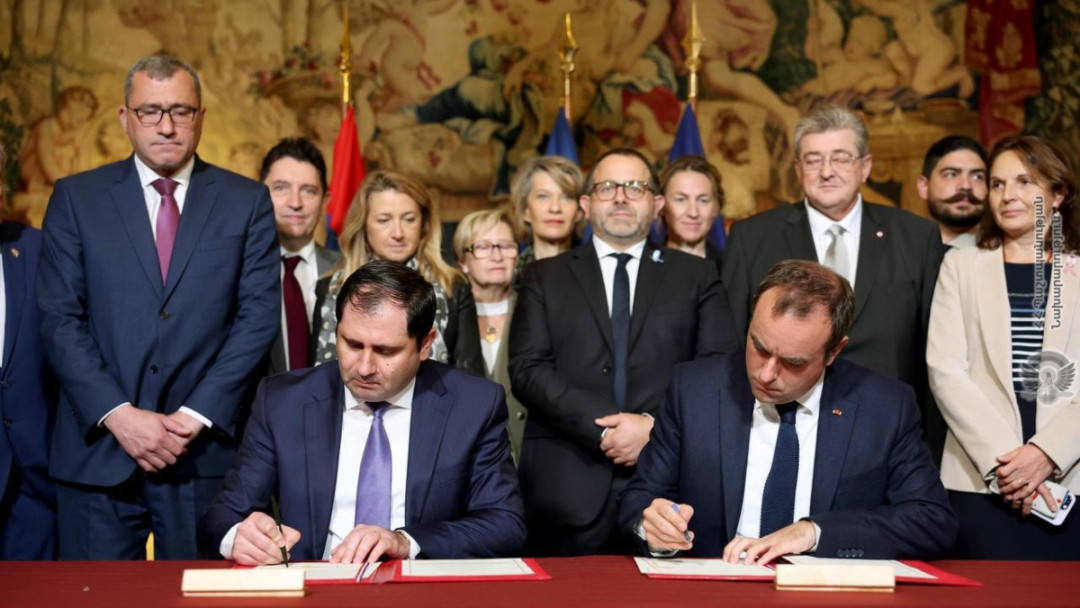
By Mark Dovich
Armenia and France signed an arms deal Monday, marking the first time Yerevan has purchased Western-made weapons.
The agreement allows Armenia to obtain radar systems and other equipment from the French defense manufacturers Thales and Safran, and also permits Paris to help Yerevan train military officers and reform its armed forces.
“France and the French people are by our side, a fact that deserves our highest appreciation,” Armenian Defense Minister Suren Papikyan said at Monday’s signing ceremony in Paris.
In addition, Papikyan and his French counterpart, Sébastien Lecornu, signed a “letter of intent” to greenlight the future sales of French Mistral short-range surface-to-air missiles to Armenia.
Senior officials in Yerevan and Paris have repeatedly stressed the defensive nature of the weapons.
“This is a weapon system that, by its very nature, can only be used when there is an act of aggression against Armenian territory,” Lecornu insisted.
There was no timeline immediately given for the deliveries, nor any financial details of the deal, which is remarkable as an arms agreement between NATO member France and Armenia, part of the Russian-led CSTO military alliance.
What’s the context?
The first-of-its-kind arms deal comes as France continues to deepen its engagement in the region, while Armenia’s ties with Russia, its traditional arms dealer, continue to fray.
At a press conference in Yerevan earlier this month, French Foreign Minister Catherine Colonna said she is personally pushing the European Union to bolster its monitoring mission along the Armenian side of the border with Azerbaijan, as well as to add Armenia to an EU funding instrument that provides military support to non-member countries.
Brussels “will likely approve the expansion (to the monitoring mission) in the coming weeks,” an unnamed “senior European official” told Radio Azatutyun, RFE/RL’s Armenian service, last week. CivilNet was not immediately able to confirm that news.
In addition, Colonna has indicated France plans to open a consulate in Syunik, becoming the third country after Iran and Russia to establish or announce plans to establish a permanent diplomatic presence in Armenia’s strategically vital southernmost region.
At the same time, Armenia’s relations with Russia have worsened dramatically in recent months, with anger mounting in Yerevan over Moscow’s unwillingness or inability to prevent Azerbaijan’s lightning offensive against Nagorno-Karabakh last month.
After keeping Nagorno-Karabakh’s roughly 100,000 Armenians under near-total blockade for more than nine months, Azerbaijan launched a lightning offensive against the region last month that left hundreds dead on both sides, including civilians.
After fewer than 24 hours, the Nagorno-Karabakh government agreed in a Russia-brokered ceasefire deal to disband the local army and dissolve itself, sparking a mass exodus of nearly all the region’s population to Armenia.
In turn, Moscow has issued unusually strong alerts to Yerevan about its foreign policy, calling Armenia’s move to join the International Criminal Court earlier this month “extremely hostile” and “unacceptable” and warning of “the most negative consequences.”





 Stories