Civilnet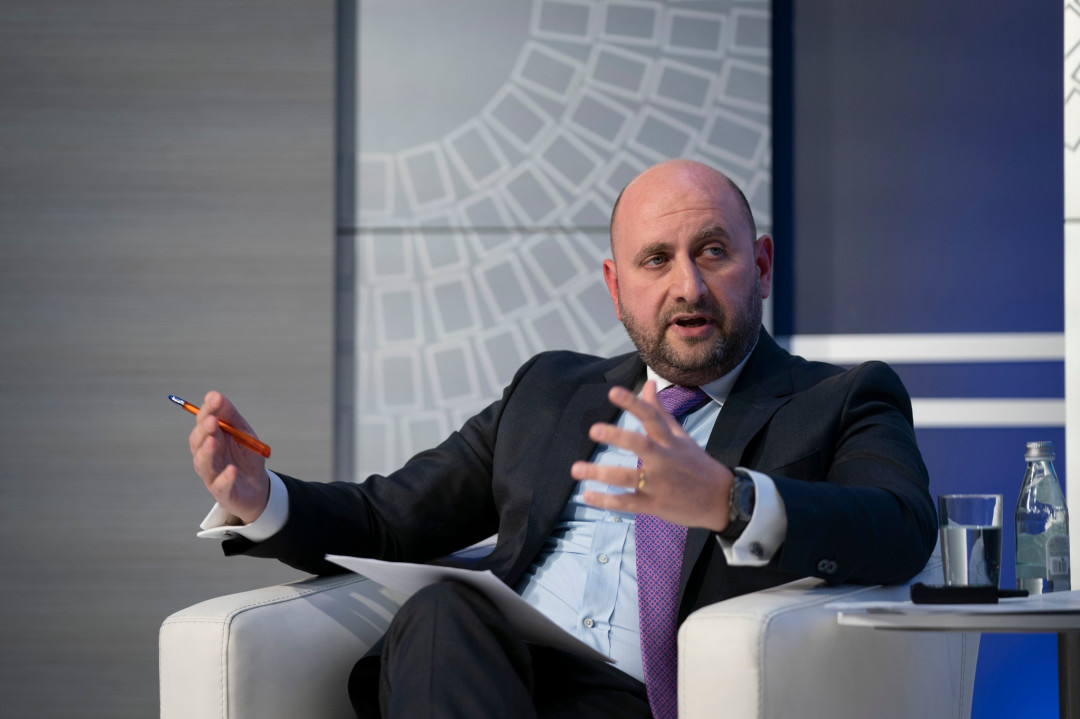
By Arshaluis Mgdesyan
Armenia’s Central Bank is closely monitoring potential scenarios stemming from the ongoing war in Ukraine, including the possibility of new U.S. secondary sanctions against Russia, according to Central Bank Governor Martin Galstyan.
Speaking at a press conference on May 6, Galstyan confirmed that secondary sanctions—targeting third countries doing business with Russia in sensitive sectors such as banking and energy—are among the scenarios under review.
“International meetings I’ve attended recently have hinted that this scenario is highly probable,” Galstyan said in response to a CivilNet question. “We are treating this as a realistic possibility.”
The United States Senate is currently preparing a bill that would impose both primary and secondary sanctions on Russia. The draft legislation includes punitive tariffs of up to 500% on imports from countries that continue purchasing Russian oil, gas, uranium, or petroleum products.
This development is particularly significant for Armenia, which maintains deep economic ties with Russia. The country relies heavily on Russian energy imports, investment, and trade. Should secondary sanctions be enacted, Armenia may face serious exposure due to its structural dependence on Russian markets.
The risks are further compounded by growing U.S. pressure on Armenia’s southern neighbor, Iran. Despite existing international sanctions, trade between Armenia and Iran increased by 6.5% in 2024, reaching $737 million. Much of this trade is energy-based: Armenia imports natural gas from Iran in exchange for electricity under a barter agreement, delivering 3 kilowatt-hours of electricity per cubic meter of gas.
Galstyan emphasized that global uncertainty is now a dominant theme in economic discussions. “At the recent IMF and World Bank Spring Meetings, the word most frequently used by all speakers was ‘uncertainty’,” he said. “There is no institution, no group of economists, no university that can confidently predict how things will unfold.”
The Central Bank is analyzing two main scenarios for the Ukraine war. The first envisions a resolution of the conflict, lifting of sanctions, and a recovery in global trade and financial flows. The second foresees a further escalation of sanctions if the U.S. fails to bring Russia and Ukraine to the negotiating table. Galstyan said the latter is being treated as the more likely scenario based on private discussions during international meetings.
Armenia, as a small open economy, is particularly vulnerable to geopolitical and geo-economic shocks. In addition to sanctions on Russia and Iran, Galstyan noted that cryptocurrency regulation and its implications for financial systems were also a key theme in recent global forums.
The Central Bank governor stressed that Armenia must be prepared for a range of outcomes, particularly in the energy sector. “Can we manage without Russian or Iranian energy? Or would Armenia be granted an exemption?” he asked.
Galstyan concluded by noting that the Central Bank has already incorporated these scenarios into its internal planning processes to better prepare for global economic disruptions.




 Stories