 Civilnet
By Nanor Froundjian
Religious organizations take the lead, politics take a fall
Political parties and media organizations rank among the least trusted institutions in Armenia, while religious institutions and army lead as the most trusted.
This is revealed in the latest Caucasus Barometer survey – a nationwide household survey, conducted by the Caucasus Research Resource Center (CRRC) which sampled 1,561 respondents aged 18 and over in Armenia between July and October, 2024.
This is a significant setback for political parties; the share of respondents fully distrusting them doubled, sitting at 51.4% in 2024, up from 25% in 2021.
The parliament and the executive government (prime minister and cabinet ministers) tied at 57% as the entities most fully distrusted by the public in 2021. This had improved marginally by 2024, with full distrust in them dropping to 50% and 42.3%, respectively.
In a similar vein, levels of trust in the president have remained relatively consistent within the three years, with about half of respondents expressing distrust. Unlike the prime minister, the president in Armenia acts as figurehead, fulfilling a ceremonial role rather than holding executive or legislative power.
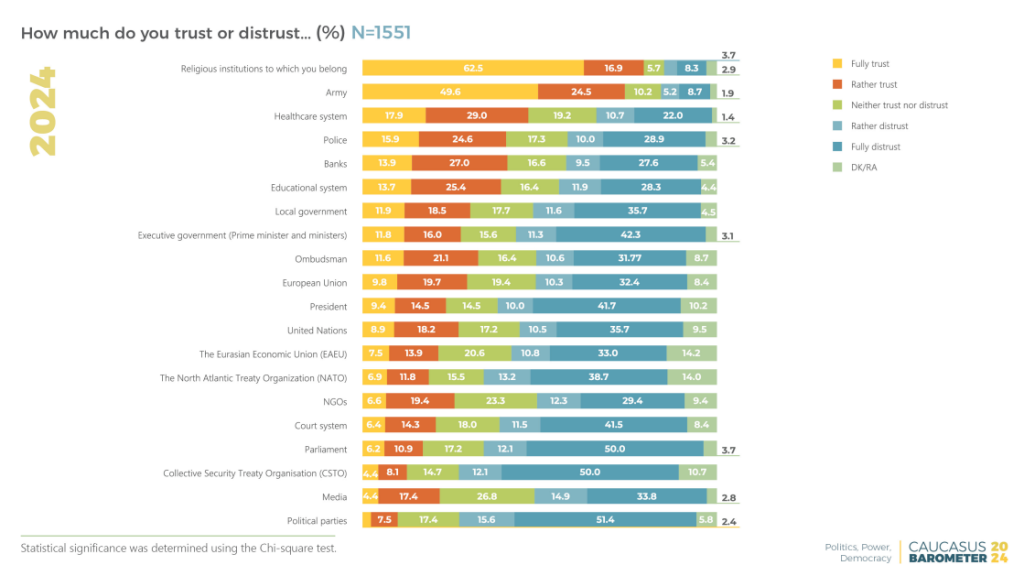
Currently, the media also stands among the least trusted institutions, ranking right above political parities and the Collective Security Treaty Organisation (CSTO), a Russian-led military alliance which failed to adhere to its commitments to respond to Armenia’s call for backing during and after the Second Nagorno-Karabakh War. Nearly two-thirds of those surveyed, 62.1%, distrust the CSTO.
Similarly, there is also a distrust in NATO, with over half of respondents, 51.9%, fully or rather distrusting the organization.
Though the public’s trust in media may have improved by a slight margin over the past three years, it still remains alarmingly low. The survey revealed that 21.8% of respondents fully or rather trust the media, up from 10% in 2021. 33.8% said they fully distrust the media, compared to 52% in 2021.
For their part, some international organizations saw a worsening reputation in the public eye. Those fully trusting, or rather trusting the European Union shrunk by half, from 63% in 2021 to 29.5% in 2024; while those fully distrusting or rather distrusting it increased from 24% to 42.7%. This shift knocked the EU from the third to the tenth spot from 2021 to 2024.
By contrast, trust in religious institutions saw an increase according to the CRRC survey, with those fully trusting them going from 11% in 2021 to 62.5% in 2024.
The army ranked a close second to religious institutions in 2024, having the full trust of nearly half the respondents, 49.6%. Though this marks a subtle decline from 2021, when 58% of respondents cited fully trusting the army, it still ranks as the second most trust institution.
Where do people go for news?
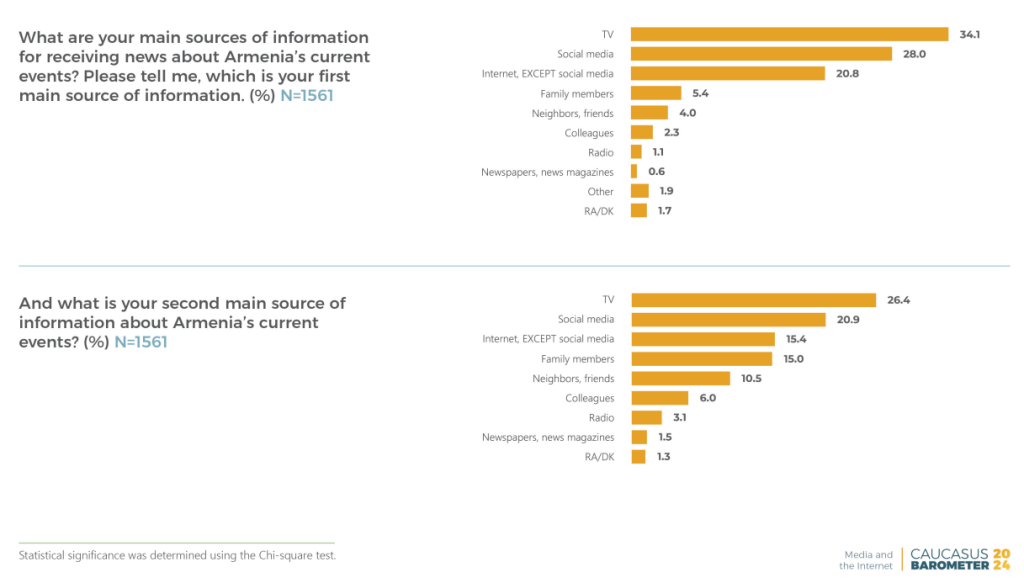
Television remains the most popular media as a source of information for current events in Armenia, with 34.1% citing it as their primary source, followed closely by social media at 28%.
Despite a dwindling level of trust in news media, 63% of respondents said Armenian media outlets are very or somewhat trustworthy as a source of information on the security situation in Armenia, according to another survey conducted by the International Republican Institute (IRI). The December 2023 survey sampled 1,508 permanent residents of Armenia aged 18 and over.
The number dropped to 49% for Western international media outlets, and 28% for Russian media outlets. At the same time, a clear majority of 72% turn to friends and family as their trusted sources.
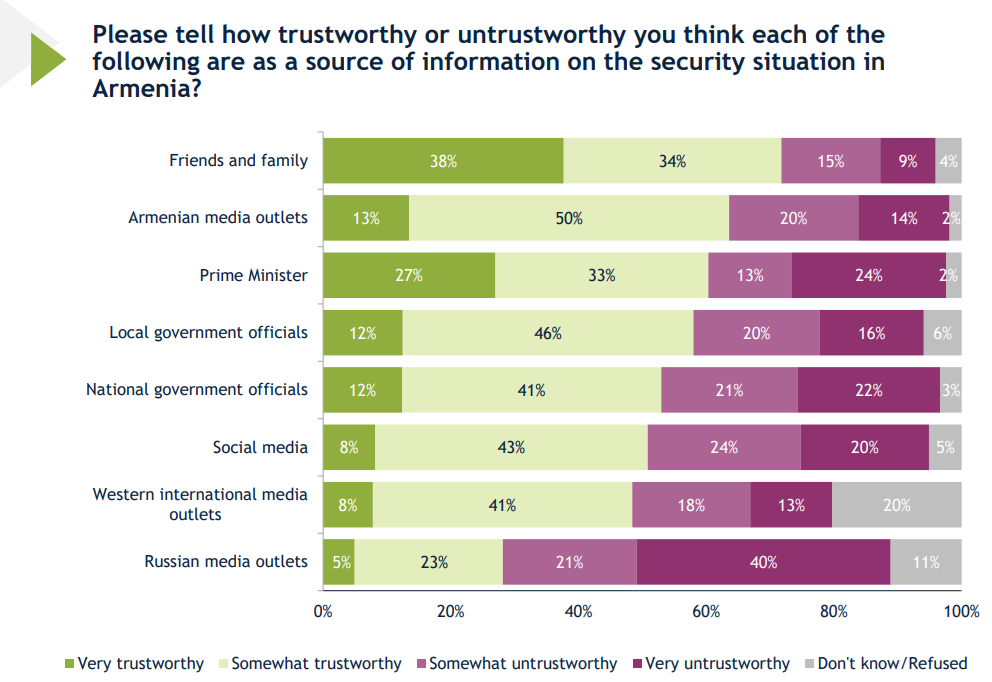
Just over one-fifth of respondents, 22%, said they don’t consider any media outlet trustworthy for political information.
With a clear disengagement or lack of trust in political figures as sources of information, nearly three quarters of respondents, 73.3% in 2024, agree that sometimes politics and government seem so complicated that they can’t really understand what’s going on, while nearly the same amount, 72.1%, feel that public officials do not care much about their opinions, according to the CRRC.
Despite the poor perception of its media landscape, Armenia ranked 34th out of 180 countries on this year’s RSF Press Freedom Index with a score of 73.96. Accordingly, Armenia is ranked as having a “satisfactory” press freedom situation, the second best category out of five, well ahead of the United States, which ranked 57/180 in the third category.

 Stories