Civilnet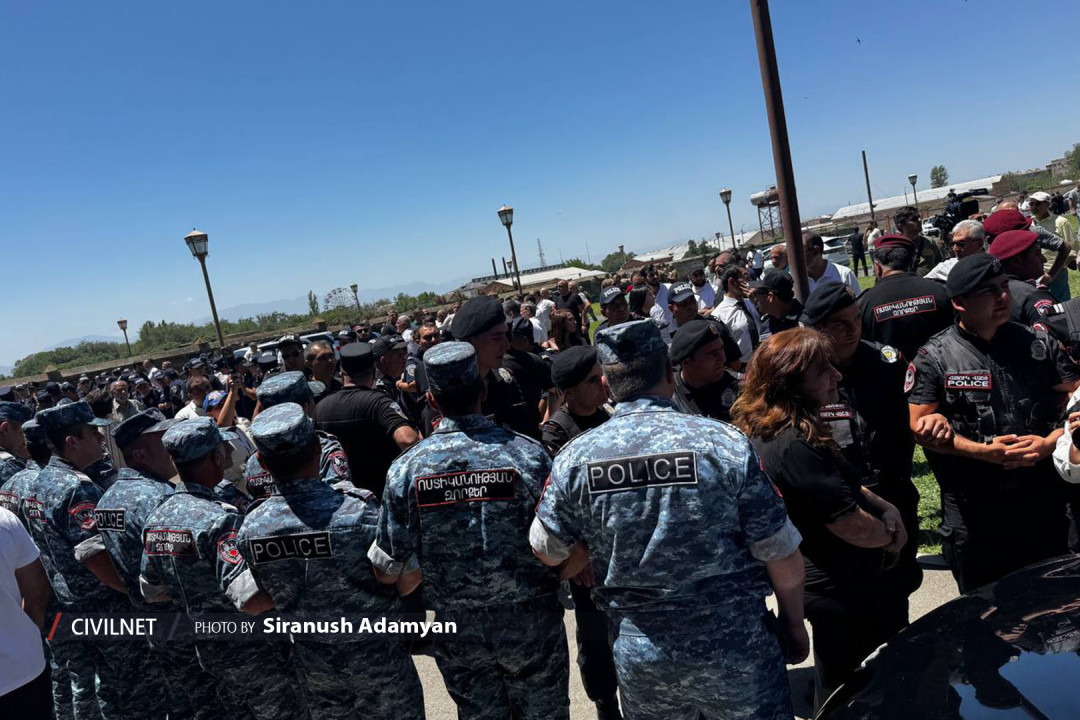
By Lia Avagyan
A group of Armenian civil society organizations and human rights activists has accused the government of applying selective justice, pressuring courts and law enforcement bodies, violating the principle of presumption of innocence, and using disproportionate force during its confrontation with the Armenian Apostolic Church.
The statement comes nearly two weeks after the authorities launched a wave of actions against senior clergy and individuals close to the Church.
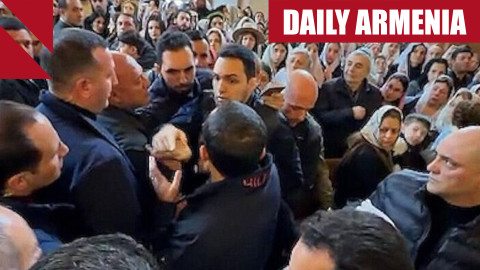
The statement was issued days after the National Security Service attempted to detain Archbishop Mikayel Ajapahyan inside the Mother See of Holy Etchmiadzin. That operation followed the arrest of Archbishop Bagrat Galstanyan and Russian-Armenian billionaire Samvel Karapetyan, who is accused of supporting what the authorities claim was a coup plot. Karapetyan denies the charges, and many observers view the legal actions against him as politically motivated. Pashinyan’s government has also initiated a process to nationalise Karapetyan’s company, Electricity Networks of Armenia. Tensions escalated further when the prime minister mocked a Church leader’s insult by publicly offering to expose himself in a Facebook post, an act that many saw as a deliberate humiliation of the Catholicos.
In their joint statement, the NGOs criticised the authorities for using disproportionate force, including masked police raids on church property, and for targeting minors during recent protests. They urged the government to refrain from interfering with the judiciary, and called on law enforcement to act with respect for legal standards and the presumption of innocence.
Despite the force of the language, the list of signatories did not include several prominent human rights organisations such as the Union of Informed Citizens, the Gyumri-based journalists’ club Asparez, and the Vanadzor office of the Helsinki Citizens’ Assembly.
Levon Barseghyan, head of Asparez, said he only learned of the statement after it had been published. “If I had known, I would have contributed to its drafting,” he said. “The title and the content are somewhat mismatched—the title lists recent events, but the body focuses mainly on what the authorities should do. Still, it’s good to see some NGOs speaking out, including those that have generally stayed silent in recent years.”
Daniel Ioannisyan, coordinator of the Union of Informed Citizens (UIC), said his organization had declined to sign the statement because it lacked crucial context. “The statement entirely omits the necessary context,” he said. “Unlike others, we had already published documents showing that Ajapahyan’s previous statements were not deemed criminal by the Prosecutor’s Office.”
In 2024, UIC formally requested the Prosecutor-General’s Office to assess whether Archbishop Ajapahyan’s sermons, which called for the overthrow of the government, contained elements of a crime. The response was negative: prosecutors did not see grounds for criminal prosecution at the time.
“That changed only after Prime Minister Nikol Pashinyan launched his political attack on the Church,” Ioannisyan said, suggesting a shift in legal interpretation driven by political motives. “Now, the exact same statements are being treated as criminal. We insist there is a political component in this prosecution, but unlike others, we have provided concrete evidence.”
At the same time, he criticised the statement’s silence on Ajapahyan’s repeated calls for a military coup. “Civil society cannot simply protest the criminal case and ignore the fact that Ajapahyan was advocating for abolishing democratic mechanisms for government formation. You can’t have it both ways,” he said.

 Stories