 Civilnet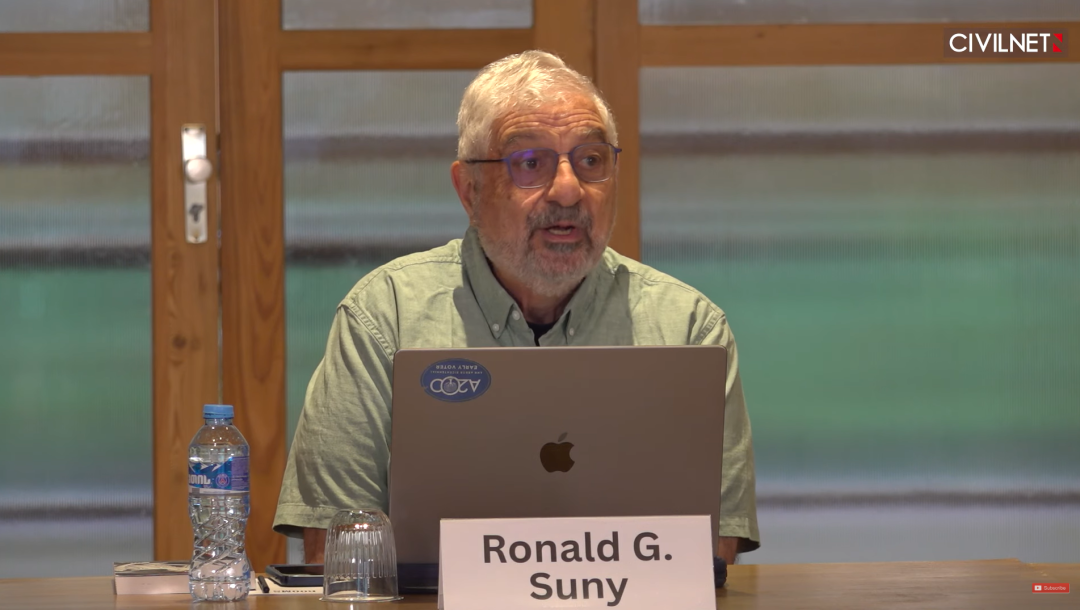
By Lia Avagyan
At a lecture delivered during the 2025 Monterey Summer Symposium on Russia, historian Ronald Grigor Suny argued that Russia’s foreign policy is driven not by a singular pursuit of power but by a complex mix of historical insecurity, fragmented identity, and perceptions of threat.
Suny, a distinguished professor of history at the University of Michigan and emeritus professor at the University of Chicago, spoke in Batumi on June 25 as part of the symposium organized by the Monterey Initiative in Russian Studies at the Middlebury Institute of International Studies.
In a keynote address titled “Empires and the Making of Nations in the South Caucasus,” Suny outlined what he called six major factors that have historically shaped — and continue to shape — Russian foreign policy. He urged the audience to move beyond simplistic realist interpretations and instead adopt a “constructivist” lens that emphasizes how national identities, ideologies, and historical narratives influence the behavior of states.
“Russia’s actions in the world are not just about power. They are shaped by how its leaders understand their own state, their history, and the threats they believe they face,” Suny said.
1. Perceived insecurity
Contrary to conventional views of Russia as an assertive power, Suny argued that Russian foreign policy has long been motivated by a sense of vulnerability.
“Russia is not a security state — it is an insecurity state,” he said. “For centuries, Russian and Soviet leaders have acted out of fear — fear of invasion, encirclement, and internal collapse.”
He added that this fear is not always irrational, noting that Russia was invaded twice in the 20th century and has experienced internal rebellions in regions like Chechnya.
2. Geographic overstretch
Russia’s massive size, underdeveloped infrastructure, and low population density, according to Suny, present deep structural challenges.
“Geography is both a gift and a curse,” he explained. “Russia’s borders are hard to define and even harder to defend. Its sheer size creates a permanent security dilemma — for itself and for its neighbors.”
3. Fragile national identity
Russia’s identity crisis, rooted in its imperial past and ethnic complexity, is another key driver of its foreign policy, Suny said.
“Russia has never been a nation-state in the classic sense. It’s a multinational empire in constant search of a unifying identity,” he said. “That’s why you see contests — even today — over what it means to be Russian.”
He noted that President Vladimir Putin has made repeated attempts to articulate a coherent national identity, often blending Soviet nostalgia, Orthodox Christianity, and imperial myth-making.
4. Ideological narratives
Suny emphasized that Russia’s foreign policy cannot be understood purely in terms of realist power calculations.
“Ideas matter. Narratives about history, destiny, and victimhood all shape what Russian leaders perceive as their national interest,” he said. “Even the so-called realist tradition — realpolitik — is itself an ideology.”
Putin’s worldview, Suny added, is driven as much by historical grievance and a belief in Russia’s civilizational mission as by strategic logic.
5. Internal composition
The structure of the Russian state — its uneven development and ethnic diversity — plays a role in shaping its outward behavior.
“Russia’s internal contradictions often push it outward,” Suny said. “Its own weakness — infrastructural, political, and demographic — feeds the need for external affirmation.”
He argued that a fragmented state looks for legitimacy abroad when it cannot secure it at home.
6. A “Dangerous neighborhood”
Finally, Suny pointed to Russia’s perception of its geopolitical environment as a source of anxiety.
“Russia sees enemies everywhere — from NATO expansion to Islamic radicalism,” he said. “Whether these threats are real or perceived doesn’t matter. What matters is that they are believed.”
Suny cautioned that this siege mentality has been central to Russian strategic thinking and has often led to aggressive policies aimed at preempting threats rather than responding to them.
Suny called for a more nuanced understanding of Russian behavior, one that takes into account historical context and the psychology of power.
“To make sense of Russian foreign policy, we need what I call strategic empathy — the ability to see the world through Russia’s eyes,” he concluded. “Only then can we respond wisely — not just react.”

 Stories